



Banks in Malta have registered a drop in borrowers defaulting on their loans. The ratio of non-performing loans and advances at Maltese banks has been on a downward trend since the fourth quarter of 2024, showing a reduction in the share of banks’ loans and advances that are not being repaid as agreed.
Two of Malta’s leading banks partially attributed this to a resilient economy.
Recent supervisory banking statistics for June 2026, published by the Malta Financial Services Authority, show that the non-performing loans and advances ratio (NPL – excluding cash balances at central banks and other demand deposits) for Maltese banks, and banks’ non-performing exposures ratio (NPEs – which measures broader credit exposures) have been on a downward trajectory.
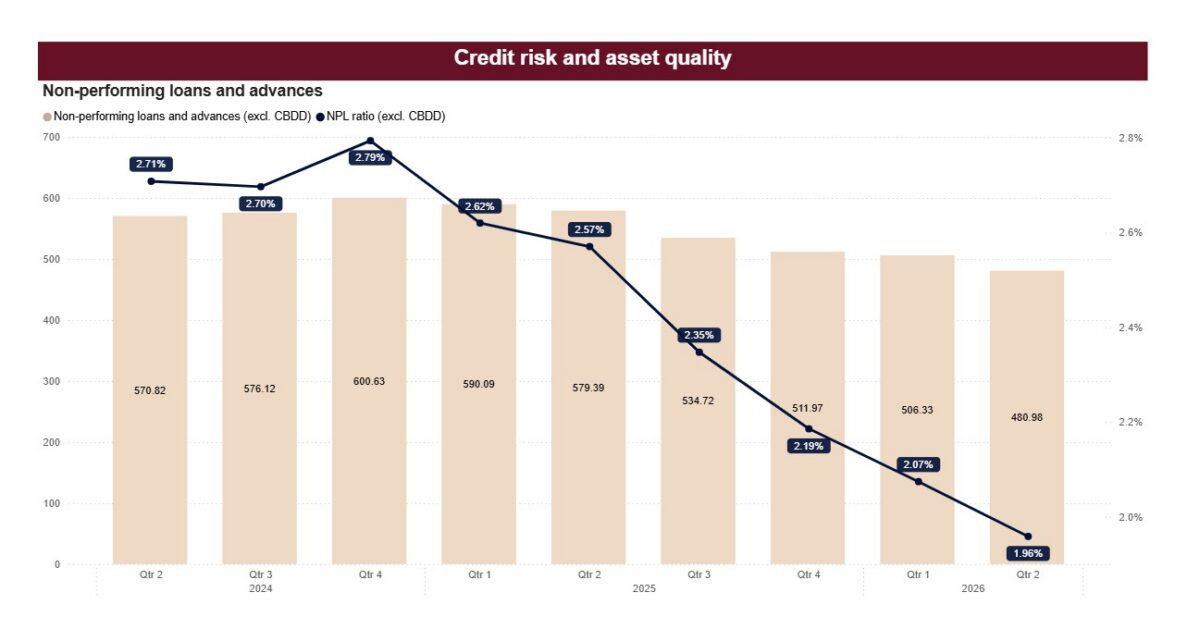
The NPE ratio has also been on a downward trend since the fourth quarter of 2024, when it stood at 1.54 percent, dropping to 1.2 per cent in the second quarter this year. The NPL ratio dropped from 2.79 per cent to 1.96 per cent during the same period.
Bank of Valletta and HSBC, two of the country’s largest banks, both said that the reduction reflects, among other things, a resilient domestic economic environment and strong, steady employment levels.
Healthy financial position of businesses
BOV told this newsroom that aside from the aforementioned points, it also reflects the generally healthy financial position of many businesses and households.
“Banks have also continued to apply prudent credit risk management practices and actively monitor their lending portfolios. This is broadly consistent with BOV's own experience. The Bank has continued to maintain robust underwriting standards, closely monitor credit exposures and engage proactively with customers to identify and address emerging risks at an early stage. In parallel, BOV has remained focused on the reduction of legacy non-performing exposures through a combination of recoveries, restructurings and portfolio management actions,” BOV said.
It said that these efforts and a “generally supportive” operating environment contributed to a continued strengthening of asset quality across the bank's principal lending portfolios. It said that while the current trend is encouraging, the bank remains committed to maintaining prudent risk management practices to ensure resilience across the credit cycle.
Improvement in asset quality across the banking sector
HSBC said that the decline in non-performing exposures and in the ratio of NPEs reflects a broader improvement in asset quality across the banking sector.
“At HSBC Bank Malta, this progress reflects a combination of factors,” it said, including a resilient economic environment, steady employment and income levels, a well-managed loan portfolio with strong credit assessment on new lending and active resolutions of legacy exposures, and proactive support and risk management, with close portfolio monitoring and early engagement with customers facing financial pressure, alongside customer repayments and the resolution of problem exposures.
Banks hail reduction as positive
Both banks said that lower ratios are good for financial stability.
“Lower NPEs are positive for financial stability and indicate that fewer borrowers are facing significant repayment difficulties. Access to finance will continue to depend on each customer's circumstances, including affordability, repayment capacity, business performance and the outcome of the applicable credit assessment,” HSBC said, adding that it remains committed to supporting personal customers and viable businesses, including local SMEs, backed by a strong liquidity and capital position.
BOV also hailed the trend as a positive. “A reduction in non-performing loans is a positive development for the banking sector as it reflects healthier lending portfolios and lower levels of distress among borrowers. For businesses and households, strong asset quality contributes to the overall stability and resilience of the banking system, which is an important foundation for sustainable access to finance. However, lending decisions continue to be assessed on an individual basis, taking into account factors such as affordability, repayment capacity and the specific circumstances of each borrower.”
BOV said that from its perspective, continued improvement in asset quality enhances the bank's ability to support creditworthy customers and maintain prudent lending standards. “Sector-wide trends are encouraging, but responsible lending remains central to ensuring sustainable outcomes for both borrowers and banks.”
As for whether they foresee the trend continuing, HSBC expects the trend to remain supported by the resilience of the economy, borrowers' repayment performance, “and our proactive risk management, while remaining mindful of uncertainties such as interest rates, inflation and geopolitical developments.”
“The Bank remains focused on maintaining a high-quality loan book, supporting customers responsibly and managing credit risk prudently as we move forward and pursue sustainable growth over the long-term,” HSBC said.
BOV highlighted that the recent trajectory is encouraging and reflects the favourable conditions that have supported both borrowers and the banking sector over recent years.
“BOV has also continued to report improving asset quality indicators, broadly in line with wider sector developments. While the outlook remains positive, future trends will continue to depend on a range of factors, including economic conditions, interest rate developments, geopolitical uncertainties and borrower-specific circumstances. It is therefore important to remain prudent,"
It said that although current indicators are supportive, it remains focused on maintaining robust risk management practices and closely monitoring developments to ensure that asset quality remains resilient across different economic scenarios.


Malta’s traffic congestion takes toll on tourist experience and investor impressions
Malta’s traffic congestion is putting pressure on tourist guides, frustrating visitors and leaving a negative impression on potential foreign investors

BNF Bank welcomes Izzat Nuseibeh as Chairman, reinforcing its long-term commitment to Malta
He brings more than four decades of international banking experience across corporate, private and institutional banking

Malta’s FDI appeal rises, but concerns about skills shortage persist, EY survey finds
44% of investors describe Malta’s planning and preparedness for population growth as inadequate