



Small and medium-sized enterprises (SMEs) account for around two-thirds of the value added generated by Malta’s business economy, spotlighting their importance to the country at a time when local businesses continue to report difficulties ranging from labour shortages to administrative burdens.
A recent publication by Eurostat shows that Malta is among the EU countries where SMEs make the largest contribution to business value added.
The data, referring to 2023, defines SMEs as enterprises employing fewer than 250 people and covers industry, construction, distributive trades and market services.
In Malta, SMEs generated approximately two-thirds of business economy value added, placing the country behind only Estonia, Cyprus and Latvia in terms of the share attributable to smaller enterprises. Across the EU as a whole, SMEs accounted for 50.9 per cent of value added, compared with 49.1 per cent generated by large enterprises.
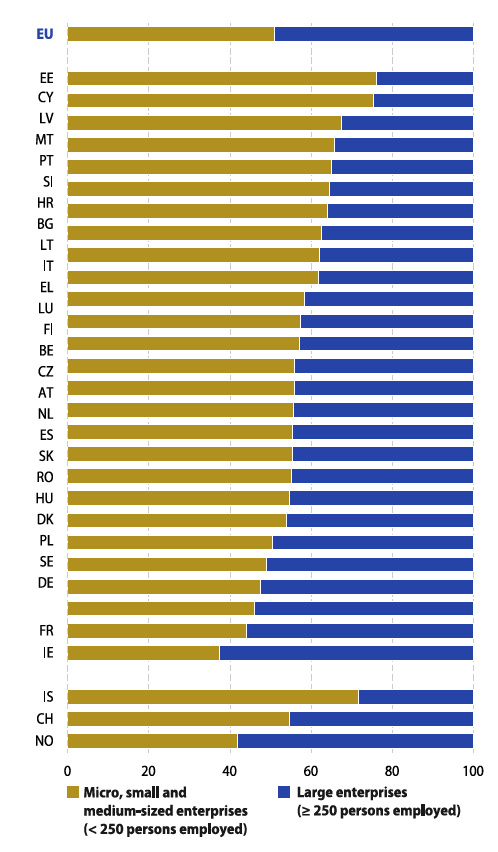
Across the bloc, SMEs employed 103 million people and generated €5.33 trillion in value added in 2023. Micro-enterprises – those employing fewer than 10 people – also made up 94.3 per cent of enterprises in the EU business economy.
In 2025, services accounted for 88.5 per cent of the Malta’s total value added, one of the highest shares in the EU. Only Luxembourg, where services represented 89.9 per cent, recorded a higher proportion, while Cyprus followed Malta at 86.2 per cent. Eurostat describes both Malta and Cyprus as tourism-oriented economies.
This leaves a comparatively small proportion of Malta’s value added coming from other parts of the economy, including industry, construction and agriculture, forestry and fishing. The contrast with some other member states is significant: industry accounted for 36.9 per cent of value added in Ireland, 25.6 per cent in Czechia and 25 per cent in Slovenia. Meanwhile, Romania recorded the EU’s largest contribution from construction, at 9.6 per cent.
The figures therefore show Malta firmly among the EU’s most service-oriented economies. This is relevant when considering the position of the country’s SMEs, which operate across sectors including retail, tourism, professional services and other service activities, alongside construction and manufacturing.
Eurostat’s figures also provide a broader context to the recruitment difficulties being reported by Maltese businesses. Malta recorded the highest employment rate in the EU in 2025, at 83.6 per cent of people aged between 20 and 64, while unemployment stood at just 3.1 per cent.
This combination of high employment and low unemployment means that the pool of people outside employment from which businesses can recruit is relatively limited. Against this backdrop, the Malta Chamber of SMEs’ finding that 41.8 per cent of respondents identified employee shortages as one of their two most important business issues provides a local indication of the recruitment pressures facing firms.
Figures from the Chamber of SMEs
According to the Malta Chamber of SMEs' first-quarter 2026 SME Barometer published earlier this year, employee shortages remained the single most commonly cited problem facing businesses.
Of the 382 businesses surveyed between 3rd and 17th April, 41.8 per cent identified employee shortages as one of the two most important issues affecting their business.
Unfair competition followed at 21.5 per cent, while traffic congestion and skills mismatches were each selected by 15.7 per cent of respondents.
The labour concerns come despite Malta recording one of the strongest headline labour-market performances in the EU. Eurostat figures show that Malta had the EU's highest employment rate in 2025, at 83.6 per cent among people aged between 20 and 64.
At the same time, unemployment stood at just 3.1 per cent in 2025, compared with an EU rate of six per cent. Only Czechia recorded a lower rate.
The SME Barometer also points towards broader concerns affecting the operating environment. When businesses were asked what form of Government support would be most effective, the most popular response was greater regulatory flexibility and a reduced administrative burden, selected by 29 per cent.
Another 22 per cent identified financial assistance, while 17 per cent called for support related to supply chains and logistics.
Investment sentiment also remained subdued. Almost half of respondents – 49 per cent – said they were unsure whether the coming 12 months would be a good time to invest, while 32 per cent said it would not be. Just 19 per cent believed it would be a good time to invest.
The proportion expecting unfavourable investment conditions had increased from 24 per cent in the final quarter of 2025.
External pressures are also filtering through to some businesses. Asked about the impact of the ongoing conflict in the Middle East, 13 per cent of respondents reported a significantly negative impact on their operations, while 32 per cent described the negative effects as manageable.


AI ‘increasingly becoming embedded across gaming operations’, new charter states
Most mature AI use cases are in operational optimisation and data analytics, customer support chatbots

Tourist spending hits €1.21 billion in Malta in second quarter of 2026
The average length of stay per tourist dropped from six nights in 2025 to 5.5 nights this year

Revolut won’t disclose number of data breach victims in Malta, but there is at least one
Hackers obtained files by compromising an Italian government email system