


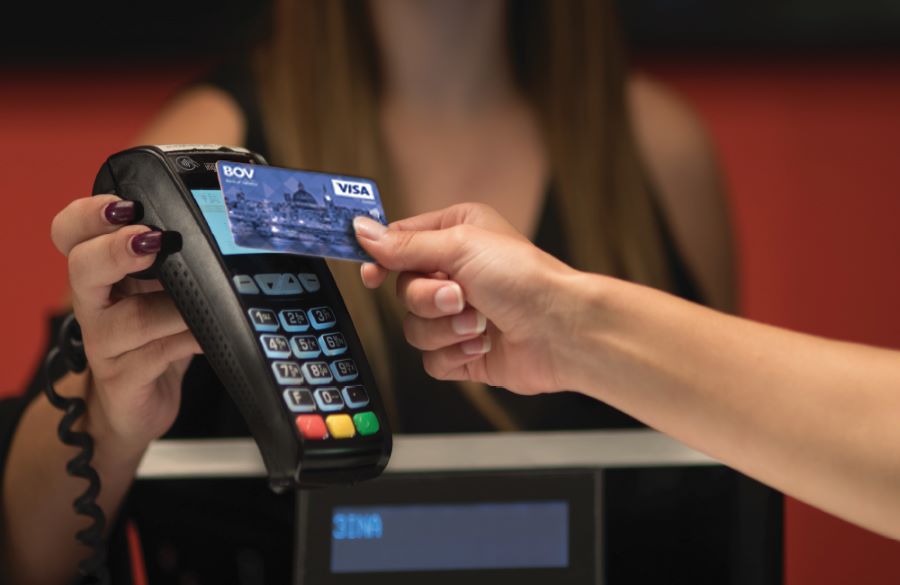
Card usage continues to gain ground across Malta’s consumer economy, with new figures showing how deeply digital payments have become embedded in everyday spending.
The latest data, provided by the Central Bank of Malta (CBM) and published by the National Statistics Office (NSO), highlights strong year-on-year growth, clear industry-level differences, and the evolving role of card payments as a real-time indicator of economic behaviour.
The retail industry remains the largest driver of card transactions, registering €1.89 billion in 2024 – equivalent to 37 per cent of all POS and online card payments. Supermarkets (‘non-specialised stores’ under NACE G47.1) stand out as the strongest adopters, with 60 per cent of all sales now made by card, a share that has increased steadily by around three percentage points each year.
Fuel stations lag behind on card use
One of the starkest contrasts in the data emerges in the fuel sector. Despite the widespread availability of card facilities in larger stations, only 30 per cent of fuel sales were made using cards in 2024. Cultural habits play a significant role here: consumers have long preferred paying for fuel in cash, and this persistence of traditional behaviour is reflected in the data.
Merchant acceptance also varies by size. While all top-tier stations (with annual sales above €3.5 million) offer card payments, only 48 per cent of low-tier stations (sales below €2.5 million) do so. This uneven distribution suggests that access, rather than preference alone, continues to shape consumer habits.
Strong seasonal patterns and a record summer surge
Card payments show clear monthly cycles aligned with Malta’s tourism-driven economy. February is consistently the quietest month for card spending, while August remains the peak.
The highest monthly value ever recorded was €596 million in August 2025, driven by strong tourist inflows and increased domestic spending. Year-on-year growth in August has also been volatile:
- +11 per cent in August 2023
- +5 per cent in August 2024
- +18 per cent in August 2025, amounting to a €90.1 million increase over the previous year
These rapid fluctuations underline how sensitive consumer spending is to tourism patterns and seasonal activity.
Gozo leads in card acceptance, despite lower total spending
While Gozo and Comino recorded one of the lowest total values of POS transactions (at €184.4 million), the district stands out for a different reason: it had the highest merchant card acceptance rate at 68 per cent. This means that a larger share of Gozitan retailers offer customers the option to pay by card, even if the total transaction volumes remain lower than those in Malta’s more commercial districts.
Other districts show substantially higher spending volumes, particularly:
- Northern Harbour – €1.5 billion
- Northern District – €660.6 million
- Western – €243.1 million
- South Eastern – €240.2 million
Localities such as Sliema, St Julian’s, Qormi, Birkirkara, Gżira and Msida fall into the highest transaction bands, reflecting their combined commercial and tourism intensity.
POS transactions still dominate over online payments
Although online shopping has grown in recent years, the data shows that physical point-of-sale remains the primary channel for card transactions:
- 89 per cent of retail card payments occur in person
- 93 per cent of card payments in accommodation (I55) are processed at POS
- 99 per cent of card payments in restaurants, cafés and bars (I56) are made on site
By contrast, 96 per cent of gambling and betting transactions (R92) are processed online, highlighting the highly digital nature of Malta’s gaming industry.
It is also worth noting that accommodation payments made through global platforms such as Booking.com or Airbnb are processed abroad and therefore do not appear in Malta’s local card payment statistics, meaning true online spending in this category is significantly understated.
Card payment data now functioning as an economic indicator
Beyond the consumer trends, the NSO emphasises the increasingly important role of card payment data in economic measurement. Unlike traditional data sources, card payments offer rich, near real-time insights into spending patterns with minimal administrative burden on businesses and individuals.
Because B2B payments typically occur via bank transfers, cash or cheques, the analysis focuses primarily on B2C industries where card usage is most representative of retail and tourism consumption.
The findings show a clear upward trend: card payments are expanding their share of total sales across multiple industries, with supermarkets leading the way and other categories catching up at different speeds.
As digital transactions continue to deepen their role in Malta’s economy, they are offering policymakers and businesses a more immediate view of spending behaviour – and signalling a long-term shift in how Maltese consumers prefer to pay.


Malta looks to China and Asia to diversify tourism markets
The partnership aims to promote Malta, diversify its tourism offering and boost sustainability

Strong demand for Malta Government Stocks as offers reach €617 million
The Government had initially authorised an issue of €300 million
Employers call for ‘decisive’ shift in public spending ahead of Budget 2027
The upcoming Budget 'must be judged' on its capacity to deliver long-term transformation, not just sustain short-term consumption