


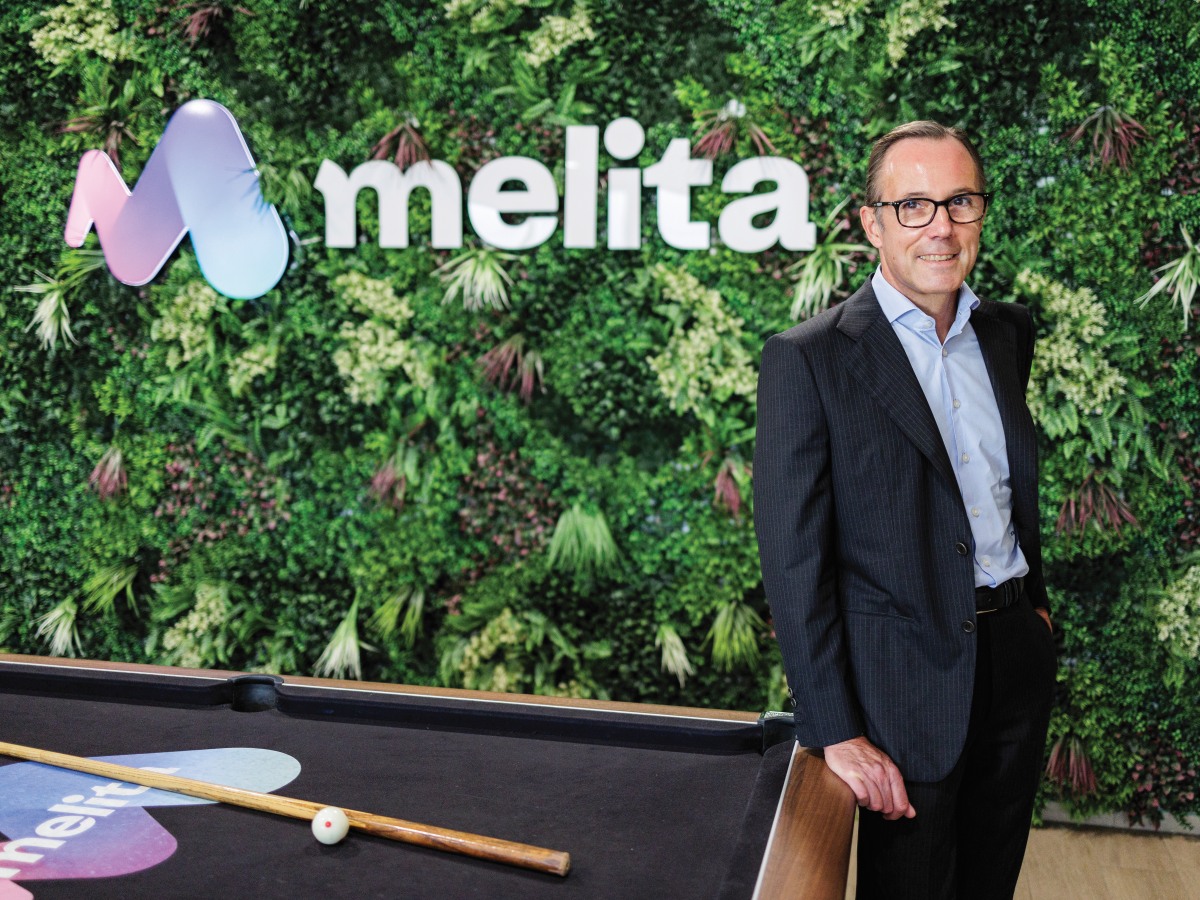
Buoyed by its in-house intuitive AI, Melita has its sights set on pioneering a future where customer interaction is seamless, efficient and consistently positive – cementing its identity as a global technology leader. In this feature that first appeared in Business Now 2026 magazine, Melita CEO Harald Roesch talks about the commitment to excellence that is the driving force behind the company’s technological evolution.
For over 30 years, Melita has been a household name in Malta. A stalwart of the nation’s technological infrastructure – from pioneering cable television to rolling out nationwide fibre and 5G networks – its legacy is one of connection and communication. But in today’s fast-paced world of digital transformation, resting on one’s laurels is not an option, and this year, the company is undertaking its most significant strategic pivot yet.
With the launch of AI Solutions, the traditional Telco is boldly transforming into an innovative, technology-driven TechCo, leveraging its own powerful AI to redefine customer service for businesses worldwide.
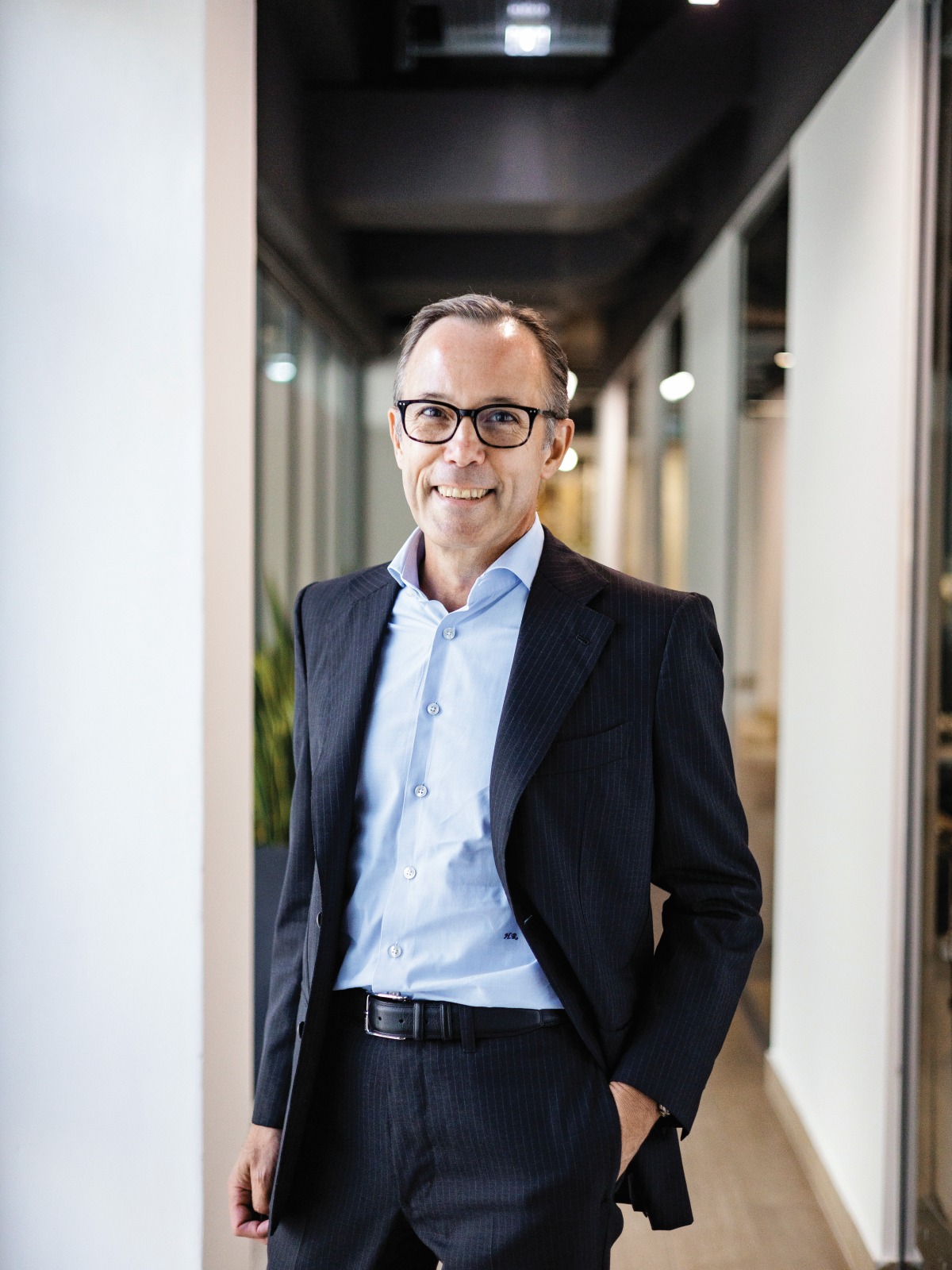
This evolution, explains CEO Harald Roesch, is not an overnight reinvention but a calculated next step, built on a foundation of international ambition.
The journey began several years ago, when Melita looked beyond Malta’s shores with the launch of its international Internet of Things (IoT) division in 2019 – a step that enabled the company to provide the specialised connectivity required for smart devices (such as connected vehicles, industrial sensors and payment terminals) to communicate seamlessly across the globe.
“That proved to be a success, with around 95 per cent of our revenues in this segment now generated abroad. With AI, the idea is to build up a second international business line that is more software-driven,” Mr Roesch states.
This new venture rests on a platform born of necessity. Faced with ever-rising customer service expectations, Melita developed its own sophisticated AI solution in-house. Having refined its capabilities within its own operations, the company is now offering this proven technology to other businesses, giving them a unique competitive edge in a market saturated with generic, off-the-shelf products.
Careful to distinguish their AI from the simplistic chatbots of old, the team at Melita refer to it as a ‘virtual agent’, a term that better captures its intelligence and capability. “It is not a fully off-the-shelf solution,” Mr Roesch clarifies. “It’s an approach that enables us to deliver, in a very short timeframe, answers to personalised questions.”
He illustrates the difference with a practical example that gets to the heart of customer frustration. “If you have an off-the-shelf solution and a customer calls, saying ‘My internet is down, what should I do?’, a generic platform would likely suggest trying this and that from a list of frequently asked questions,” he explains. “Instead, our platform first authenticates the customer and reviews their connection details, performing multiple technical checks in the background. The AI then uses this data to guide the customer – for instance, it might detect a modem issue and suggest restarting it, or if a technician visit is required, it will automatically schedule that visit.”
Moreover, it isn’t a single monolithic AI that’s at work, but a coordinated team. The CEO explains that the internal name ‘Billy’ is the public-facing persona for a suite of specialised virtual agents, including ‘Toby’ for technical issues and others for sales, all orchestrated to provide the right expertise at the right moment.
This deep level of integration is central to the core value proposition. For a business considering the platform, Mr Roesch’s pitch is compelling, focusing on a rapid, low-risk, success-based partnership rather than a simple product sale. “The key advantage we offer is speed – setup takes roughly six weeks to go live,” he notes. “It’s a light lift for our enterprise clients, requiring only a designated project manager and minimal IT support.”
Crucially, Melita eschews the heavy upfront investment model that often creates a barrier to entry for new technology. “We do not require a significant initial investment,” Mr Roesch states plainly. “The service is success-based. We’re not in the business of selling a platform and then leaving it to the customer to be successful. We guarantee the success of it.”
Acknowledging the common fear that AI signifies the displacement of the human workforce, Mr Roesch argues that Melita’s model actually does the opposite – creating a more positive and efficient environment for customer service agents by elevating their role. By automating routine queries, the AI liberates human agents to focus on the more complex, high-value interactions where their expertise is most needed.
The results internally have been striking. “The load on the human team is lighter, with latest data from the Malta Communications Authority (MCA) showing Melita answers 95 per cent of calls within two minutes, compared to competitors’ average of 72 per cent, resulting in far less stress for both customers and the team. Internally, this has created a very positive attitude from our customer care team towards the AI,” Mr Roesch smiles. This improved working environment has had a tangible impact on staff retention, a notorious challenge in high-pressure customer service roles.
Remarkably, this transformation requires no complex reskilling. Asked about reskilling of their workforce and fostering collaboration between employees and their new AI assistants, the CEO asserts that the system is designed to be seamless. “The human workforce does not need to change anything in their behaviour,” he says. “It’s completely transparent and really just improves their life.”
I go on to ask about the leadership principles behind Melita’s technological evolution, and the innovation driving this new venture, to which the CEO replies with characteristic humility, pointing to a company culture that values internal talent. “I think we are lucky to have innovative people among our colleagues,” he says. “The only leadership principle is to listen to what they tell you, and then to implement it. The development of AI Solutions was done completely in-house by our team.”
Looking ahead, the roadmap for Melita’s AI is focused on deepening its capabilities in customer service and sales automation across various industries, rather than diversifying too quickly. For Mr Roesch, who has overseen a massive technological evolution since taking the helm in 2016, the mission is both personal and professional.
“For me, this is the key to delivering consistently great customer service,” he states with conviction. “As CEO, I suffer when we’re not offering a good level of customer service, and I can tell you that for a year and a half now, I haven’t been suffering,” he concludes, good naturedly.
This interview was first carried in the 2026 edition of Business Now Magazine, the sister brand to BusinessNow.mt and produced by Content House Group.

Mandatory culture and language course introduced for foreign workers seeking longer permits
The reform aims to improve labour market stability by ensuring that foreign workers are better integrated and trained
Malta explores importing renewable energy from North Africa
The project is targeting the importation of approximately 0.8 terawatt-hours (TWh) of renewable energy annually
Employers call for moratorium on public sector recruitment ahead of elections
Malta Employers President Ivan Refalo once against raised concerns about politically driven recruitment