


Malta has emerged as one of the European Union economies most exposed to the latest surge in oil prices, with Eurostat data showing that the country has both a near-total dependence on imported oil and the bloc’s largest energy trade deficit relative to the size of its economy.
The figures come as Brent crude topped $100 a barrel on Wednesday following renewed attacks on shipping around the Strait of Hormuz. According to Euronews, Brent has risen by 65.7 per cent since the end of 2025, when it closed the year at $60.85.
While larger European economies import substantially greater volumes of oil, Malta stands out when energy imports are considered relative to the size of its economy.
Eurostat data cited by Euronews show that Malta recorded a net trade deficit in energy products equivalent to 5.4 per cent of GDP in 2025 – the highest in the EU.
Bulgaria had the second-largest deficit at 3.5 per cent of GDP, followed by Croatia at 3.4 per cent, Hungary at 2.9 per cent, Belgium at 2.6 per cent, Luxembourg at 2.5 per cent and Cyprus at 2.4 per cent.
Major European economies recorded considerably smaller deficits. Italy’s stood at 1.9 per cent of GDP, Spain and Poland at 1.7 per cent, while Germany and France both registered 1.5 per cent.
At the opposite end of the scale, Denmark recorded an energy trade deficit equivalent to just 0.1 per cent of GDP, followed by Sweden at 0.5 per cent and the Netherlands at 0.6 per cent.
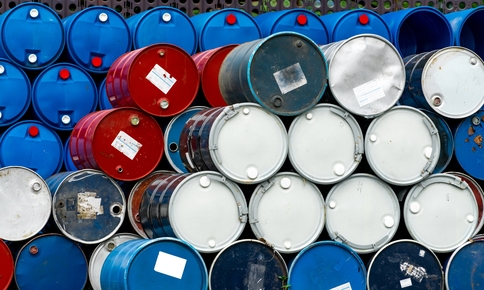
Malta imports 99.6 per cent of its oil requirements
Malta’s exposure is also evident when looking specifically at oil.
In 2024, net imports accounted for 99.6 per cent of Malta’s oil requirements, according to Eurostat data.
That puts Malta among the most import-dependent countries in Europe, although several countries recorded rates of 100 per cent or slightly higher. Latvia stood at 108.3 per cent, Sweden at 101.3 per cent, Ireland and Luxembourg at 101 per cent, Spain at 100.3 per cent and Poland at 100.1 per cent.
Portugal, at 99.9 per cent, and France, at 99.8 per cent, were also more dependent than Malta, while Greece stood just below it at 99.4 per cent.
By comparison, Germany's oil import dependency stood at 96.9 per cent and Italy's at 89.8 per cent. Denmark recorded the lowest rate cited, at 58.1 per cent.
High import dependency is not unique to Malta. The EU as a whole imported 471.3 million tonnes of crude oil in 2024 while producing just 15.5 million tonnes domestically, putting its overall oil import dependency at 96.6 per cent.
However, Malta's combination of near-total oil import dependence and a comparatively large energy trade deficit as a proportion of GDP makes the country particularly sensitive to movements in international energy prices.
In March, Finance Minister Clyde Caruana had told BusinessNow.mt that the Government’s policy of energy price stability would remain in place regardless of fluctuations in oil prices, stressing that such stability was “especially important during these times of uncertainty”. Malta has budgeted €172 million for energy support measures in 2026, up from an estimated €152 million in 2025, with the subsidies having been in place since 2022 to shield households and businesses from increases in electricity prices.

Education system ‘stifles creativity’, Malta Employers’ chief says as association calls for ‘transformation’
Association's Director General says system is geared towards conformity

MFSA flags missing information in pension statements
Some pension statements omitted key details on investments, fees, contributions and account changes

Budget should support sustainable economic growth, promote financial stability – BOV
Maintaining a stable and predictable business environment, encouraging investment in productivity remain important, it said