


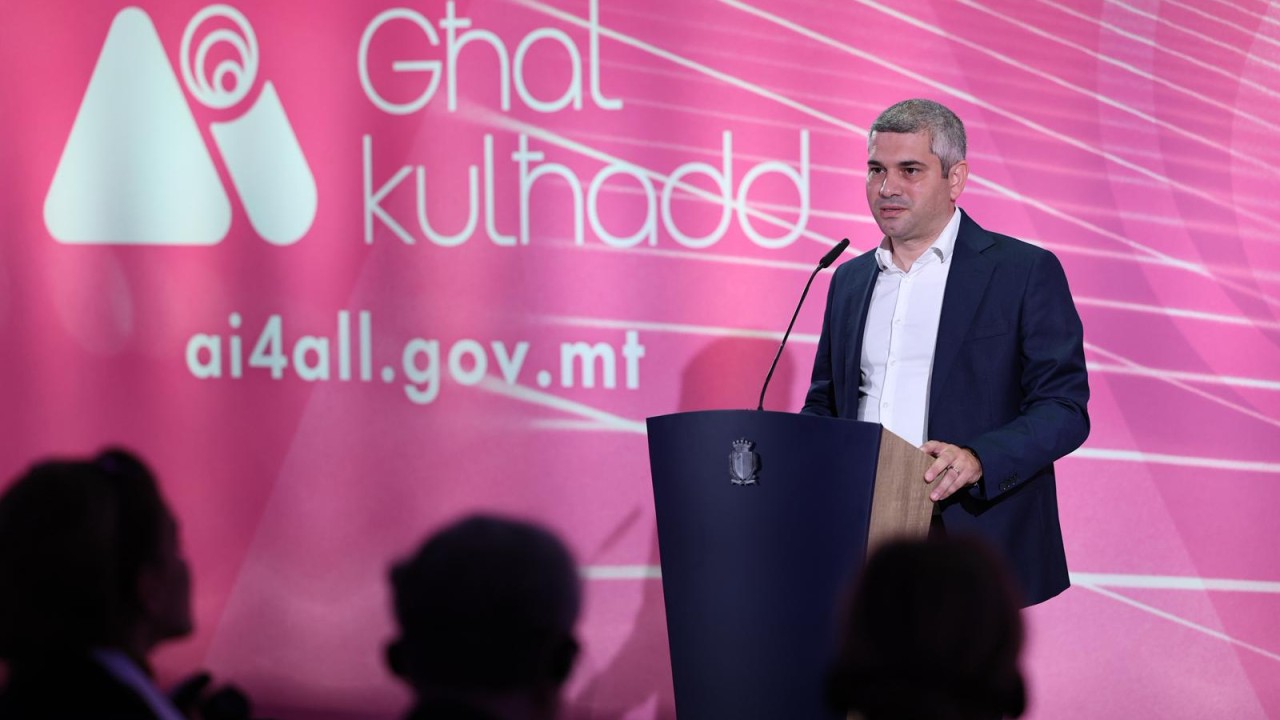
Malta has officially launched AI Għal Kulħadd (AI for Everyone), a national AI literacy programme aimed at making Artificial Intelligence accessible to the wider public. But according to the programme’s principal investigator Dylan Seychell, the initiative is less about technology itself and more about how people think.
Developed by the Department of AI at the University of Malta in collaboration with the Malta Digital Innovation Authority, the course is available free of charge to anyone in Malta over the age of 14 with a Maltese e-ID. Participants who complete the course can also opt for a one-year subscription currently offered through partnerships with OpenAI and Microsoft.
For Dr Seychell, applied AI specialist and professor, the philosophy behind the programme mattered just as much as the launch itself.
“When we sat down to design this programme, the first question we asked was not what features to teach or which tools to cover,” he explains. “It was a simpler question. What actually makes someone good with AI?”
Rather than focusing on technical jargon or coding, Dr Seychell says the course begins from a more human place: communication, judgment, and clarity of thought.
“Think about the last time you wrote a message to someone who mattered to you and spent ten minutes getting it right,” he writes. “That is the same skill that makes someone good with AI.”
The programme positions AI literacy as a form of national infrastructure. Dr Seychell compares it to roads or public utilities: something that enables wider participation across society rather than benefiting only specialists.
“The government invests in creating a national baseline,” he says. “Every other investment, from the private sector or from individuals, builds on that foundation.”
The initiative arrives at a moment when Malta already ranks highly in AI usage. According to figures cited by Dr Seychell, Malta is fourth in Europe for personal AI use, while Maltese workers lead the European Union in generative AI usage at work, with 29.6 per cent reporting usage in recent months, almost double the EU average.
Yet he argues there is currently a disconnect between individual experimentation and wider organisational adoption.
“Individuals are moving forward at a pace. Organisations are not keeping that pace,” he says.
One of the more striking elements of the programme is its emphasis on ethics, misinformation and emotional boundaries. Dr Seychell noted that these issues are integrated throughout the course rather than isolated into a single module.
One line in particular stands out: “If you are in a personal crisis, find a human. AI is good for almost everything else, but for that, find a human.”
At a time when AI tools are increasingly being used for emotional support, the statement feels unusually grounded. Rather than promoting total dependence on AI systems, the course repeatedly stresses human responsibility and critical thinking.
The programme evaluates learners across five dimensions: theoretical understanding, prompt engineering, ethical evaluation, tool integration and what Seychell describes as “strategic oversight” - knowing when not to use AI.
Importantly, the course also uses AI-generated avatars within its videos, a decision Dr Seychell describes as intentional rather than cost-cutting.
“A literacy course about AI that uses AI-generated avatars is making a deliberate pedagogical point,” he explains. “People will increasingly encounter this kind of media. Evaluating it critically, pausing, asking questions, not simply accepting what you see, is exactly what the course teaches.”
Ultimately, Dr Seychell believes the success of AI adoption will depend less on the sophistication of the tools and more on the quality of human judgment behind them.
“You own whatever you press send on,” he said. “The responsibility is yours. The judgment is yours. The thinking behind it is yours.”


German court clears use of breached MGA documents in reporting, Lilith Wittmann says
The MGA has previously rejected the suggestion that its legal measures were intended to silence or intimidate her

Enemalta advances plans for new Malta-Gozo interconnector
This follows a €45 million general election pledge for a Malta-Gozo high-voltage link
MDIA to assess potential for new research and innovation network in Gozo
Research is intended to provide an assessment of how a future research and innovation ecosystem in Gozo could be structured