



The US Dollar ended the third quarter of 2026 with its sixth consecutive quarterly gain against a basket of major currencies – the longest positive streak since 2022. Earlier this week, the euro slipped below USD1.121 for the first time since May 2025, leaving the single currency at a 17-month low against the greenback. This is an important development for Maltese investors and other citizens across the euro area.
It is worth recalling that at the start of this year, the euro had reached the USD1.20 level for the first time since mid-2021. At the time, the prevailing view among most international banks was that the weakness in the USD would continue leading to a rise in the euro to above USD1.25 as the Federal Reserve was expected to continue cutting interest rates. Moreover, there had been consistent evidence of a shift away from US assets by major global investors. However, since the recent peak reached in January 2026, the euro has shed over 6.4 per cent of its value against the US Dollar which is a significant turnaround in currency markets.
This reversal can be attributed to three overlapping forces, namely (i) the energy shock triggered by the prolonged war in the Middle East; (ii) a sharp change in the direction of monetary policy by the Federal Reserve and also the European Central Bank (ECB), and (iii) a strong upturn in yields of most major sovereign bonds which has once again exposed fiscal vulnerabilities, especially in France.
A volatile period since 2024
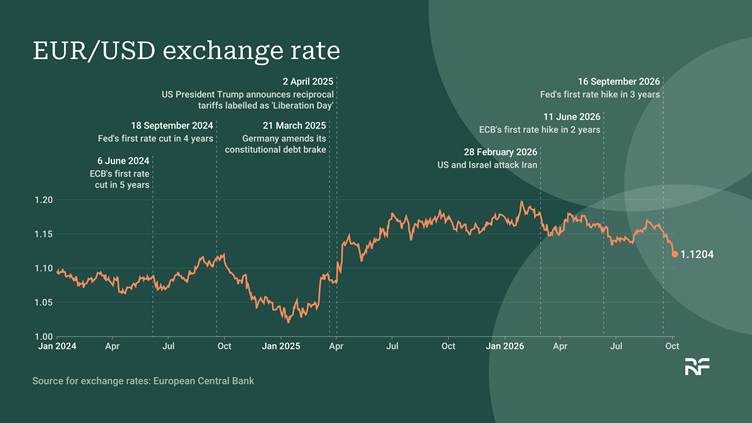
Since the start of 2024, the EUR/USD exchange rate has moved through three distinct phases.
The euro traded within a relatively narrow range of USD1.06 and USD1.12 until October 2024. The ECB began cutting rates in June 2024, ahead of the Fed, and the euro rallied only briefly after the Fed’s first rate cut in September. The US presidential election in November 2024 then sparked a strong rally in the dollar on expectations of the so-called ‘US exceptionalism’ advocated by President Trump. In fact, by early January 2025, the euro had fallen to below USD1.03, prompting widespread speculation of parity between currencies.
However, there was a major reversal in 2025. The decision by Germany in March to loosen its constitutional debt brake to fund defence and infrastructure lifted the euro from about USD1.05 to USD1.09 within a week. The sweeping US tariff announcements in early April then triggered a wide sell-off in the USD with the euro surging above USD1.15 within three weeks. The Fed’s resumption of rate cuts in September, which brought the federal funds rate down to 3.50 per cent–3.75 per cent by year-end, added to the dollar’s weakness. The euro ended 2025 at above the USD1.17 level, representing an annual gain of 12.6 per cent. The swing from the January 2025 low to the high exactly 12 months later represented an extraordinary move of 17.4 per cent which is largely unprecedented between these currencies in such a short period of time.
Since the high earlier this year, the trend has started to reverse again as the euro dropped to around USD1.145 in mid-March as the war in the Middle East erupted. It then recovered to near USD1.18 in April on hopes of a swift resolution but slipped to USD1.134 in late June. After a brief rebound in August, the major developments across bond markets in recent weeks sent the euro to below USD1.121 in early October.
From rate cuts to a hiking race
The outbreak of hostilities involving Iran and the threat to oil and gas flows through the Strait of Hormuz reshaped the monetary policy outlook that markets had been anticipating at the start of the year. Before the conflict, investors expected no rate hikes from the ECB in 2026 with a slight chance of further easing.
However, in view of the higher inflation readings, the ECB was the first major central bank to respond to the war and it raised rates in June for the first time since 2023. A further rate hike took place on 10 September bringing the deposit facility rate to 2.5 per cent. The ECB revised its inflation projections upwards and a number of economists now expect a further hike in rates by the end of 2026 and other possible rate rises to follow in 2027.
The Federal Reserve also changed course and on 16 September, the Federal Open Market Committee raised the federal funds rate by 25 basis points to a range of 3.75 per cent to 4.00 per cent – its first increase in more than three years, and a sharp reversal from the three consecutive cuts implemented in late 2025.
The French impact
The most recent upturn in the USD has been driven by developments across the global bond market. Yields of US Treasuries have risen rapidly in recent weeks and months with the yield on the 10-year US Treasury rising above 5.3 per cent (the highest level since 2002). The pressure across the eurozone has been even more intense especially in France. The yield on the German 10-year Bund climbed to 3.65 per cent (the highest since 2009) and that of the 10-year French government bonds (OATs) reached over 4.9 per cent. The spread between French yields and Bunds grew to over 130 basis points – a level last seen in the eurozone periphery nations during the sovereign debt crisis 15 years ago.
Last week, the French government published its proposed budget for 2027. The concerns centre around the size of the country’s deficit especially in the light of the presidential election in Spring 2027. The French government now expects its debt servicing costs to reach €91 billion in 2027.
While the eurozone economies continue to report very weak growth, the US economy is expanding at a solid pace which is a key consideration in foreign exchange markets.
The severe currency swings over the past two years would have impacted the performances of the investment portfolios of Maltese investors. The allocation to USD denominated assets would have negatively impacted portfolio performance as a result of the sharp downturn in the USD during 2025. Conversely, an investor’s portfolio would have recovered part of these declines in recent months as the USD gained over 6 per cent against the euro.
The developments over recent months provide another important reminder of how rapidly things can change in the currency markets. As such, while investors need to maintain diversified portfolios, they should remain cognisant that higher bond yields in the US and other regions can easily be offset by currency movements in a short period of time.

The article contains public information only and is published solely for informational purposes. It should not be construed as a solicitation or an offer to buy or sell any securities or related financial instruments. No representation or warranty, either expressed or implied, is provided in relation to the accuracy, completeness or reliability of the information contained herein, nor is it intended to be a complete statement or summary of the securities, markets or developments referred to in this article. Rizzo, Farrugia & Co. (Stockbrokers) Ltd (“Rizzo Farrugia”) is under no obligation to update or keep current the information contained herein. Since the buying and selling of securities by any person is dependent on that person’s financial situation and an assessment of the suitability and appropriateness of the proposed transaction, no person should act upon any recommendation in this article without first obtaining investment advice. Rizzo Farrugia, its directors, the author of this article, other employees or clients may have or have had interests in the securities referred to herein and may at any time make purchases and/or sales in them as principal or agent. Furthermore, Rizzo Farrugia may have or have had a relationship with or may provide or has provided other services of a corporate nature to companies herein mentioned. Stock markets are volatile and subject to fluctuations which cannot be reasonably foreseen. Past performance is not necessarily indicative of future results. Foreign currency rates of exchange may adversely affect the value, price or income of any security mentioned in this article. Neither Rizzo Farrugia, nor any of its directors or employees accepts any liability for any loss or damage arising out of the use of all or any part of this article.


Alkagesta hosts banking partners summit as international financial support exceeds $1 billion
Malta's strong regulatory framework, EU membership, and expanding logistics infrastructure continue to attract international trading companies and their financial partners

Malta’s bond market in Q4
The next few months could prove to be an eventful period for the bond market

Heading into the fourth quarter
The fourth quarter of the year commences next week