


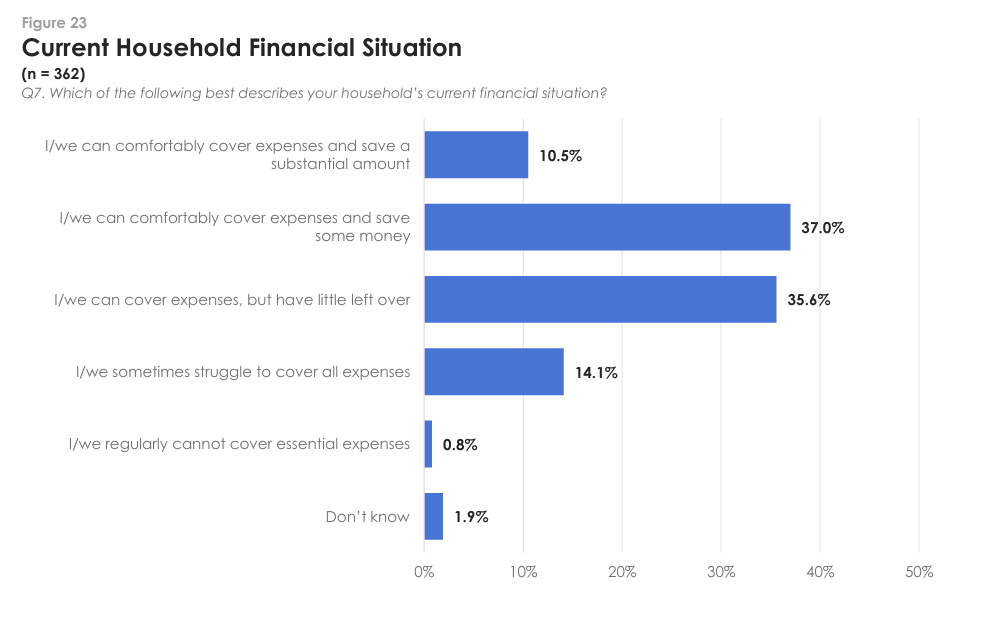
Almost half of households are able to comfortably cover their expenses, while nearly 15 per cent report difficulty to some degree, a survey by Marketing Advisory Services has found.
The ‘National Budget Priorities & Household Finances in Malta’ survey was carried out between 18th September and 11th October and gathered responses from 362 people.
The survey provides an insight into households' ability to meet their expenses and put money aside, highlighting the financial divide between different income groups.
Almost half (47.5 per cent) of respondents said they were able to comfortably cover their expenses and put money aside. Of these, 10.5 per cent said they could save a substantial amount, while 37 per cent could save some money.
Another 35.6 per cent can cover their expenses but have little left over.
But 14.9 per cent report difficulty to some degree. 14.1 per cent said they sometimes struggle to cover all expenses and 0.8 per cent regularly cannot cover essential expenses. The rest said they did not know.
The survey found that as wages increased, the percentage of people who can comfortably cover their expenses and save money increases, rising to 64.2 per cent among those earning more than €50,000 a year.
It also found that almost half of respondents save regularly – 31.5 per cent put money aside every month and 17.7 per cent in most months. 26 per cent said they save in some months, while 23 per cent said they rarely or never save.
In households with incomes below €30,000, 42.7 per cent rarely or never save, four times the 10.5 per cent among households earning more.
The ability to save also falls sharply with age. Just over 63 percent of those under the age of 45 say they can save every month or most months, dropping to 46.5 per cent for those aged 45-64, and 39.2 per cent for those aged 65+.
Savings broadly unchanged for 35% over 12 months
Over the past 12 months, savings remained broadly unchanged for 34.8 per cent of households. Meanwhile, 29.9 per cent reported an increase in their savings, compared to 27.9 per cent who said their savings had fallen.
The survey shows that almost half of households that can comfortably cover their expenses increased their savings, and that among households that struggle, 57.4 per cent saw their savings fall.
So what are households mainly saving for?
Respondents were able to select a number of choices, and 41.2 per cent highlighted saving an emergency fund or financial safety net as one of their choices. The second highest choices (both 34.8 per cent) were for retirement or for a holiday.
Barriers to saving
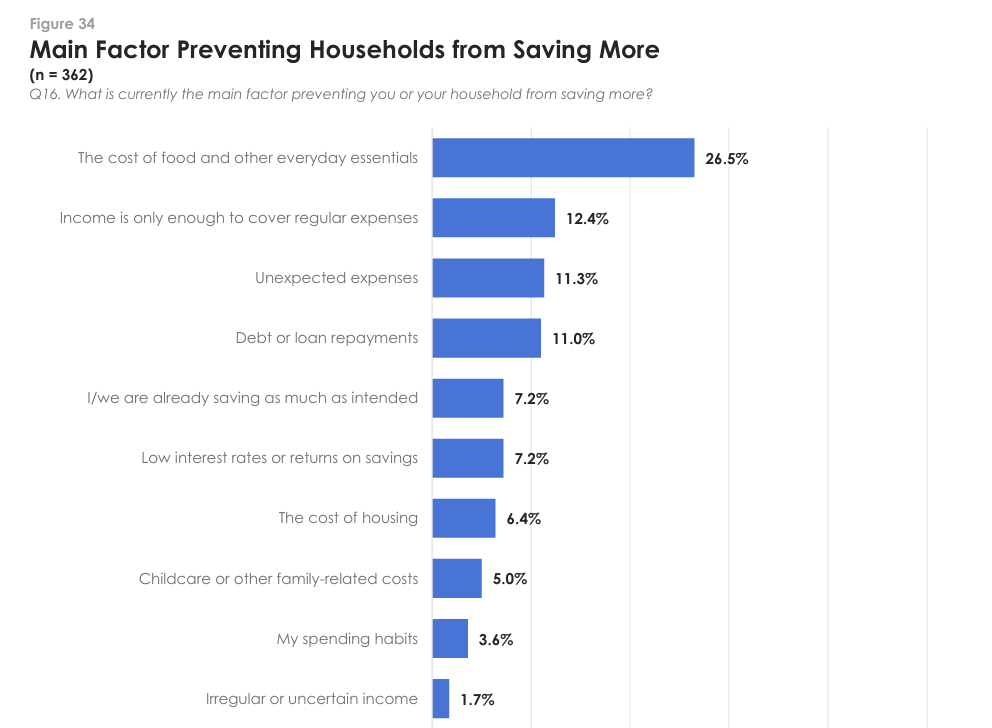
The Marketing Advisory Services survey also shows what people say are the biggest barriers stopping them from saving more. The cost of food and other everyday essentials is by far the biggest barrier, named by 26.5 per cent, which is more than twice the share for any other factor. Three factors follow at around 11–12.4 per cent each: income that only covers regular expenses (12.4 per cent), unexpected expenses (11.3 per cent) and debt or loan repayments (11 per cent)
All other barriers are named by fewer than one in ten. Separately, 7.2 per cent said nothing is holding them back, as they are already saving as much as they intend to.
As for what would help households save more, the answers mirrored the barriers.
“Lower food and everyday living costs is the change most often said to help households save more (36.5 per cent), followed by higher take-home income (25.7 per cent). Tax incentives or government contributions towards savings (11.9 per cent) and lower housing costs (8.3 per cent) came next.”
Covering shock expenses
The responses also help bring to the fore the ability of Maltese households to absorb shocks. It found that 82 per cent could cover an unexpected €500 expense from their own money, without borrowing, using credit or paying by instalments. However, one in ten could not.
Those who could cover it would rely almost entirely on savings (56.9 per cent) or money in their current account or income received that month (37 per cent). Among the 40 who could not, the picture changes: 35 per cent would borrow from relatives or friends, 25 per cent would reduce or postpone other spending, while 15 per cent would look into credit cards or overdrafts. 7.5 percent would not be able to cover it at all.
Those who could cover the expense would rely primarily on savings (56.9 per cent) or money in their current account or income received that month (37 per cent). Among the 40 respondents who could not, 35 per cent would borrow from relatives or friends, while 25 per cent would reduce or postpone other spending and 15 per cent would turn to credit cards or overdrafts. A further 7.5 per cent said they would be unable to cover the expense at all.
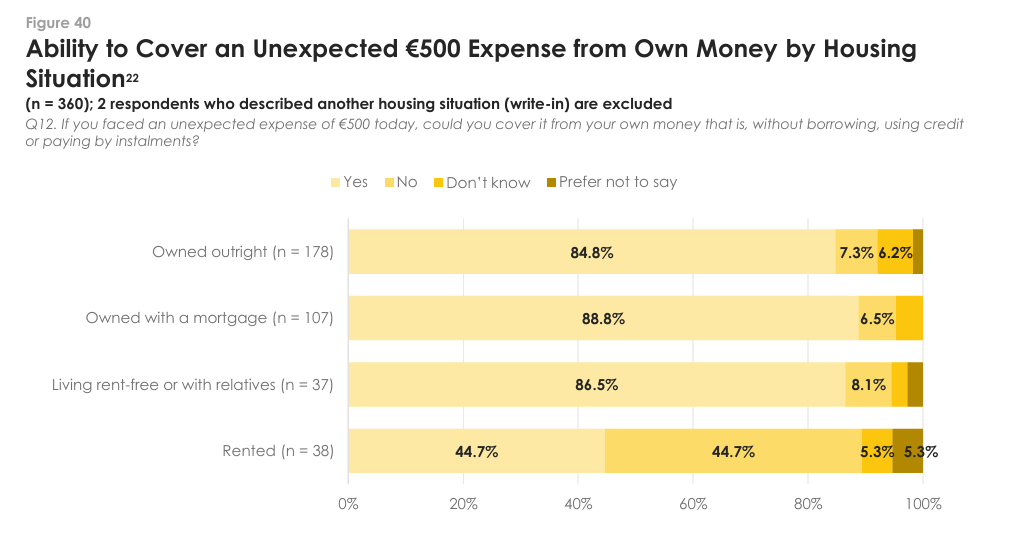
A correlation with property ownership could also be seen. Fewer than half of renters (44.7 per cent) could cover €500 from their own money, and the same share (44.7 per cent) say they could not. Of those who own a property or live rent free with relatives, at least 84 per cent could cover the unexpected €500 expense from their own funds.
The survey states that the results are unweighted and the margin of error is approximately ±5.2 per cent with a 95 percent confidence level.
Featured image: Nejc Soklič/Unsplash
Related

PTL partners with Zoho – Less paperwork, more possibilities
The partnership will help businesses across Malta simplify their operations, connect their teams and make more time for what matters
Fyorin launches expense management to bring business spending into one place
For businesses managing several teams, departments or projects, small work payments quickly adds up

Government responsible for ensuring infrastructure supports economic model – Employers’ Association
Economic growth has relied heavily on sustained construction and was encouraged by government’s pro-development policies, it said