



40.8 per cent of respondents to this year's State of the Nation survey said their financial situation was better this year than last year, a six percent increase over those who responded the same way in last year’s survey.
This percentage has been rising since 2023. 46 per cent of respondents this year said their financial situation remained the same, while 13.2 per cent said it's worse.
The survey had 1,064 respondents aged 16 and up, statistician Vince Marmara, who presented the results, said. Results were gathered between the third week of June and the second week of July this year.
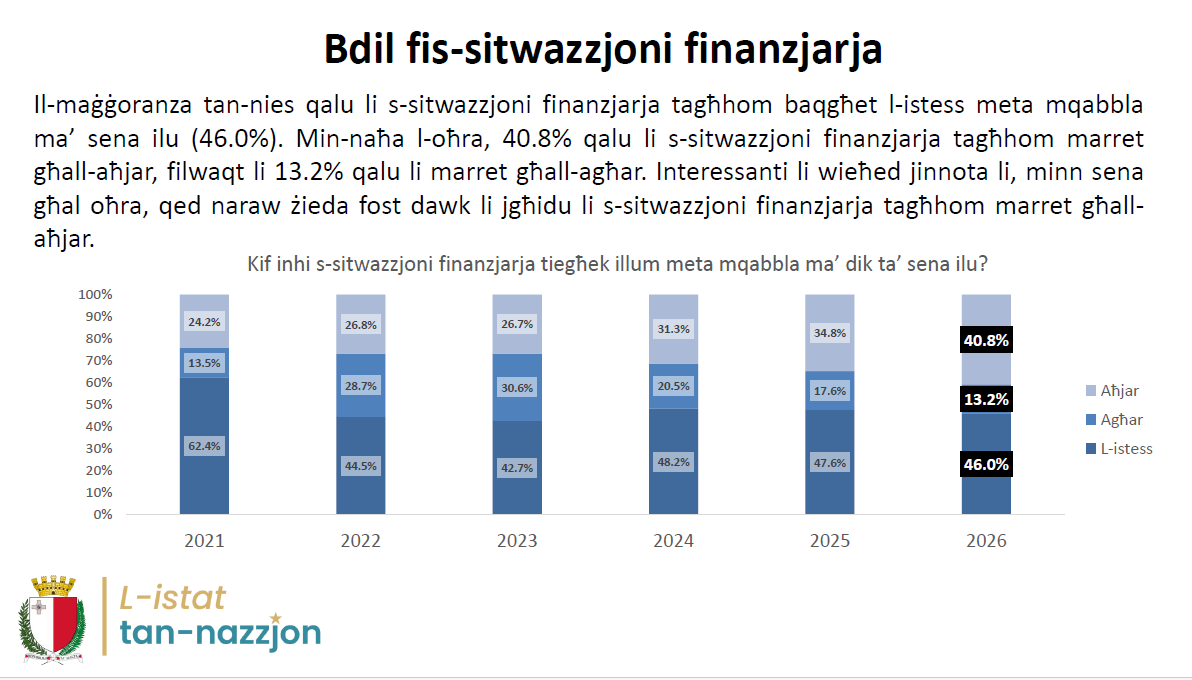
In terms of age groups, those aged 16-25 and those aged 66+ had the highest percentages of responses saying their financial situation has improved since last year (56.2 per cent and 48.6 per cent respectively).
Respondents were also asked about their standard of living, and the result is similar to previous years. 3 out of every 4 people say their standard of living is average. 17.1 percent feel their standard of living is above average and 6.8 per cent feel it is below the average.
The survey also notes that over the past three years, the percentage of respondents who believe their lives will be better in a year’s time has been rising, from 39.1 per cent in 2023 to 52.3 per cent this year. The younger age groups are more optimistic in this regard, where for those aged 26-35, 71.8 per cent believe their lives will be better and in the 16-25 age group, 66.7 per cent believe so.
The older the age group above those, the fewer believe this to be the case and the more responded “don’t know”. 37.6 per cent of respondents aged 66+ said they believe it will be better, 13.1 per cent don’t and the rest said they don’t know.
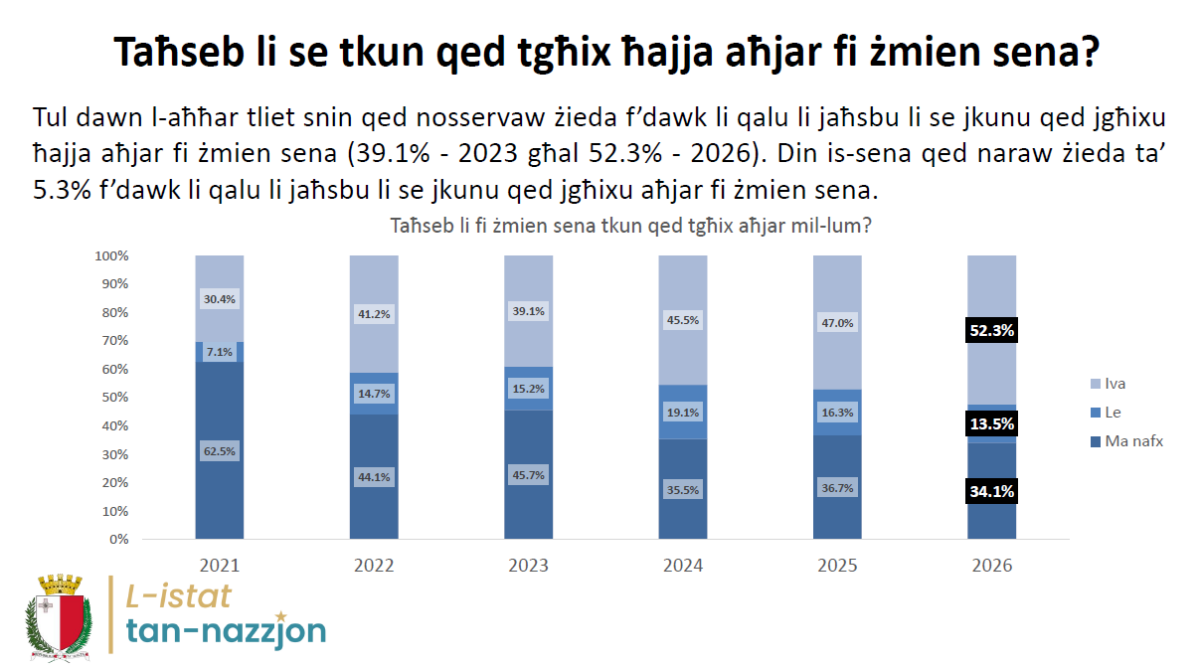
When looking at education level, the highest percentage who believe their lives will be better next year are those who have gone through tertiary education.
Survey respondents were also asked to classify what aspects of work are most important to them. Work satisfaction was the highest rated, followed by income, security of employment, appreciation at the workplace and then flexibility of hours. Last year, income was the most important.
37.8 per cent don’t believe foreigners are the solution or jobs Maltese don’t want to do
The survey also asked respondents questions related to multiculturalism in the country, and the data revealed a curious statistic.
While the population numbers have risen substantially in recent years, there are jobs which Maltese no longer seem willing to do. The survey, however, found that a large percentage of respondents, 37.8 per cent, do not believe that bringing in foreigners is the solution to fill certain jobs that Maltese don’t want to do.
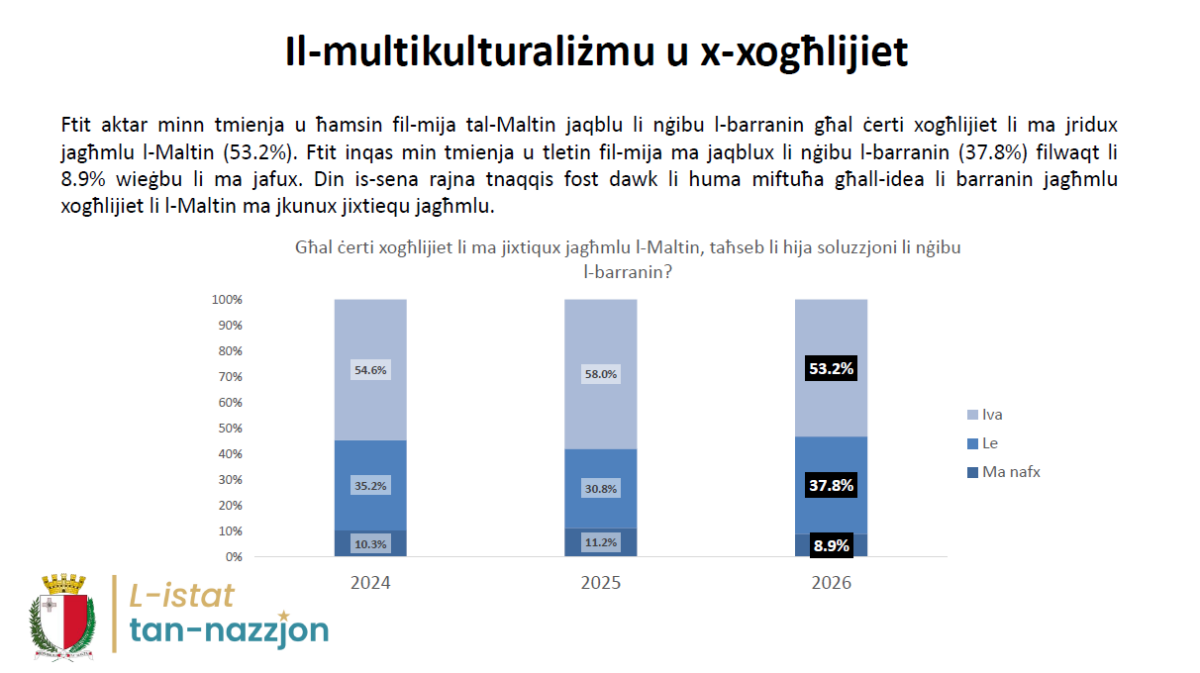
This is the highest percentage who gave such an answer in the past three years, with 35.2 per cent responding so in 2024 and 30.8 per cent responding so last year.
53.2 per cent of respondents this year believe it is the solution and 8.9 per cent said they don’t know.
The age groups with the highest percentages who had answered that bringing foreign workers isn’t the answer are 16-25 and 26-35, where 44.9 per cent and 49.2 per cent responded as such respectively. The 66+ age group had the least percentage (28.9 per cent) of respondents who said bringing in foreigners isn’t the answer.
Asked whether they are comfortable with the mix of cultures in society (using a scale of 1-5 with 1 being not comfortable at all), the average answer among respondents was 2.75, the same as last year. Youths aged 16-25 are feeling the least comfortable, with an average answer of 2.41 among them.
In its conclusions, the survey notes that among youths, there are more who view foreigners as a threat, “maybe because they fear that they could take their place or their opportunities?”
“On the other end, the higher the age, it appears that people understand that we need foreign workers for the diverse services they ended up depending on.”
The conclusions also note that a substantial number of workers in sectors like catering, elderly homes, nursing and construction are foreign.
More than half of respondents say incentives won't convince them to have more children
As for incentives, such as those introduced locally or abroad, to have more children, the survey asked respondents whether such things would convince them to have more children.
47.6 per cent said no it wont convince them, to the question, 36 per cent said yes and 16.4 per cent said they do not know. Those aged 46 to 45 are the least likely to agree that incentives would convince them.
Malta’s fertility rate is at the bottom of the EU, with 1.01 births per woman.
Importance of politics
The survey also delved into the impact of politics on Maltese people.
In terms of the importance of Maltese politics in their lives, 32.2 per cent of respondents said ‘very important’ which is slightly higher than the 30.8 per cent last year. 40.5 per cent said kind of, while 26.2 per cent said not at all and 1.1 per cent did not know.
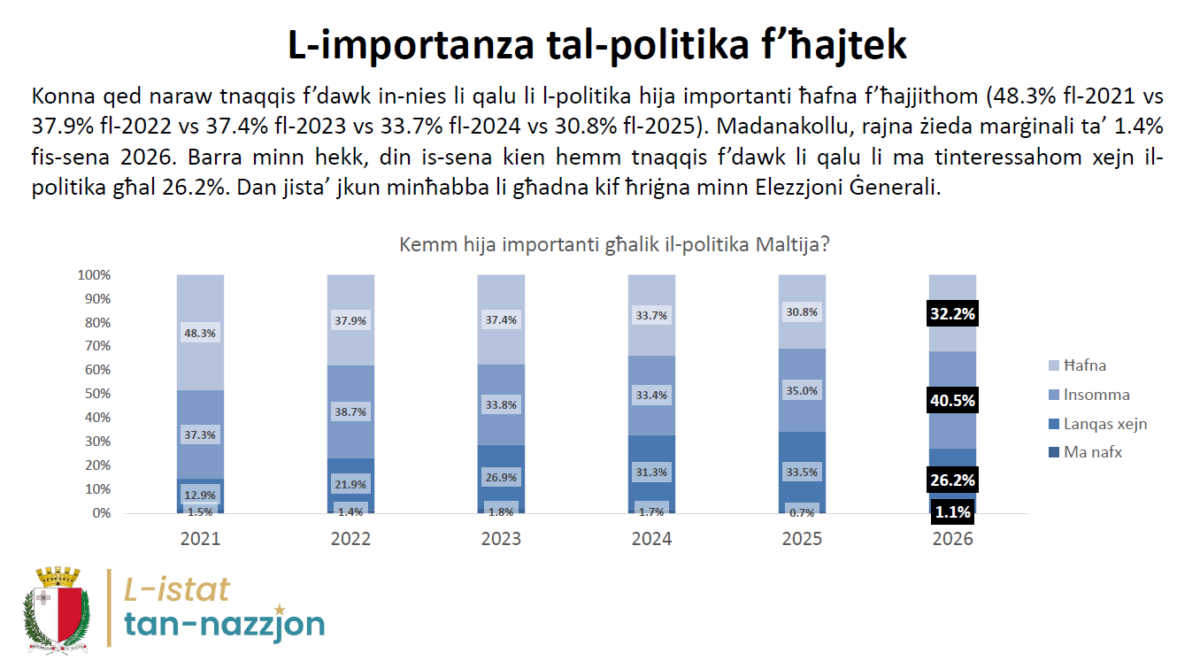
Questioned whether they on occasion went to a politician because they needed something, 31.1 per cent said yes, the highest percentage since 2022.
Social media use
The survey found that Facebook remains the most popular social media across all age groups, although use reduces as the age rises.
Instagram and TikTok are particularly popular among 16-25-year-olds, at 98 per cent and 89.1 per cent respectively. In the same age group, 91.2 per cent also use Facebook. Nearly all those aged 16 to 25 use the three forms of social media.
While popular in that age group, TikTok use immediately drops in the 26-35 age group to just under 46 per cent. Instagram use remains high until the 36-45 age group where 51.2 per cent use it.
The percentage of people who use no social media drops as the age groups rise. None of those in the 16-25 year-old age group said they don’t use any social media, while 41.9 per cent of those aged 66+ don’t use any.
‘Businesses are making money, but at what cost?’ Malta’s tourism under the lens
Important questions were raised during FAA's national conference on Tuesday (today)
Planning Malta’s future, one shared map at a time
Ahead of the PA's annual conference, Joseph Gauci discusses integrated planning, 3D mapping and global insights for Malta’s future.
PA CEO resigns as director of his consultancy firm
The PA CEO remains the sole shareholder of the consultancy firm, under his legal name 'John Buttigieg'