


Malta consumes more bottled water per person than any other country in Europe, with annual consumption reaching 274 litres per person in 2023 – almost four times the European Union average of 74 litres.
The figure places Malta ahead of Cyprus, which ranks second at 235 litres per person, according to data compiled by Statista and the University of Geneva's Global Water Observatory.
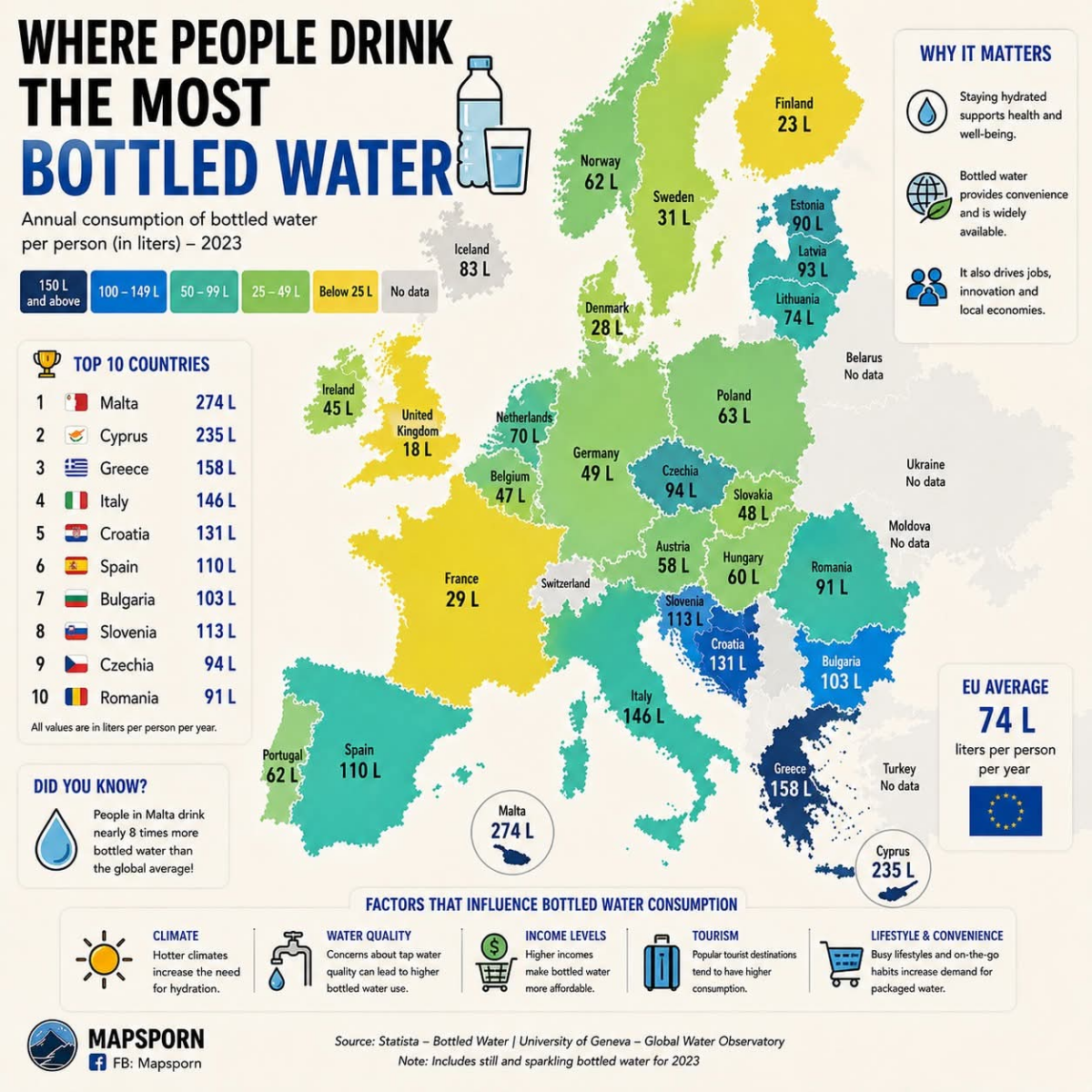
The figures reveal a clear regional trend. Mediterranean countries dominate the rankings, with Malta, Cyprus, Greece, Italy, Croatia and Spain making up the top six positions. Greece recorded 158 litres per person annually, while Italy stood at 146 litres.
The data suggests that climate, tourism, convenience and perceptions about water quality continue to influence bottled water consumption patterns across Europe.
For Malta, the issue is particularly striking given the country's small size and growing environmental ambitions. The island consumes almost 15 times more bottled water per person than the United Kingdom, where annual consumption stands at just 18 litres, and significantly more than France (29 litres), Germany (49 litres) and Sweden (31 litres).
The European figures also align with previous international research that found Malta has the third-highest bottled water consumption per capita globally, behind only Singapore and Australia. That study focused exclusively on still bottled water intended for drinking purposes, excluding flavoured and sparkling varieties.
Why do Maltese consumers choose bottled water?
While convenience and lifestyle factors play a role, research suggests perceptions of tap water remain one of the main drivers behind Malta's high bottled water consumption.
A study by researchers Christian Camilleri and Alex Rizzo published in the MCAST Journal of Applied Research & Practice found that the strongest factor influencing bottled water consumption was what researchers termed the "organoleptic quality" of tap water – essentially how consumers perceive its taste, hardness and appearance. The second most important factor was "tap water insecurity", referring to concerns about health and safety, while social influences such as advertising, trends and public perceptions also played a role.
The study noted that although Malta's tap water complies with European drinking water standards and is safe to consume, there remains a gap between actual water quality and public perception.
Many Maltese consumers in recent years have pointed to the widespread adoption of reverse osmosis (RO) systems and water filtration units in homes as evidence that attitudes may slowly be changing. Some say these systems allow them to drink tap water more comfortably by improving taste and reducing salinity, thereby reducing their reliance on bottled water.
Efforts to improve tap water quality
The Water Services Corporation has been working to address long-standing concerns regarding the taste of tap water.
Malta’s water has always been safe to drink, meeting World Health Organisation guidelines and in line with the EU Drinking Water Directive. However, Malta’s geography – featuring no rivers or mountains and being entirely surrounded by sea – has long influenced the taste of its water.
To address this, WSC adjusted its blending strategy, increasing the proportion of reverse osmosis water by 10 per cent and reducing groundwater abstraction by the same amount, lowering salinity and improving taste. The corporation has also introduced better water harmonisation, blending water centrally at Ta’ Qali and Qrendi before distribution, ensuring the same quality of water is delivered to people wherever they are located.
Karl Cilia, WSC's CEO says this approach is beginning to show results, with more restaurants and hotels increasingly offering tap water, and more households relying on it. “This is a cultural change that will take time,” he says, “but we’re getting there.”
Environmental implications
Malta's position at the top of the European rankings also raises questions about plastic waste and sustainability.
The international study that ranked Malta third globally concluded that the country still has considerable progress to make in reducing single-use plastics associated with bottled water consumption. As governments and businesses across Europe seek to cut plastic waste and improve circular economy practices, encouraging greater confidence in tap water could become an increasingly important part of Malta's environmental strategy.
The challenge may ultimately be as much cultural as technical. While infrastructure improvements and better water quality have addressed many historical concerns, changing long-established consumer habits could take significantly longer.
For now, however, Malta remains Europe's undisputed leader in bottled water consumption.

German court clears use of breached MGA documents in reporting, Lilith Wittmann says
The MGA has previously rejected the suggestion that its legal measures were intended to silence or intimidate her
Enemalta advances plans for new Malta-Gozo interconnector
This follows a €45 million general election pledge for a Malta-Gozo high-voltage link
MDIA to assess potential for new research and innovation network in Gozo
Research is intended to provide an assessment of how a future research and innovation ecosystem in Gozo could be structured