


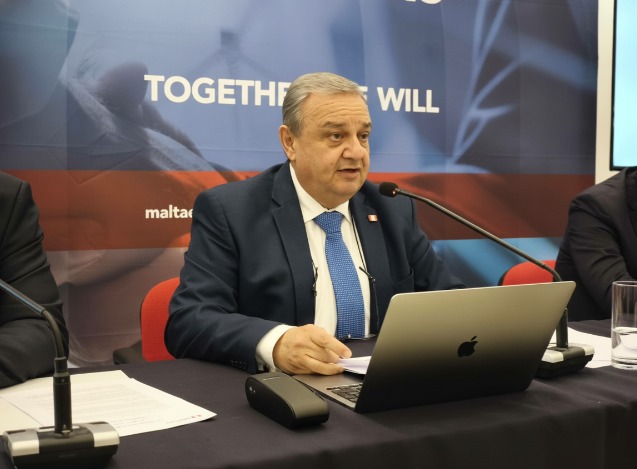
Malta’s education system “stifles entrepreneurship and creativity,” President of the Malta Employers’ Association Ivan Refalo has said, as the association is calling for its transformation.
“Children up to the age of four are very creative, unfortunately few of them carry that beyond the age of 10, because our education system is geared that way,” Mr Refalo said.
In its Budget proposals, the association is calling for the initiation of an open and inclusive national debate “on the transformation required in the education system.”
Here, the association said that despite considerable public expenditure in the education structures, the country continues to produce a high share of low achievers, while the gap between the skills coming through the education system and those required by industry continues to widen. It mentioned the need to guide more students to undertake vocational trades which are in high demand, but beyond technical skills, the association said that the system has to develop creativity, critical thinking, teamwork, adaptability, and communication and embed digital agility at every level, "because these are the capabilities that retain value as artificial intelligence absorbs routine work."
Among its proposals, the association is calling on the Government to build a forward-looking education system that prepares the population for tomorrow's jobs, to make a concerted effort to reduce early school leaving, and also to “mainstream culture and creativity in education, moving from STEM (Science, Technology, Engineering, and Mathematics) to STEAM (Science, Technology, Engineering, Arts and Mathematics).” The association's heads highlighted the creativity aspect of education while talking to this newsroom.
Kevin J. Borg, Director General of the Malta Employers’ Association said that the system kills creativity in children as it is geared towards conformity. “You have to fit in a box,” he said, describing the current system. Abroad, he said, children are given the space to share their opinions but in Malta they just have to repeat what’s in the book.
He said the system doesn’t foster creativity in terms of how to use language or the way one interprets facts for instance.
In terms of the culture and creativity sector in general, Mr Borg believes that there needs to be more organisation and commercialisation in the sector, in the sense that artists should be able to earn a living from their talent, he said, praising their creativity.
“They shouldn’t have to go to work in the morning and then in the afternoon work on or perform their art,” he said. He said it shouldn’t have to be something part-time.
As part of its proposals, the association is calling on the Government to set up funds, resources, and opportunities to internationalise local talent, and also to invest in infrastructure and increase affordable creative spaces, such as studios and rehearsal spaces, for artists and performers.
“We believe that if you have a talent, are able to do something different, and your talent is scarce, then you should be helped and self-sustained to be able to earn your living from your talent, being able to focus on it," Mr Borg said.
Mr Refalo used an example in the sports sector, mentioning SportMalta encouraging children who have a talent for sports to have a focus on sports and also academics. He said that if something similar to that can be replicated for the performing arts for instance, building similar structures, that is something that could help the creativity sector. The sector needs more support, he said.
He said that the country needs to better identify those who have an artistic talent and seek way to help them develop it further.

MFSA flags missing information in pension statements
Some pension statements omitted key details on investments, fees, contributions and account changes
Budget should support sustainable economic growth, promote financial stability – BOV
Maintaining a stable and predictable business environment, encouraging investment in productivity remain important, it said
Identità aims to shorten waiting times and simplify procedures as part of its vision for coming years
Improvements must be achieved without compromising identity security or personal data protection, it said