


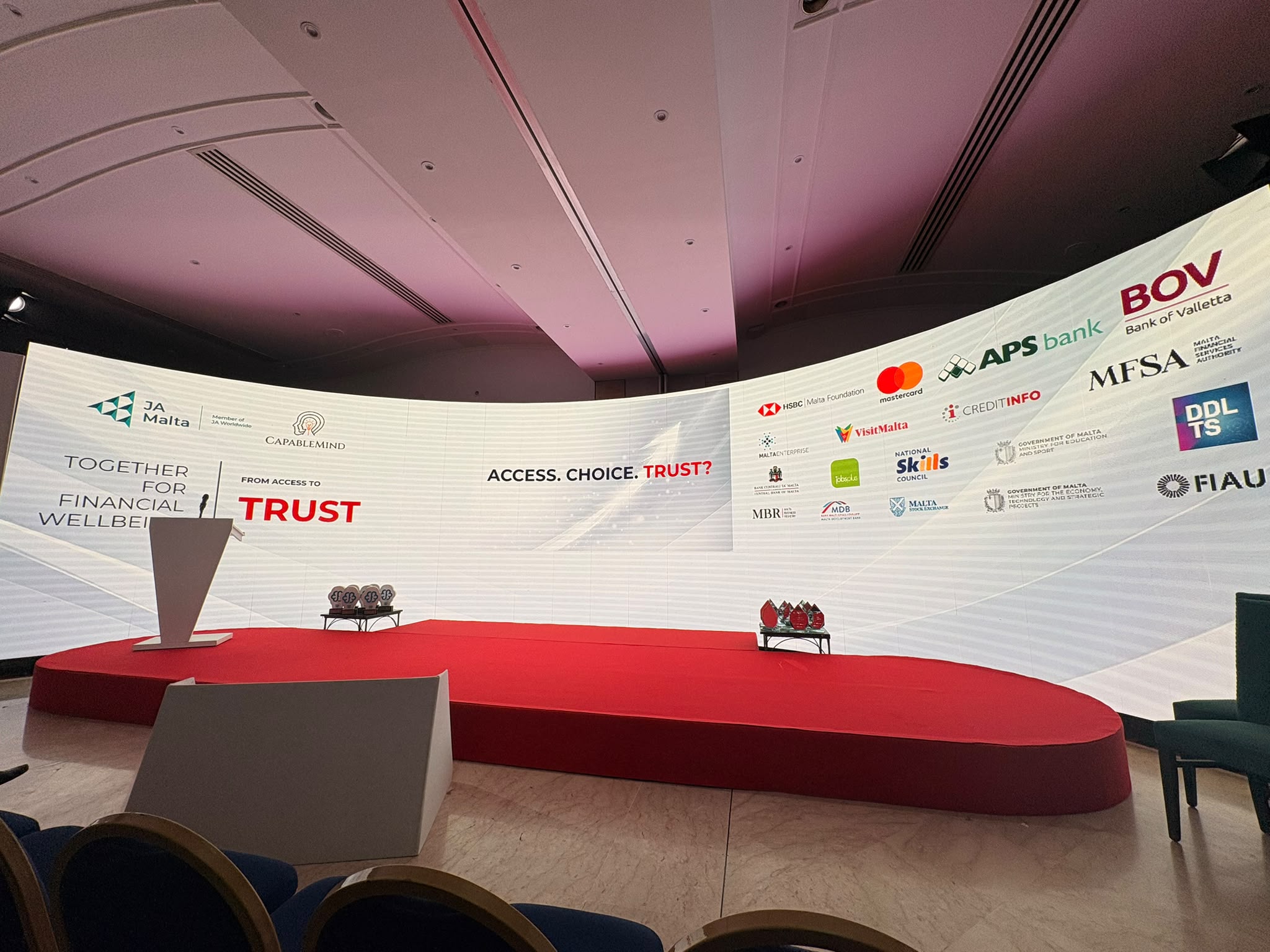
Financial literacy must go beyond teaching people how to manage money, with experts calling for greater emphasis on behavioural change, consumer protection and practical financial skills.
This was among the central messages emerging from the first half of the Financial Capability Awards conference, which brought together local and international experts to discuss how financial education can be translated into better financial decisions.
The discussions explored Malta’s progress in promoting financial literacy, the challenges facing consumers and the role of financial institutions, policymakers and educators in improving financial wellbeing.
Opening the conference, Petra Ellul Mercer reflected on developments in Malta’s financial literacy landscape since last year’s edition, pointing to initiatives undertaken by the Malta Financial Services Authority (MFSA), the Central Bank of Malta and the Malta Stock Exchange (MSE).
These included research published by the MFSA, financial education initiatives such as ĠEMMA, the Central Bank’s efforts to promote financial literacy and the MSE’s launch of Investi.
She also noted how access to financial information has changed considerably, making financial knowledge more readily available to consumers. However, discussions throughout the morning highlighted that greater access to information does not necessarily translate into better financial decisions.
Finland's approach to financial literacy
Anu Raijas from the Bank of Finland outlined how the country has sought to move from developing a national financial literacy strategy to implementing practical measures.
Finland has set itself the ambition of achieving the highest level of financial literacy in the world by 2030, with its approach focusing on improving people's knowledge, skills and confidence in managing their finances throughout their lives.
Ms Raijas identified five steps underpinning the country's approach: developing a strategy based on evidence and broad participation, assigning permanent institutional responsibility, establishing a practical action plan, coordinating stakeholders and adapting to changing circumstances.
Finland's financial literacy action plan for 2024–2026 prioritises preventing over-indebtedness, strengthening digital financial literacy, supporting financially sustainable choices and improving consumers' understanding of credit and fluctuating interest rates.
The country has also established a network of more than 80 organisations contributing expertise and resources to financial education initiatives.
Ms Raijas emphasised the importance of national coordination alongside local implementation, arguing that successful strategies require both shared ownership and clear accountability.
Financial education is not always the solution
Professor Adele Atkinson from the University of Birmingham challenged the assumption that improving financial knowledge automatically results in better financial behaviour.
She argued that financial education, while important, is not necessarily the most effective response to every financial challenge.
In some circumstances, she explained, social policy, regulation or changes to financial product design may be better suited to addressing the difficulties consumers face.
Prof. Atkinson stressed that financial education programmes should be developed around the needs of their intended audiences, rather than simply providing information.
This involves understanding the challenges individuals encounter, identifying practical applications for financial knowledge and providing opportunities to practise making financial decisions.
She also highlighted gaps in existing research, including uncertainty surrounding the long-term impact of financial education, its effect on financial wellbeing and which programmes can be effectively implemented on a larger scale.
Meanwhile, Professor Elaine Kempson CBE raised concerns that existing financial services do not always adequately meet the needs of all consumers.
Drawing on the United Kingdom's regulatory framework, she referred to requirements for financial services firms to demonstrate appropriate standards of consumer care, particularly when dealing with vulnerable customers.
She argued that access to financial services should not be regarded as the ultimate objective of financial inclusion.
Rather, the focus should be on whether individuals are achieving better financial outcomes.
Behavioural factors influence financial decisions
The relationship between financial knowledge and behaviour was also examined during a panel discussion moderated by JA Malta CEO Matthew Caruana.
Professor Marie Briguglio explained that financial decisions are not always driven by rational considerations, with individuals frequently relying on instinctive responses rather than carefully evaluating their options.

She referred to the distinction between automatic, instinctive decision-making and slower, more deliberate thinking.
According to Prof. Briguglio, relatively simple interventions can encourage individuals to reconsider their choices before making financial commitments.
She pointed to cooling-off periods as one example of how consumers can be given additional time to assess decisions.
Conversely, marketing strategies that create urgency through limited-time offers can encourage consumers to make decisions without sufficient consideration.
The discussion also addressed the responsibilities of financial institutions in supporting consumers.
Panel participant Simon Azzopardi emphasised the importance of trust in banking relationships, noting that banks have responsibilities extending beyond regulatory compliance.
He also observed that physical banking services remain important to customers, particularly when making significant financial commitments such as taking out loans.
Another panellist, Nicole Azzopardi, highlighted the difficulties young people face in applying financial knowledge while balancing university, employment and social commitments.
She also pointed to uncertainty surrounding employment prospects, artificial intelligence and the cost of living as factors contributing to financial stress, even among individuals who have managed to accumulate savings.
Young people and practical financial skills
Economy Minister Silvio Schembri also addressed the conference, emphasising the importance of supporting young entrepreneurs and encouraging young people to develop financial skills through practical experience.
He noted that young people learn by making choices, understanding their consequences and connecting financial lessons to real-life situations.
The Minister also stressed that building trust and developing the necessary financial infrastructure require cooperation between different organisations.


Tourism intensity climbs as Malta’s effective population tops 670,000 in August
During August 2025, St Julian’s tourism intensity reached 143 tourists per 100 residents

Millions in taxable income declared by 81 companies with no employees
Tax declared by US multinationals in Malta rose to €118 million in 2024, up from €24.7 million in 2020

MIA sees emissions per passenger fall as traffic tops 10 million during 2025
Malta International Airport’s revenue increased by 9.9% to €157 million in 2025