


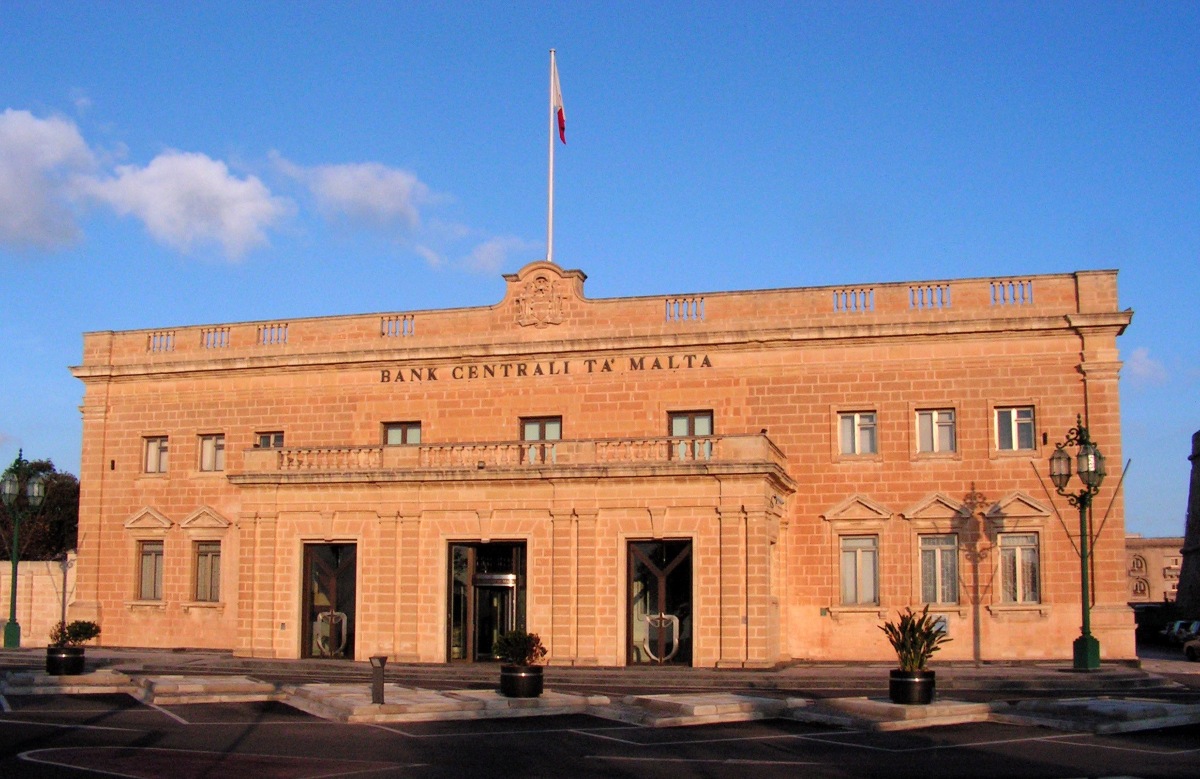
Malta entered 2026 from a position of economic strength, but the Central Bank of Malta’s latest Annual Report for 2025 makes clear that the country’s resilience will now be tested by a more unpredictable international backdrop, renewed inflation risks, and the banking sector’s continued exposure to property.
The Central Bank of Malta formally launched its 2025 Annual Report during an event at its Valletta premises on Friday, with Governor Alexander Demarco, Chief Economist Aaron Grech, Deputy Governor for Financial Stability Oliver Bonello and Deputy Governor for Monetary Policy Rita Schembri outlining the Bank’s assessment of the economy, financial system and its own financial results.

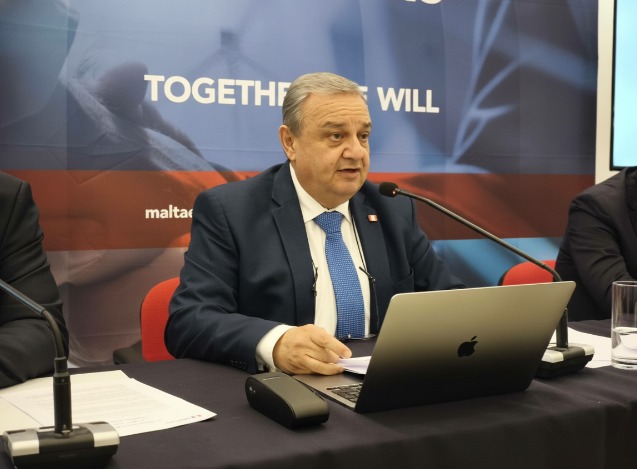
Governor Alexander Demarco and Deputy Governor Oliver Bonello. Photo: Melvin Bugeja / Central Bank of Malta
The report shows that Malta’s economy continued to outperform the euro area in 2025, even as growth moderated. Real GDP grew by four per cent, compared with euro area growth of 1.4 per cent, supported primarily by domestic demand, while net exports also contributed positively. Growth was largely driven by services, particularly wholesale and retail trade, accommodation and related activities, reflecting the continued strength of tourism.
Inflation also remained contained. Malta’s HICP inflation averaged 2.4 per cent in 2025, far below the post-pandemic peak of close to six per cent. However, the bank cautioned that its latest projections were prepared before the outbreak of the military conflict in the Middle East, meaning the outlook is now subject to higher uncertainty.
The bank expects Malta’s real GDP growth to ease to 3.7 per cent in 2026 and to remain around that level in the following two years. Inflation is projected to decline slightly to 2.3 per cent this year, before easing further to 2.1 per cent in 2027 and two per cent in 2028.
However, the report warns that the conflict in the Middle East could push energy and commodity prices higher, creating upside risks to inflation and downside risks to growth. While Government energy support measures are expected to cushion Malta from the direct impact of higher foreign energy prices, the bank also warned that such measures would require greater restraint in public expenditure if fiscal targets are to be achieved.
The public finance outlook remains relatively stable but still under pressure. The Central Bank projects the general Government deficit to narrow from three per cent of GDP in 2025 to 2.8 per cent in 2026, 2.4 per cent in 2027 and two per cent in 2028. General Government debt is projected to remain below 50 per cent of GDP, standing at 47.1 per cent in 2026 before declining to 46.2 per cent by 2028.
A key area of focus is the property market and banks’ exposure to real estate. Mr Bonello noted that Malta’s banking sector remained resilient, supported by strong capital and liquidity positions, profitability and improved asset quality. However, he also pointed to an evolving risk environment, particularly in relation to lending concentration.
In response, the Central Bank, in collaboration with the Malta Financial Services Authority and under the Joint Financial Stability Board, decided to extend the sectoral systemic risk buffer to all private-sector exposures backed by immovable property in Malta. The 1.5 per cent buffer will apply from the end of June 2026.
The move suggests that while the banking system is not being presented as vulnerable, regulators are clearly seeking to build additional safeguards around property-related lending. The bank said emerging vulnerabilities in the corporate sector, particularly sectors exposed to real estate beyond residential property, prompted the widening of the buffer’s scope.
On monetary policy, Mr Demarco noted that the euro area economy showed increasing signs of stabilisation in 2025, despite geopolitical uncertainty. As inflation moved closer to the European Central Bank’s two per cent medium-term target, the ECB cut its three key interest rates by a cumulative 100 basis points in the first half of the year, bringing the deposit facility rate to two per cent by June.
For Malta, financial conditions remained loose from a historical perspective, although less so than in 2024. Residents’ deposits rose by 7.5 per cent to €27.47 billion, while credit to residents increased at a faster pace, mainly reflecting stronger lending to households for house purchases and higher lending to non-financial corporations.
The Central Bank itself also reported a sharp improvement in profitability. Ms Schembri said operating profit before transfers to provisions reached €38.92 million in 2025, up from €4.95 million in 2024. The improvement was mainly driven by higher net interest income and a lower expense from the pooling of monetary income within the Eurosystem. The bank increased its risk provisions by €28.92 million and transferred €10 million to the Government of Malta.
Beyond the economic figures, the report also points to operational and regulatory changes. These include the rollout of instant payments for banks in October 2025, the implementation of the Eurosystem Collateral Management System, enhanced real estate data reporting, and updates to the Central Credit Register.
The bank also said it intends to strengthen cyber-related stress testing of payment systems, citing the growing threat posed by cyberattacks. It also aims to reach €500 million in green, social and sustainable bond holdings by the end of 2026.
The overall message is that Malta remains in a stronger position than many euro area peers, but the margin for complacency is narrowing. Growth remains robust, inflation is contained and banks are resilient – yet the Central Bank’s report repeatedly points to risks that are external, fast-moving and difficult to control.

Education system ‘stifles creativity’, Malta Employers’ chief says as association calls for ‘transformation’
Association's Director General says system is geared towards conformity

MFSA flags missing information in pension statements
Some pension statements omitted key details on investments, fees, contributions and account changes

Budget should support sustainable economic growth, promote financial stability – BOV
Maintaining a stable and predictable business environment, encouraging investment in productivity remain important, it said