



It was a very positive start to Malta’s interim reporting season last week with strong earnings from Bank of Valletta plc, Malta International Airport plc, APS Bank plc and Malta Properties Company plc. Market participants and financial analysts who pay regular attention to the periodic announcements of each of these companies should have not been surprised given market developments and recent statements by each of these companies.
Possibly, the main topic worth highlighting is the extent and breakdown of the improved guidance by the airport operator. Following the 15.6 per cent increase in passenger movements during the first half of 2026 to 5.25 million, the double-digit increase in seat capacity across the summer schedule as well as the original guidance at the start of the year to 10.5 million passenger movements (+4.4 per cent), it was obvious that MIA will be adjusting its traffic and financial guidance higher when reporting their interim financial performance.
However, the extent of the improvement may have caught some investors by surprise especially the projected increase in the net profit which is considerably higher than the growth in revenue and EBITDA.
A record first half
MIA’s revenue for the six-month period reached a new record of €82.5 million, an increase of 14.8 per cent over the €71.9 million generated in the corresponding period of 2025. The ‘Aviation’ segment grew by 15.6 per cent to €57.7 million while the ‘Retail and Property’ segment climbed by 13.0 per cent to €24.8 million, maintaining the roughly 70:30 split between the two principal revenue streams of the company.
Total operating costs rose by 13.7 per cent to €38.4 million. Since revenue growth outpaced the rise in costs, operating profit advanced by 15.7 per cent to €44.2 million and EBITDA rose by 17.8 per cent to €53.8 million. The EBITDA margin improved to 65.2 per cent from 63.5 per cent, while the EBIT margin edged up to 53.6 per cent from 53.2 per cent. After accounting for minimal net finance costs and a tax charge of €14.3 million, MIA reported a record interim net profit of €29.0 million, 18.5 per cent higher than a year earlier, translating into an annualised return on average equity of 24.7 per cent.
Although revenue per passenger (a key metric across the airport sector) eased marginally to €15.71 from €15.83 (since revenue grew at a slower pace compared to passenger numbers), EBITDA per passenger improved to €10.25 from €10.04 reflecting the operational leverage of the company as fixed costs were spread over a larger passenger base. This would be a key determinant in the years ahead as the terminal expansion project is completed.
The inclusion of bank debt
MIA’s balance sheet as at 30th June 2026 now includes bank borrowings of €1.17 million which is part of the €5.4 million facility from the Malta Development Bank financing the Airfield Electrification Programme. As had been announced during the Annual General Meeting, the company secured €100 million in bank borrowings split evenly between a five-year and a seven-year loan. These facilities remained undrawn at the half-year stage, which means the gearing and the associated finance costs may only begin to show later on this year and very likely through the course of 2027 given the ongoing heavy capital expenditure by the airport operator.
Capital expenditure during the first half of 2026 amounted to €24.8 million and this is expected to rise to a total of €85 million by the end of the year. Works continued on the second phase of the Terminal Expansion Project, which will add 26,000 square metres of gross floor area, 32 check-in desks and five departure gates. Progress is also being registered on Sky Parks 2, extending over 70,000 square metres and including a business hotel due to be handed over to the operator by the end of 2026.
MIA has been without borrowings for a long number of years and the €100 million in medium-term bank debt is an important and positive development in the capital allocation of the company as it supports the expansion programme without hindering shareholder returns.
Revised guidance
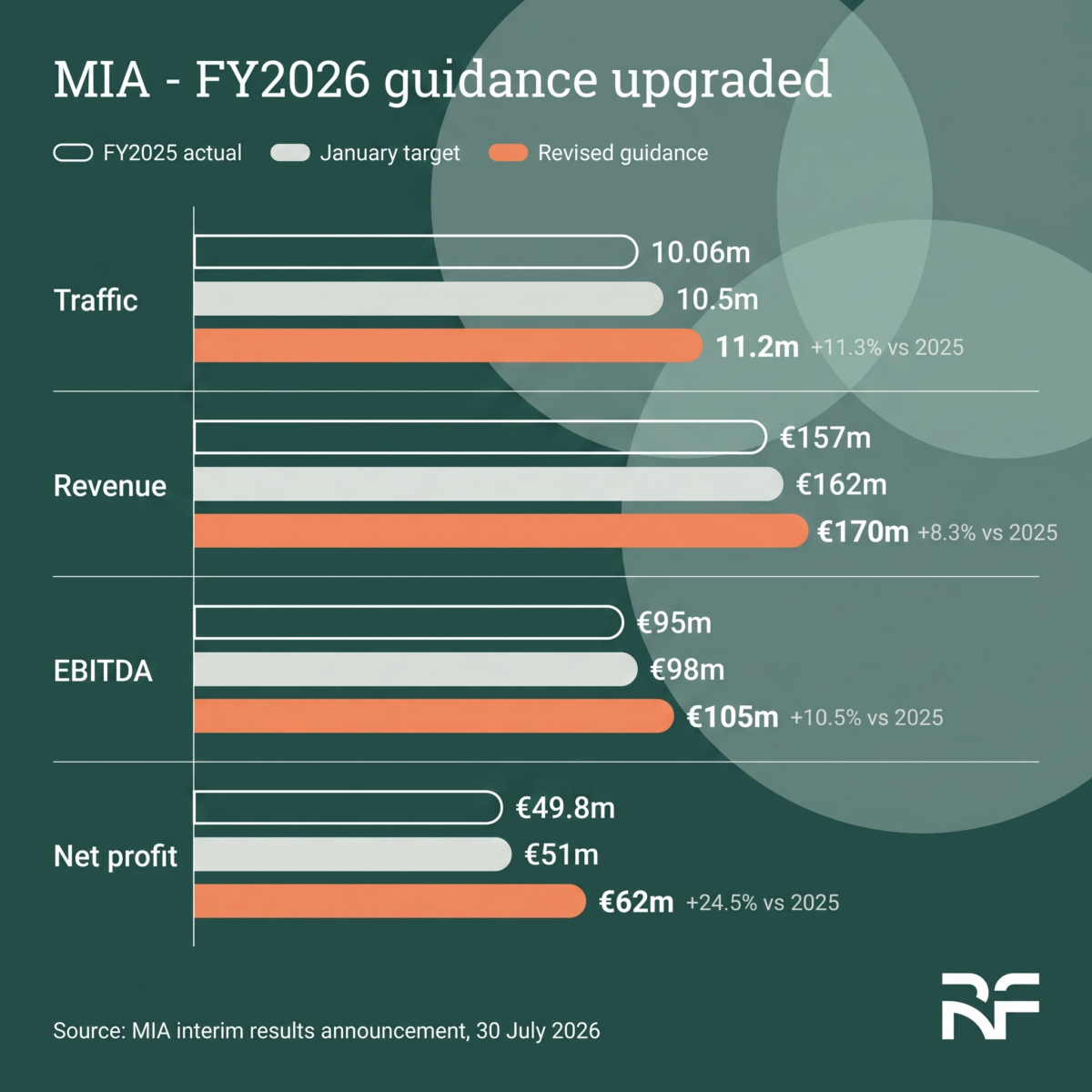
Last week, the company announced that it now expects to close the year with 11.2 million passengers, representing growth of 11.3 per cent over 2025 and a 6.7 per cent improvement over the original 2026 forecast published in January.
Apart from the improved passenger guidance, MIA also upgraded its financial forecasts. The airport operator now anticipates that it will generate revenue of €170 million this year, 4.9 per cent above the previous forecast and 8.3 per cent higher than 2025; EBITDA of €105 million, 7.1 per cent above the previous forecast and 10.5 per cent higher than 2025; and net profit of €62 million, which is surprisingly 21.6 per cent above the previous forecast and 24.5 per cent higher than the record of €49.8 million achieved in 2025.
When taking into consideration the actual figures for the first six months of the year, the revised guidance implies passenger traffic of 5.95 million in H2 which is 13 per cent higher than the first six months of the year and representing 53 per cent of the estimated full-year traffic. Generally, the company’s traffic mix is just over 55 per cent during the second half of the year.
Moreover, the guidance now indicates second-half revenue of around €87.5 million which is 6 per cent higher than the first half despite the fact that Q3 (July to September) generally accounts for circa 30 per cent of annual passenger volumes. Moreover, the estimated revenue in H2 represents growth of less than 3 per cent compared to €85.1 million in the second half of 2025. Meanwhile, the projected EBITDA in the second half of the year is expected at circa €51.2 million which is lower than the H1 EBITDA of €53.8 million and growth of just under 4 per cent against the €49.4 million in the second half of last year.
The slight decline in the growth rate during the second half of 2026 is possibly due to an anticipated slowdown in the final three months of the year reflecting the uncertainty arising from persistent geopolitical tensions and elevated jet fuel prices.
Despite this, MIA’s net profit in the second half is estimated at circa €33 million which is an increase of 13.8 per cent over the H1 2026 net profit of €29 million and more than 30 per cent from the €25.3 million in the second half of last year. The likelihood is that the company will benefit from a lower effective tax charge compared to prior periods and this should be evident once MIA publishes its 2026 annual report in Q1 2027.
Track record post-COVID
Given the relentless upturn in passenger movements in recent years and the positive impact on the company’s financial performance, many investors may not appreciate the sheer extent of the improvement being registered. In 2019, MIA handled 7.31 million passengers and generated revenue of €100.2 million, EBITDA of €63.2 million at a margin of 63.0 per cent, and net profit of €33.9 million.
Based on the revised guidance published last week, MIA is on course to handle 53 per cent more passengers than in 2019 while generating 70 per cent higher revenue, 66 per cent more EBITDA and 83 per cent higher profits after tax. Revenue per passenger would have risen from €13.71 to €15.18 during the period (which is an increase of under 11 per cent despite the unchanged passenger service charge) and EBITDA per passenger would have climbed from €8.65 in 2019 to €9.38 in 2026.
While the investing public should continue to expect double-digit growth during Q3, the monthly traffic results for the months of October, November and December will be more important to monitor to verify if the airport operator is on course to surpass the revised target of 11.2 million passengers this year.

The article contains public information only and is published solely for informational purposes. It should not be construed as a solicitation or an offer to buy or sell any securities or related financial instruments. No representation or warranty, either expressed or implied, is provided in relation to the accuracy, completeness or reliability of the information contained herein, nor is it intended to be a complete statement or summary of the securities, markets or developments referred to in this article. Rizzo, Farrugia & Co. (Stockbrokers) Ltd (“Rizzo Farrugia”) is under no obligation to update or keep current the information contained herein. Since the buying and selling of securities by any person is dependent on that person’s financial situation and an assessment of the suitability and appropriateness of the proposed transaction, no person should act upon any recommendation in this article without first obtaining investment advice. Rizzo Farrugia, its directors, the author of this article, other employees or clients may have or have had interests in the securities referred to herein and may at any time make purchases and/or sales in them as principal or agent. Furthermore, Rizzo Farrugia may have or have had a relationship with or may provide or has provided other services of a corporate nature to companies herein mentioned. Stock markets are volatile and subject to fluctuations which cannot be reasonably foreseen. Past performance is not necessarily indicative of future results. Foreign currency rates of exchange may adversely affect the value, price or income of any security mentioned in this article. Neither Rizzo Farrugia, nor any of its directors or employees accepts any liability for any loss or damage arising out of the use of all or any part of this article.

Related

From property to the stock market
The composition of household wealth locally remains heavily tilted towards real estate with very limited exposure to capital markets

What is driving the dollar’s strength?
The US Dollar ended the third quarter of 2026 with its sixth consecutive quarterly gain

Alkagesta hosts banking partners summit as international financial support exceeds $1 billion
Malta's strong regulatory framework, EU membership, and expanding logistics infrastructure continue to attract international trading companies and their financial partners