


More than seven in 10 Maltese employers surveyed are already using or testing artificial intelligence (AI), with improving productivity and efficiency emerging as the main drivers of adoption. However, gaps in workforce skills, regulatory awareness and internal governance remain significant challenges.
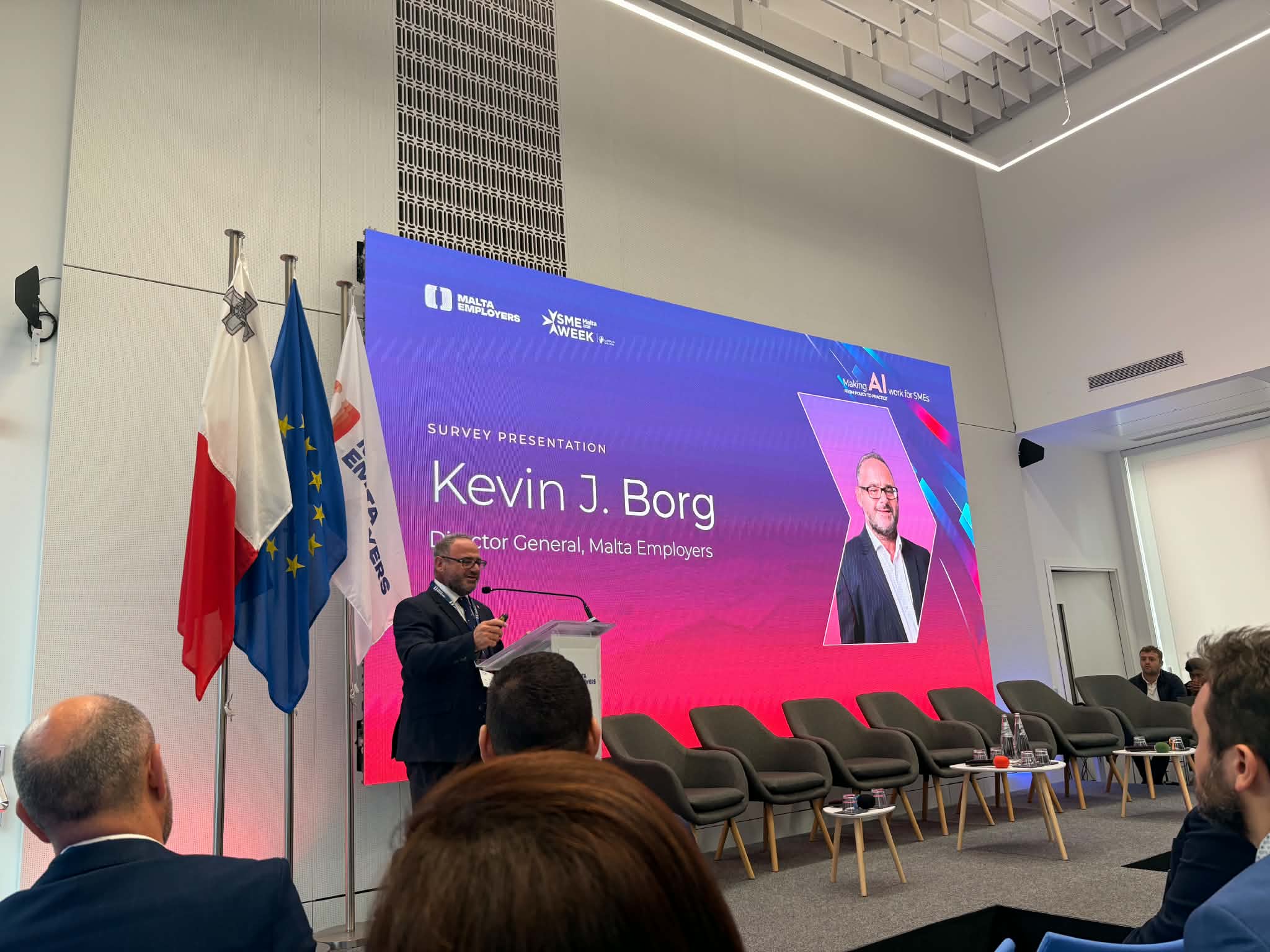
The findings emerged from Malta Employers’ Artificial Intelligence Awareness Survey, presented by Director General Kevin J Borg during the association’s 2026 SME National Conference, held on Tuesday 24th November under the theme ‘Making AI Work for SMEs’.
The survey gathered responses from 207 businesses across 17 industry sectors, with 79.2 per cent of respondents employing fewer than 250 people.
According to the survey, 55.6 per cent of respondents are already using AI routinely in their business operations, while others are testing or piloting the technology.
Improving efficiency and productivity was identified as the primary motivation behind businesses’ approach to AI by 76 per cent of respondents, followed by remaining competitive (six per cent) and reducing costs (two per cent).
Businesses are already reporting tangible benefits from adopting the technology. Among organisations using AI, 72 per cent reported improved efficiency or time savings, while 40 per cent reported better data analysis and decision-making.
A further 20 per cent reported cost reductions, 19 per cent experienced improved customer service and three per cent reported new revenue or growth opportunities.
Data analytics and forecasting emerged as the most common application of AI, cited by 44 per cent of respondents, closely followed by marketing and content generation (43.5 per cent) and process automation (42.9 per cent).
AI is also being used in human resources and recruitment screening (22.5 per cent), as well as compliance and reporting (20.4 per cent).
Fewer than two per cent of job vacancies mention AI
Despite the widespread adoption of AI among surveyed businesses, employers appear to be placing relatively little explicit emphasis on the technology when recruiting new employees.
A separate study commissioned by Malta Employers and conducted by ThinkPeople Nexus analysed 4,515 vacancies advertised across nine local job boards between 2nd and 6th November 2026.
Only 84 vacancies, equivalent to 1.9 per cent, made any reference to AI, up from 1.4 per cent in October. Meanwhile, just 19 vacancies featured AI in their job title.
Regulatory awareness and governance remain limited
The survey also highlighted a gap between the adoption of AI and businesses’ preparedness to manage the associated risks and regulatory obligations.
Only 21.4 per cent of the 98 respondents to a question on the EU AI Act said they were fully aware of their obligations under the legislation, while 26.5 per cent reported some awareness.
Approximately 52 per cent had either heard of the legislation but were unclear about its requirements or were entirely unaware of it.
Furthermore, 43 per cent of respondents to a question on AI governance reported having none of the listed governance measures in place.
While 38.1 per cent had introduced staff guidelines on AI usage, only 26.5 per cent reported having human oversight mechanisms in place, 17.8 per cent had measures to verify AI-generated outputs and 10.2 per cent had implemented AI risk assessments.
The survey also found that 38.6 per cent of respondents reported having no AI compliance expertise, while just 20.3 per cent had in-house legal or technical expertise.
Data privacy concerns and a lack of skilled personnel ranked as the two most significant barriers to AI adoption, followed by cybersecurity risks, regulatory complexity and implementation costs.
Businesses seeking training and financial incentives
Asked what support would help them adopt AI, 64.7 per cent of respondents identified training workshops, making them the most requested form of assistance.
Government incentives or tax credits followed at 56.1 per cent, while 48.8 per cent called for practical guidance for SMEs and 45.9 per cent expressed interest in Malta-specific regulatory briefings.
Approximately one-third also expressed interest in accessing AI consultants and regulatory sandbox or pilot support.
However, 80 per cent reported being unaware of the Malta Digital Innovation Authority’s (MDIA) designation as the national AI regulator or the support available to businesses.
Malta must shift towards productivity-led economic growth
Addressing the conference, Malta Employers President Ivan Refalo stressed the need for Malta to move away from an economic model reliant on workforce expansion and towards one driven by productivity, higher value-added activities, technology and innovation.
“Maltese business is not afraid of AI. It understands the opportunity,” Mr Refalo said.
However, he cautioned that the transition would take time and could not be achieved through technology alone.
“Productivity and people are not opposites. A serious strategy invests in both,” he said.

Welbee’s Supermarkets to be acquired by leading distributor
The acquirer is BG Consumer & Healthcare, the distribution and retail arm of Francis Busuttil & Sons Group

Ryanair adds almost 70,000 extra seats to/from Malta for Christmas 2026
Tidings of comfort and travel

AI adoption among Maltese businesses rises to 21.5%, surpassing EU average
The European Union has an average of 20%