


Malta's financial services and other regulated industries could face significant operational challenges as new European anti-money laundering rules reshape how businesses verify customers, manage compliance and establish commercial relationships.
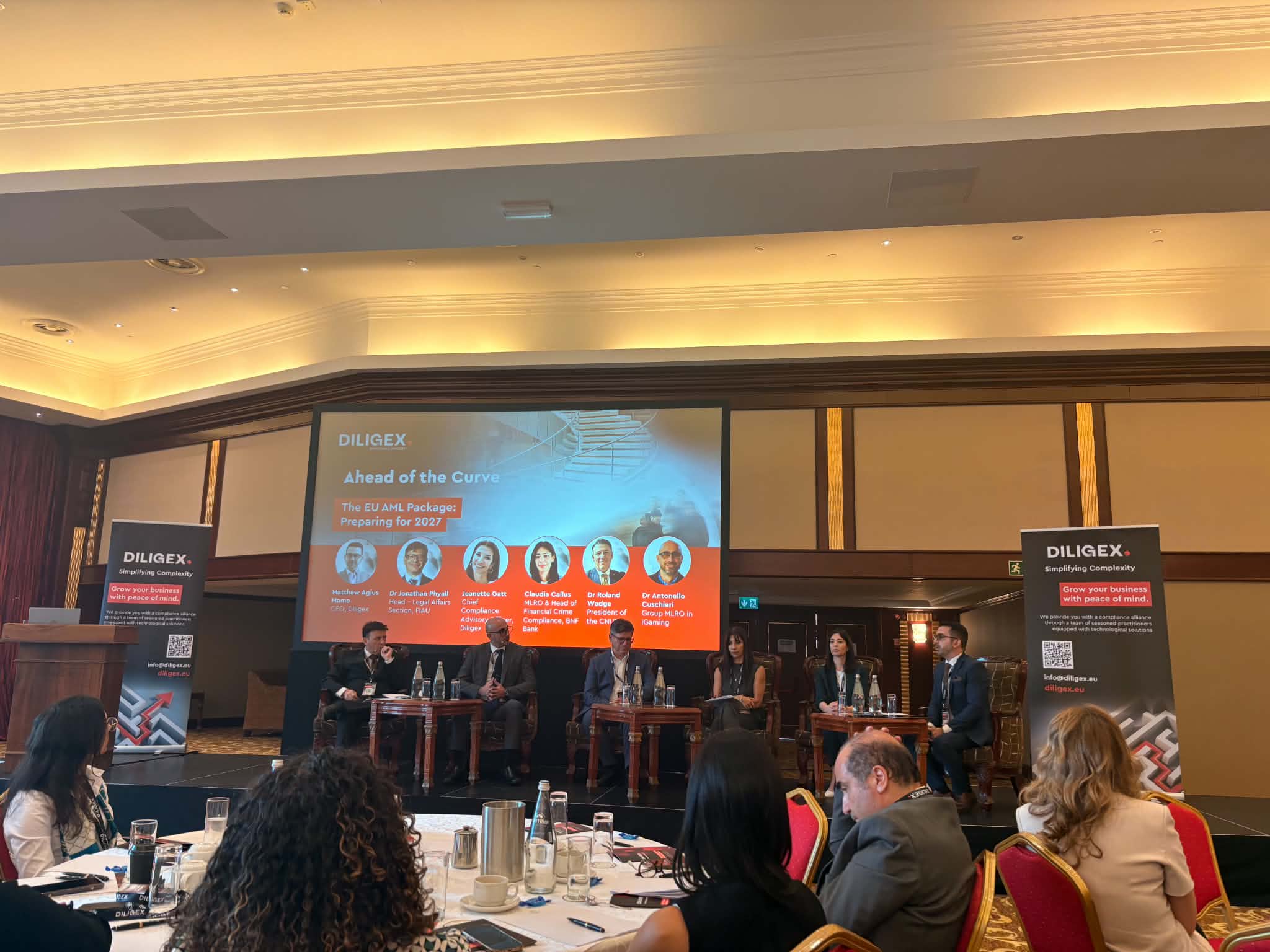
Concerns surrounding digital onboarding, identity verification and the need for clearer regulatory guidance emerged during a panel discussion at Ahead of the Curve, an executive briefing organised by Diligex with the participation of the Financial Intelligence Analysis Unit (FIAU) on Wednesday.
The discussion, titled What This Means for Malta's Operators, brought together representatives from banking, iGaming, legal professions and regulatory authorities to examine the practical implications of the EU's Anti-Money Laundering (AML) Package.
The panel featured Diligex CEO Matthew Agius Mamo, FIAU Head of Legal Affairs Jonathan Phyall, Diligex Chief Compliance Advisory Officer Jeanette Gatt, BNF Bank MLRO and Head of Financial Crime Compliance Claudia Callus, President of the Council of the Notariats of the European Union Dr Roland Wadge, and iGaming Group MLRO Dr Antonello Cuschieri.
The reforms, which will largely become applicable from July 2027, aim to harmonise anti-money laundering requirements across EU Member States. However, the discussion highlighted the difficulties businesses may encounter when translating the new European requirements into their existing compliance procedures.
Digital onboarding presents challenges
One of the central issues raised concerned customer identification and verification, particularly as financial institutions increasingly rely on digital onboarding.
Ms Callus observed that digital onboarding is becoming increasingly popular, reflecting the banking industry's growing reliance on technology to establish customer relationships. However, panellists questioned whether the same verification processes would be appropriate across different banking services and customer profiles.
While a quick and seamless onboarding process may be suitable for retail banking, more complex banking relationships may require alternative approaches.
The discussion also addressed the potential implications for financial institutions that have already invested heavily in digital onboarding systems. Proposed European technical standards have raised questions about whether existing verification methods will remain acceptable under the new framework, potentially requiring institutions to reassess their processes and technology investments. The issue has also attracted attention at European level, with industry stakeholders raising concerns during consultations about the flexibility afforded to businesses when verifying customers remotely.
Smaller operators and certified documents
Another significant issue concerned the continued use of certified identification documents.
Panellists discussed provisions allowing businesses to rely on certified copies of identity documents, such as passports or identity cards, in certain circumstances.
This was considered particularly relevant for smaller obliged entities and company service providers, which may not have access to the same technological infrastructure as major financial institutions.
However, questions remain over how these provisions should be interpreted, including who may certify documents and when alternative verification methods can be used.
The discussion highlighted the importance of maintaining proportionate compliance requirements that do not impose unnecessary administrative burdens on smaller operators.
Remote verification methods, including video-based identification, were also discussed as potential alternatives in circumstances where conventional identification procedures are impractical.
Calls for clearer regulatory guidance
Dr Wadge highlighted the importance of detailed guidance to support the implementation of the new framework, particularly for professional sectors whose activities differ from conventional financial services.
Panellists also discussed the future of Malta's existing AML implementing procedures, which will eventually need to be reviewed and adapted to reflect the directly applicable European regulation.
While the new framework seeks to establish greater consistency across Member States, certain provisions were described as leaving room for interpretation.
These include the circumstances in which additional information should be collected from customers presenting higher money laundering risks. The discussion acknowledged that regulators and industry practitioners may not always agree on how particular requirements should be interpreted.
From an iGaming perspective, Dr Cuschieri raised concerns about the possibility of customers moving away from regulated markets.
He emphasised the importance of verification requirements, with the discussion highlighting the need to ensure that regulatory safeguards remain effective without unnecessarily discouraging participation in licensed markets.
Read more from the conference here.


TCN measures risk ‘mammothing’ the human resource challenge in catering establishment sector – association
Introduction of eco-contribution alone will not ensure influx of quality tourists, ACE says

Minimum cheque payment to rise to €50 from 2027
The Central Bank aims to modernise Malta’s payments landscape
MBB calls for aligned advocacy across Government and industry to secure good EU budget package for Malta
Minister Keith Azzopardi Tanti supported the call for structured collaboration