


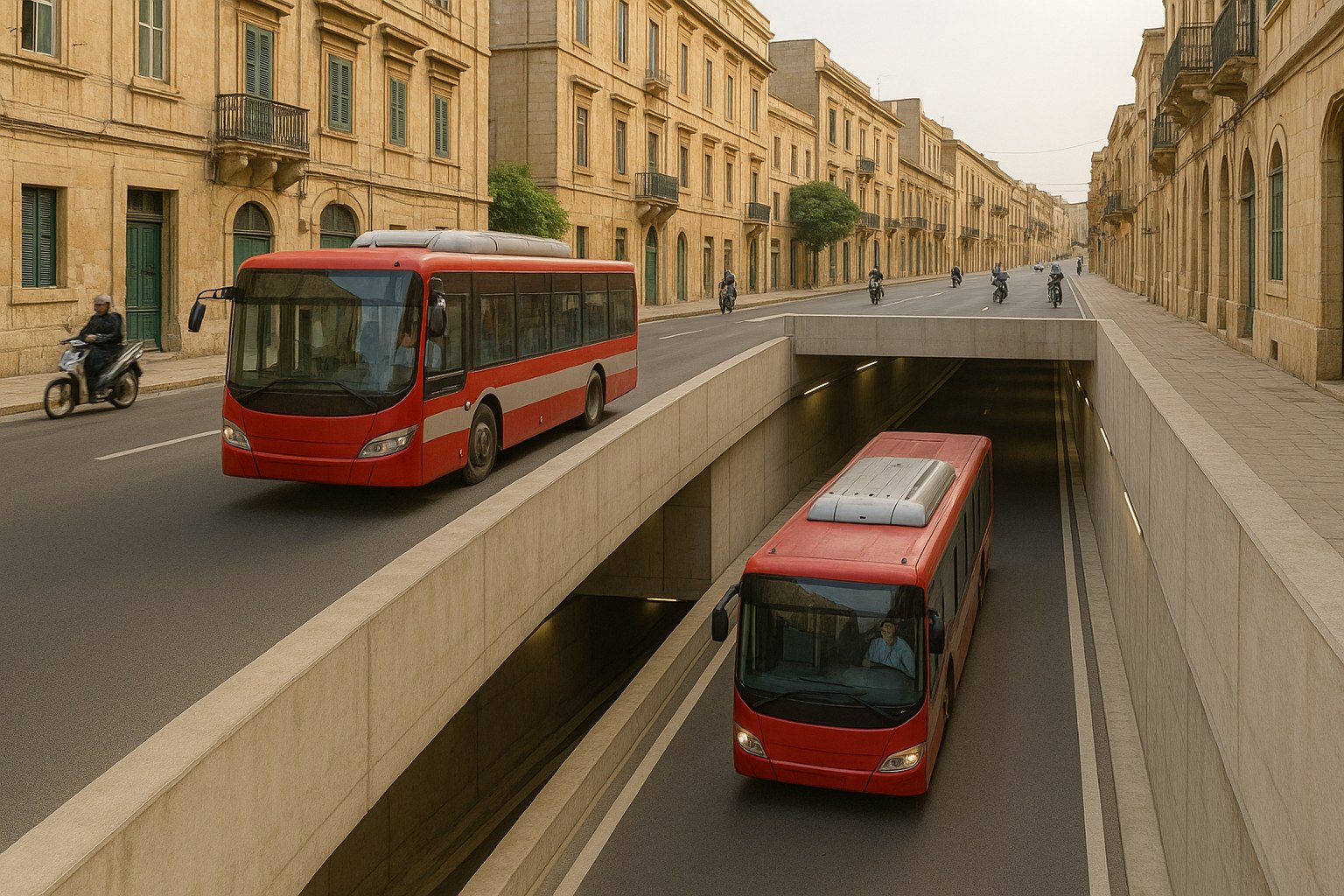
Nick Vella Muskat believes Malta could address several of its most pressing challenges by developing a second layer of infrastructure beneath the island, starting with a €20,000 pilot project.

What if the solution to Malta’s traffic congestion, shrinking open spaces and persistent flooding problems was not to build more infrastructure above ground, but to look beneath it?
This is the thinking behind ‘A Second Malta’, a proposal developed by warranted perit and technology professional Nick Vella Muskat, who is calling for a rethink of how the country uses its limited space.
Speaking to BusinessNow.mt, Mr Vella Muskat outlined his vision for an underground network of dedicated electric bus corridors, commercial facilities, logistics hubs and water storage infrastructure, which could collectively ease pressure on Malta’s increasingly congested surface.
The concept also envisages underground routes that could be prioritised for emergency vehicles, allowing ambulances, fire engines and other essential services to bypass traffic when responding to emergencies.
“I've seen ambulances stuck in Malta's traffic countless times, and giving them a way to bypass congestion could make a real difference when every minute counts,” he said.
Although ambitious, Mr Vella Muskat is not proposing that Malta immediately embark on a large-scale tunnelling project. Instead, he believes the country could begin by investing relatively modest sums in research and mapping to establish whether the concept is worth pursuing.
The idea emerged after he came across Transport Malta's call for innovative solutions to the country's traffic problems one Saturday morning.
“I decided to spend the day working on an idea and prepared my proposal for submission that evening,” he recalled.
He subsequently expanded the concept into what he now calls ‘A Second Malta’.
‘We've become so used to certain problems that we accept them as normal’
For Mr Vella Muskat, Malta's transport challenges cannot be considered in isolation from the country's wider infrastructure problems.
Traffic congestion, continuous construction, groundwater depletion and the disappearance of green spaces are all interconnected, he argued, and addressing them individually risks overlooking opportunities for more comprehensive solutions.
“I think we've become so used to certain problems in Malta that we accept them as normal,” he said.
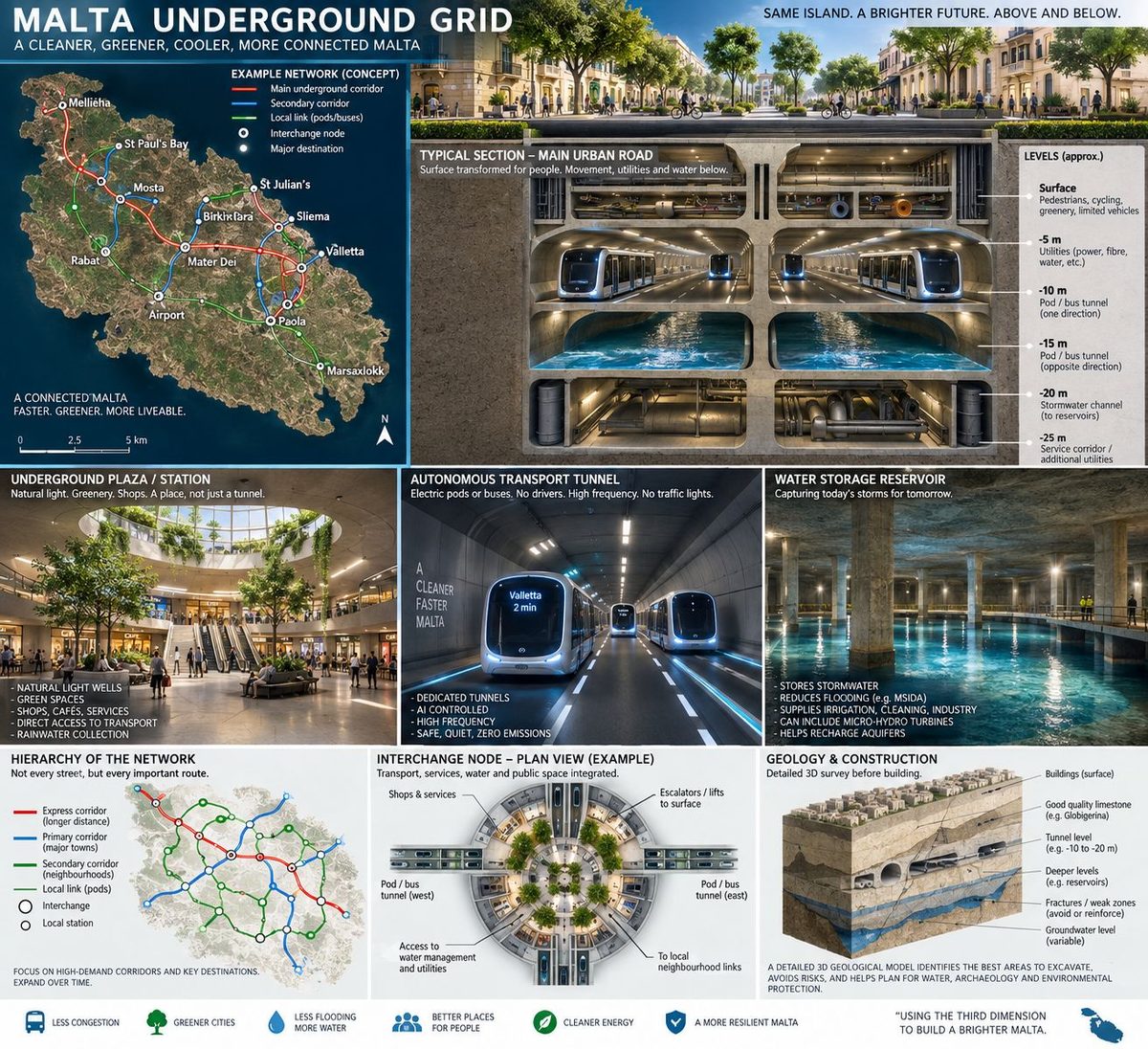
He pointed to Malta's position as the world's second most congested country in TomTom's 2025 index, contrasting this with the island's relatively short geographical distances.
Much of Malta can be crossed in approximately 35 minutes without congestion, he observed, yet journeys regularly take considerably longer because of traffic.
“That’s time we’re losing with family and friends,” he said. Meanwhile, continuous construction activity has brought noise, dust, safety concerns and pressure on residents' quality of life.
Rather than allowing the construction sector to remain primarily focused on above-ground development, Mr Vella Muskat questioned whether its expertise could be channelled into infrastructure projects that deliver broader public benefits.
He also highlighted the apparent contradiction between Malta's recurring flooding problems and its long-standing concerns over groundwater depletion.
At the same time, densely developed localities such as Sliema, Gżira and Msida offer residents increasingly limited access to substantial green spaces.
His proposal seeks to address these challenges through a shared infrastructure strategy rather than separate interventions.
Taking inspiration from Montreal and Singapore
Having lived in Toronto for four years, Mr Vella Muskat said he has long been interested in how cities around the world approach infrastructure and urban planning.
Two cities in particular influenced his proposal: Montreal and Singapore.
Montreal's underground city comprises approximately 32 kilometres of interconnected passages linking shops, restaurants, offices and public transport, providing an example of how underground spaces can support everyday urban activity.
Singapore, meanwhile, has developed extensive underground infrastructure, including rail networks, expressways and storage facilities.
Mr Vella Muskat highlighted the Jurong Rock Caverns, an underground storage development which frees up approximately 60 hectares of surface land.
Beyond the engineering itself, Singapore's approach to public investment also caught his attention.
His vision combines aspects of both models, adapting them to Malta's particular geographical and economic circumstances.
Underground electric buses could offer a more reliable alternative
Central to ‘A Second Malta’ is the development of dedicated underground corridors for electric buses.
Rather than replacing Malta's existing road network, the proposed corridors would allow buses to bypass particularly congested stretches before reconnecting with surface roads closer to their destinations.
Mr Vella Muskat believes reliability, rather than simply reducing journey times, should be the main objective.
“Malta's biggest problem isn't necessarily distance. It's congestion and unreliable public transport,” he explained.
“Personally, I'd probably book a bus an hour ahead if I knew it would arrive on time and I'd have a seat. Instead, people can spend ages waiting in the sun, only for the bus to arrive full.”
He suggested that existing GPS technology, live traffic information and artificial intelligence could be used to improve scheduling, predict arrivals more accurately and potentially introduce seat reservation systems.
These technological improvements, combined with dedicated routes that are less exposed to surface congestion, could make public transport a more attractive alternative to private vehicles.
“It's not about getting everywhere in 10 minutes. It's about having public transport you can rely on,” he said.
Importantly, the corridors could also serve emergency services.
Ambulances, doctors, nurses and fire engines could potentially be given priority access, reducing the risk of emergency response vehicles becoming trapped in traffic.
Such arrangements would require detailed operational and safety assessments, but Mr Vella Muskat believes the potential benefits warrant investigation.
Could Malta's underground become a source of public revenue?
Mr Vella Muskat envisages the corridors connecting larger underground facilities in suitable locations, including commercial premises, logistics centres and water collection infrastructure.
Shops, restaurants and other services could operate below ground, while storage and distribution facilities could reduce demand for valuable surface land.
Rainwater collection and storage infrastructure could also help manage flooding and potentially reduce pressure on other water resources.
Moving suitable parking, storage and other facilities underground could, in turn, create opportunities to introduce more parks, trees and public spaces above ground.
However, one of the more significant economic aspects of the proposal concerns ownership.
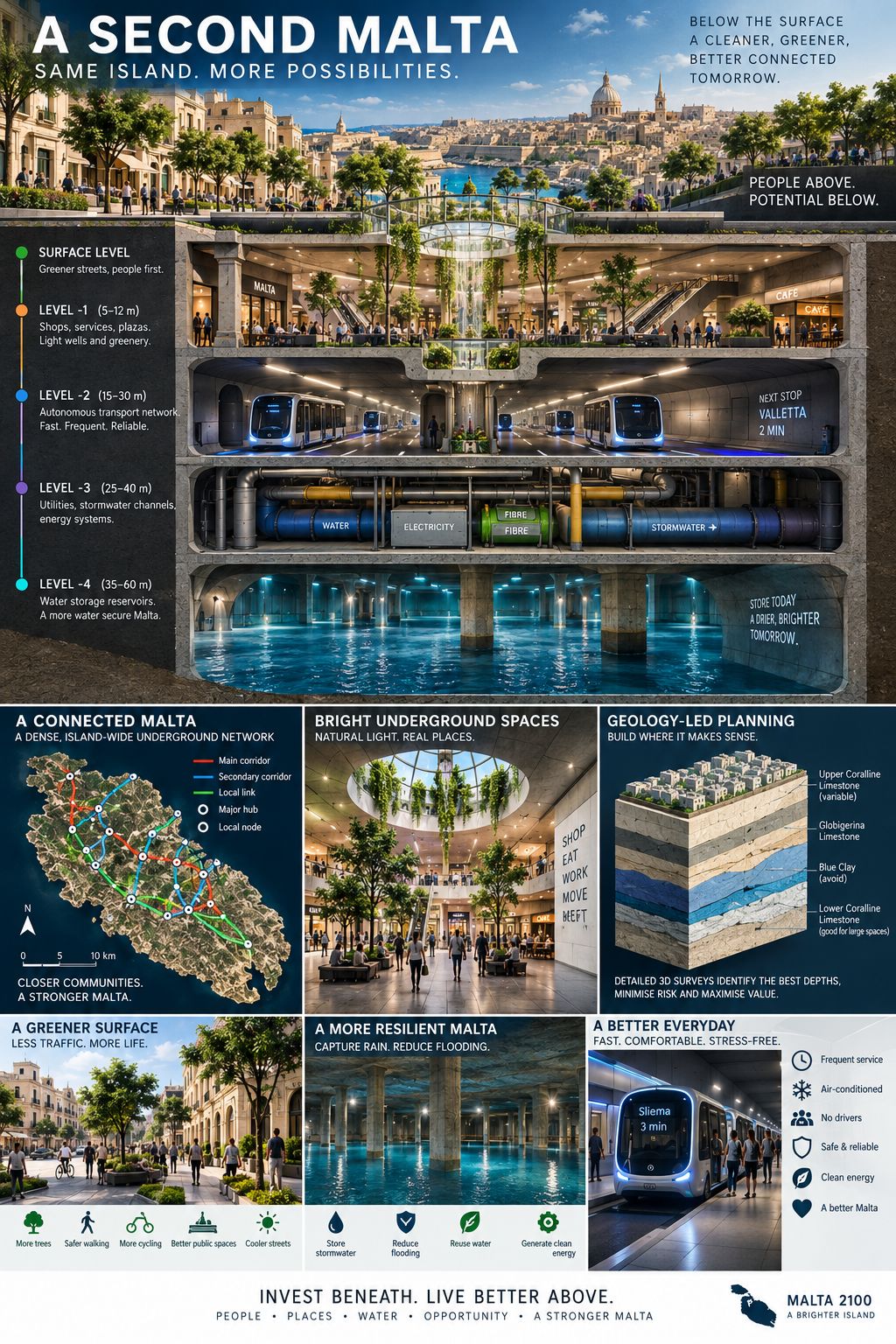
Mr Vella Muskat suggested that some underground commercial and logistics facilities could remain publicly owned and be leased to private operators.
“One of my biggest inspirations is Singapore's approach to public finances. Rather than looking only at government debt and spending, it also invests in assets that generate income and can grow in value over time,” he explained.
“I'd like Malta to adopt more of that thinking.” Under such a model, public investment in underground infrastructure could potentially create long-term revenue-generating assets rather than facilities that only incur maintenance and operating costs.
“Underground commercial and logistics facilities could potentially generate rental income while remaining public assets,” he said.
“The construction costs and any borrowing would still need to be justified, but we'd be creating something the country owns, rather than only adding an expense. Over 30 or 50 years, that could make a significant difference.”
Nevertheless, the commercial viability of such facilities, their construction costs and their potential financial returns would need to be established through detailed studies.
Starting small: A €20,000 pilot project
The authority's call offered funding of up to €20,000, prompting him to design a pilot project that could be carried out over approximately 12 to 16 weeks. Rather than attempting to construct tunnels, the pilot would focus on investigating a single congested road corridor and developing a preliminary understanding of the underground conditions.
The process would begin by collecting existing utility plans, geological information and historical excavation records.
Ground-penetrating radar and LiDAR technology would then be used for initial mapping, with the findings combined into an interactive three-dimensional model.
Engineering and archaeological specialists would subsequently assess potential constraints and determine whether more extensive investigations would be worthwhile.
“Malta has spent decades excavating roads and installing infrastructure. We already have utility plans, excavation records and geological information that could provide a starting point,” he explained.
He stressed that such preliminary work would not establish whether deep underground tunnels are technically or financially feasible.
Instead, the objective would be to identify possible opportunities, understand potential risks and determine where further geological, environmental and financial studies might be justified.
Mr Vella Muskat, who previously worked on a project involving tunnel-boring technology in Ħal Far, said he had witnessed the capabilities of local contractors first-hand.
His more recent experience in software, technology and product development also influenced his approach.
Rather than committing substantial public funds from the outset, he favours testing the concept incrementally, assessing the evidence and making further investment decisions accordingly.
“Even a negative result would be useful,” he said. “We'd identify constraints early, before committing to expensive engineering work.”
If successful, the mapping exercise could eventually be repeated across other corridors, gradually creating a more comprehensive picture of Malta's underground infrastructure.
Mr Vella Muskat tells us that he submitted his proposal to Transport Malta and followed up on three occasions, but received no feedback. The lack of a response has not discouraged him from sharing the wider vision publicly or seeking collaboration with other professionals, though.
“If I could put this idea together in a single day, what could the right team of professionals achieve in a year?” he questions.
AX Group calls for destination hubs as part of tourism strategy shift in Budget recommendations
Development of a national employment and skills strategy, investment in infrastructure, tourism strategy shift are its top priorities
‘Our objective should not simply be to build more, but to build better’ – MDA President
The MDA welcomed the Prime Minister's 'commitment to supporting the construction and property development sector'
Malta’s traffic congestion takes toll on tourist experience and investor impressions
Malta’s traffic congestion is putting pressure on tourist guides, frustrating visitors and leaving a negative impression on potential foreign investors