



The bond markets across the euro area remained particularly volatile in recent weeks as the ongoing developments in the Middle East are leading to wild swings in the oil price which directly feeds into inflation expectations.
Fixed income (bonds) as an asset class is generally regarded as one that is ideal for cautious investors in view of the low risk nature of a bond instrument. However, the persistent volatility in yields, and naturally in bond prices, may be concerning for many Maltese retail investors. This is particularly important given the current issuance of a maximum of €500 million in Malta Government Stock issues.
Oil price and bond yields
The instability across the energy sector which impacts inflation expectations is leading to consistent volatility in sovereign bond yields.
The price of oil, measured via Brent crude, jumped from around USD70 before the intense geopolitical tensions and outbreaks of war in the Middle East to above USD110 per barrel in April as hostilities intensified, culminating in the closure of the Strait of Hormuz. On the news of the agreed ceasefire between the US and Iran, Brent retreated back towards the mid-USD70’s but this has proved short-lived. A renewed exchange of strikes in recent days, and warnings of a wider confrontation, sent the oil price back up towards one-month highs of above USD90 a barrel. The price of Brent crude remains highly sensitive to daily developments around the Strait of Hormuz.
Germany’s 10-year Bund yield, which is considered as the risk-free benchmark for the euro area, climbed from roughly 2.65 per cent before the start of the conflict to around 3.10 per cent by late March. After easing back towards the 2.85 per cent level for a brief period during the ceasefire, the 10-year yield jumped back up to 3.15 per cent (its highest since 20 May) in recent days.
Throughout this period, the European Central Bank (ECB) has, as the market anticipated, delivered its first interest rate increase in over two years in mid-June as it hiked its deposit rate by 25 basis points to 2.25 per cent. ECB policymakers had been signaling that the upside risks to inflation from the energy shocks were serious enough to warrant action even at the cost of near-term growth.
The latest inflation data across the euro area published last week shows that headline inflation eased to 2.8 per cent in the year to June, down from 3.2 per cent in May and below the 3.0 per cent expected. Core inflation fell back to 2.4 per cent, and second-quarter inflation averaged 3.0 per cent against the ECB’s forecast of 3.2 per cent, reflecting the lower energy prices during the short ceasefire. Although the lower inflation reading is welcome news, the improvement was clearly driven by the energy component that has since turned higher again in view of the renewed escalation in the Middle East.
The ECB’s monetary policy meeting is taking place this week at the time of the planned MGS issuance with natural implications on the pricing dynamics by institutional investors. Traders across the international fixed-income markets are again adjusting to a “higher-for-longer” inflationary environment due to the persistent geopolitical conflict involving the US and Iran.
Movements in the MGS market
The daily indicative MGS bid prices quoted by the Central Bank of Malta mirror closely the movements across the eurozone benchmarks. MGS yields have therefore been very volatile as the 10-year yield rose from 3.53 per cent in late February to above 4.05 per cent by the end of March. It had then drifted towards 3.70 per cent at the time of the ceasefire and currently hovers around 4.00 per cent.
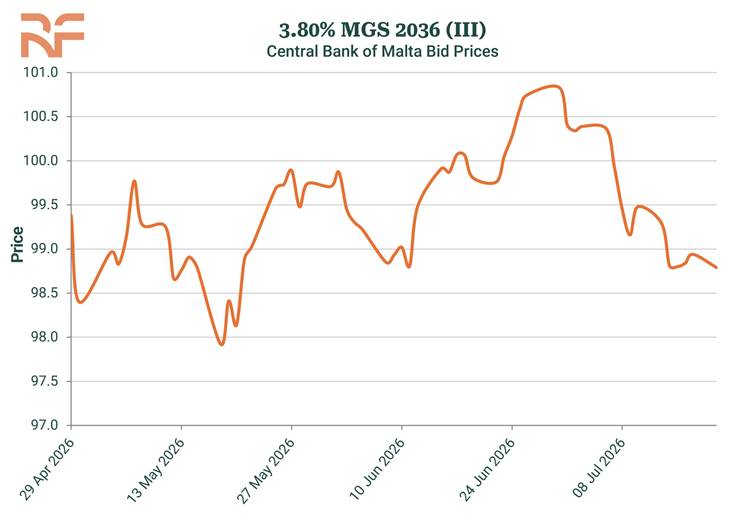
This is reflected in the indicative price of the 3.80 per cent MGS 2036 (III) which was issued earlier this year. The price had dropped to a low of 97.92 per cent in mid-May compared to the fixed offer price to retail investors of 100 per cent par value. It had then completely recovered to 100.83 per cent at the end of June before dropping back to below 99 per cent earlier this week.
A new 20-year MGS
The issuance of a 20-year bond is an important feature of the new offering. Apart from the 20-year bonds with a coupon of 4.25 per cent, there will also be another 10-year issue again at 3.8 per cent.
Although the Treasury Department issued 20-year bonds before and the longest dated bond is currently 26 years (maturing in 2052), the ability of the Treasury to place these 20-year bonds in this environment will provide important pointers of the structural shifts taking place across the MGS market as I highlighted in one of my article in April. The results of the last MGS issuance earlier this year clearly demonstrated that the appetite for long-dated Maltese sovereign bonds (beyond 10 years) is increasingly contingent on international institutional demand. European credit institutions were allotted €228 million in the MGS issue in April, representing 78.6 per cent of the competitive auction and circa 46 per cent of the entire issue of just under €500 million.
Meanwhile, for Maltese retail investors who generally focus on the coupon being offered (in this case it is 4.25 per cent) rather than the term to maturity, these long-dated bonds carry increased price risks that warrant attention. A 20-year bond price has substantially greater interest rate sensitivity, which is particularly important for investors who may need to sell their holding before maturity. These investors would be exposing themselves to meaningful capital risk should yields be higher than current levels when they would need to dispose. Movements in MGS prices in recent years provide ample evidence to investors on the volatility in prices. As interest rates jumped sharply in 2022 and 2023, the prices of all MGS’s declined with the largest movements across the long-dated bonds. Likewise, as interest rates decline, long-term bond prices rise.
On the other hand, for those investors whose purely intend to collect annual coupons and receive par at maturity (so called ‘buy-and-hold’ investors), this 20-year MGS with an interest rate of 4.25 per cent is the highest yielding sovereign offering in three years and should attract a number of retail persons who continue to invariable maintain far too much idle liquidity across the banking system which is not generating any sort of returns.
Any investor considering these new MGS offerings need to first determine their possible investment horizon since this matters a great deal. Matching the maturity of a bond to one’s actual investment horizon – and laddering across maturities rather than reaching for the longest bond simply because it offers the highest yield – is a very important factor that investors need to contemplate when deliberating these MGS issues and also others in the near term as the Treasury requires record issuance in excess of €1.9 billion this year.
The article contains public information only and is published solely for informational purposes. It should not be construed as a solicitation or an offer to buy or sell any securities or related financial instruments. No representation or warranty, either expressed or implied, is provided in relation to the accuracy, completeness or reliability of the information contained herein, nor is it intended to be a complete statement or summary of the securities, markets or developments referred to in this article. Rizzo, Farrugia & Co. (Stockbrokers) Ltd (“Rizzo Farrugia”) is under no obligation to update or keep current the information contained herein. Since the buying and selling of securities by any person is dependent on that person’s financial situation and an assessment of the suitability and appropriateness of the proposed transaction, no person should act upon any recommendation in this article without first obtaining investment advice. Rizzo Farrugia, its directors, the author of this article, other employees or clients may have or have had interests in the securities referred to herein and may at any time make purchases and/or sales in them as principal or agent. Furthermore, Rizzo Farrugia may have or have had a relationship with or may provide or has provided other services of a corporate nature to companies herein mentioned. Stock markets are volatile and subject to fluctuations which cannot be reasonably foreseen. Past performance is not necessarily indicative of future results. Foreign currency rates of exchange may adversely affect the value, price or income of any security mentioned in this article. Neither Rizzo Farrugia, nor any of its directors or employees accepts any liability for any loss or damage arising out of the use of all or any part of this article.

Extending the reach of the Maltese equity market
'The privatisation of the MSE could be a major focal point of the MSE internationalisation strategy'

State of the Nation: Growth pains, not dying pains
Why Malta’s tourism success demands smart management, not panicked rhetoric
Highlights from interim reporting season
The MSE Equity Total Return Index reached a new all-time high this week, writes Edward Rizzo