


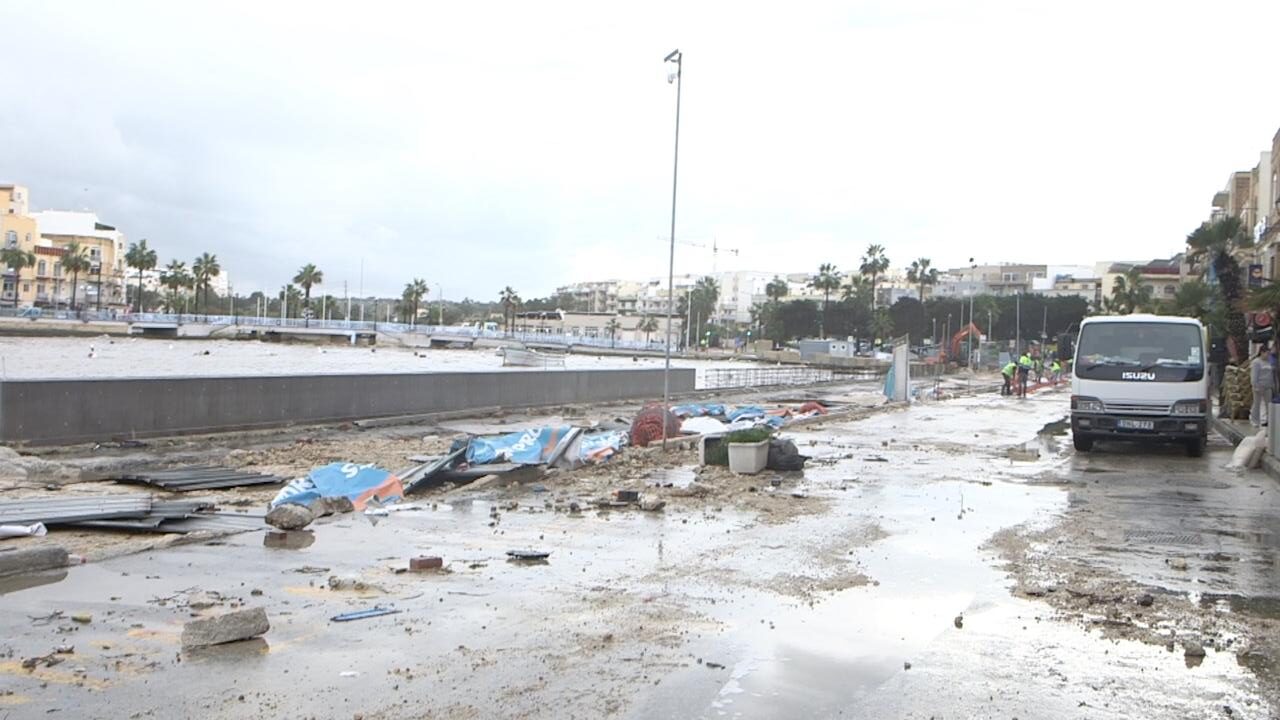
Businesses hit by sudden disasters, like Storm Harry, may soon be able to rebuild faster – but only if they stick strictly to what was there before.
The Planning Authority (PA) has launched a two-week public consultation on a proposed amendment to the Development Notification Order (DNO), introducing a new “Class 25” that would allow the reconstruction of buildings damaged or destroyed by unforeseen incidents without going through the full development permit process.
At first glance, the reform appears to offer long-awaited clarity for property owners and operators facing abrupt losses due to events such as natural hazards or other external causes beyond their control.
Under the proposed Class 25, reconstruction would be permitted only if the building is restored to its identical external envelope – meaning the same footprint, height and gross external volume – and retains the same use it had prior to the incident.
There will be no scope for extensions, additional floors, basements, unit subdivision, change of use or any intensification of development. In other words, a damaged property can be reinstated – but not upgraded or expanded under the guise of emergency works.
Further clarifying Class 25, the PA says that this is intended to “provide a clear and controlled process allowing such buildings to be reconstructed exactly as they were prior to the incident, meaning:
- The same footprint
- The same height
- The same volume
- The same use
The draft Legal Notice defines an “incident” as a sudden, unforeseen event arising from a natural hazard or other external cause that is not attributable, directly or indirectly, to any act or omission of the applicant, owner or occupier.
Crucially, it explicitly excludes gradual deterioration, lack of maintenance, structural failure arising from defects that should reasonably have been addressed, unauthorised works, or deliberate or reckless acts.
That distinction is likely to prove decisive for businesses hoping to rely on the new class.
Strict safeguards and evidentiary burden
The Authority is building in several safeguards. Applicants will be required to submit a perit’s report confirming that the damage was caused by the stated incident, that it was not materially contributed to by neglect or unauthorised works, and that the proposed reconstruction reinstates the pre-incident external envelope and use.
They must also provide a measured survey of the remains and reliable evidence of the lawful pre-incident situation – such as dated photographs, photogrammetry or compliance certificate drawings – together with a police report.
For sites within Urban Conservation Areas, scheduled properties, scheduled building settings, Outside Development Zone locations or areas protected under environmental legislation, a works or restoration method statement will also be required. The Planning Authority may consult the Superintendence of Cultural Heritage or the Environment and Resources Authority where appropriate.
Moreover, the Authority retains broad discretion. It says it may refuse to accept a notification where it is not satisfied that the incident was sudden and beyond the applicant’s control, and may request independent structural or forensic reports if doubts remain . The order makes it clear that, for the avoidance of doubt, the Authority’s opinion shall prevail.
The proposed class will apply only to buildings that were legally established and not subject to an active enforcement notice immediately prior to the incident.
That condition is significant in Malta’s planning landscape, where enforcement and historic irregularities remain an ongoing concern. The new mechanism is therefore not intended as a route to regularise problematic structures after a collapse or demolition.
The Authority states that the reform aims to provide a clear framework for restoring legally established buildings that experience sudden damage, while ensuring that no new development rights are created in the process. It describes the consultation as part of a broader effort to balance efficiency with safeguards and prevent misuse.
If adopted, notifications under Class 25 would need to be submitted strictly within three months from the date of the incident.
For businesses operating from commercial premises – particularly in sectors vulnerable to storm damage or other sudden events – the proposal could offer a faster path to reinstatement. But the PA is clear about the fact that this is about restoring what was lawfully there, nothing more.
Stakeholders have until Wednesday, 4th March 2026 to submit feedback as part of the public consultation process.

Residential property sales jump by 16.8% in February
Over €352 million in property changed hands during the month

Malta airport launches summer schedule, including New York route
Delta will operate three weekly flights between Malta and New York between June and October

The Remarkable Collective welcomes collaboration with NOUV, completing end-to-end business services portfolio
The addition directly addresses the sophisticated needs of today’s businesses