


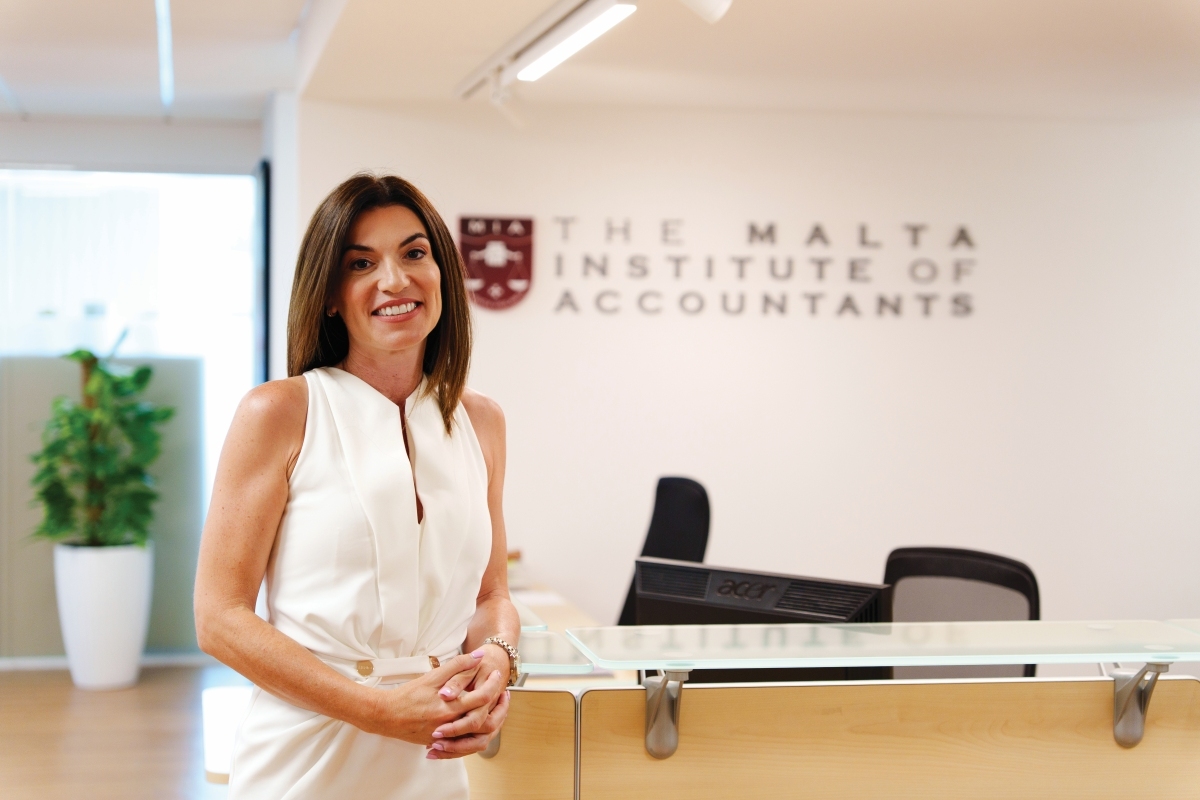
In a fast-moving world where digital innovation, global tax developments and climate change are rewriting the rules of business, accountancy professionals have become key players in economic resilience. In Malta, the Malta Institute of Accountants (MIA) is at the forefront of this shift, evolving from a guardian of professional standards into a driving force of national competitiveness.
At the helm is Maria Cauchi Delia, its Chief Executive Officer, who describes accountants as “the bedrock of trust in Malta’s economy”.
For the CEO, the institute’s mission is clear: “Our role is not only to support accountants, but to help strengthen the very foundations of Malta’s competitiveness.”
The institute’s remit is deliberately broad, covering technical guidance, professional education, ethical standards, and national and EU-level policy input. Rather than viewing these as separate responsibilities, Ms Cauchi Delia insists they must be fully integrated.
“Everything we deliver must be practical, relevant and forward-looking,” she says, noting how EU-level policy trends inform technical guidance while training programmes combine market realities with ethical imperatives. This integration, she explains, ensures that value creation ties all the institute’s functions together.
Collaboration is a cornerstone of the MIA’s work. Its partnerships and ongoing exchanges with the Malta Financial Services Authority, the Financial Intelligence Analysis Unit, the Malta Business Registry, the Malta Tax and Customs Administration, Malta Enterprise, the Malta Gaming Authority, and other authorities ensure that Malta’s business environment remains robust yet workable.
“Our feedback helps shape policies to be locally and internationally aligned while proportionate for smaller jurisdictions like Malta,” she explains, adding, “by serving as a bridge between authorities and our members, we ensure that regulation is not just technically sound, but also practical for businesses.”

The CEO is adamant that competitiveness must be treated as a national priority, stating that it is a theme the institute pushed strongly at its 2025 Biennial Conference and again through the proposals put forward for Budget 2026.
“True progress requires regulators, Government, business and education to work together. Malta cannot afford fragmented policymaking or slow implementation if it is to keep pace with global change,” she warns.
Over the past few years, the institute has significantly strengthened its international role. “It is imperative that we have comprehensive visibility of global developments to enable us to undertake the necessary discussions locally, provide our input at European and international fora, and adapt effectively,” Ms Cauchi Delia explains, noting, “this gives us the ability not only to react, but in some cases to secure a first-mover advantage.”
This proactive stance is particularly important as Malta faces sweeping reforms in sustainability and taxation. The EU’s Corporate Sustainability Reporting Directive and the European Sustainability Reporting Standards will elevate sustainability disclosures to the same level as financial statements, pushing companies to embed environmental, social and governance considerations into their operations.
For Malta, with its SME-dominated economy, this presents both risk and opportunity. “We are guiding our members and working closely with local authorities to ensure that implementation is practical and proportionate,” Ms Cauchi Delia says.
“Our priority is to make sustainability a strategic pillar, not just a compliance exercise.”
On taxation, the stakes are equally high. Malta’s open, service-based economy is sensitive to global changes, from Pillar II reforms to developments in key trading partners like the United States. Here, too, the MIA has stepped in with technical expertise and a holistic perspective.
“Our role is to provide guidance that is not only technically sound, but strategically coherent, aligned with broader priorities like investment, digitalisation and sustainable growth,” she explains. Through evidence-based feedback, conferences and working groups, the institute is preparing members for both the technical and strategic implications of change.
The MIA’s work in these areas builds on the lessons of Malta’s greylisting, which its CEO describes as a turning point, even for the institute. “That period demonstrated that the institute is not only a professional body, but a guardian of economic stability,” she reflects, adding, “we continue to apply that same spirit of vigilance and proactivity to the reforms that lie ahead.”
Yet, while regulation is vital, competitiveness ultimately depends on people. “The boldest and most necessary step is to invest decisively in talent. Without a skilled and adaptable workforce, Malta will not be able to sustain competitiveness in an era of global change,” she warns.
For the institute, this has meant expanding professional development to equip accountants with future-facing skills in AI, digital finance, sustainability, and ethical leadership. Its Continuous Professional Education portfolio and conferences have been redesigned to embed adaptability, resilience and strategic thinking. The message is clear: Malta’s accountants must be future-ready.
At the same time, the institute is challenging outdated stereotypes to attract new generations to the profession. Its #AccountsForYou campaign, rolled out in schools, career fairs and on social media, seeks to reframe accountancy as a dynamic, impactful career. Partnerships with ACCA, University of Malta, MCAST, and other educational institutions ensure education stays relevant to industry demand, but Ms Cauchi Delia stresses that retention is just as important as attraction.
“We need to showcase Malta not only as a place of professional opportunity, but also as a place where people can build their lives,” she says. That means better incentives, competitive compensation, clear career progression, and quality of life advantages. It also requires removing administrative bottlenecks and improving integration of foreign professionals.
“This challenge demands systemic change, and we are determined to keep it front and centre of the national debate. Administrative bottlenecks must be removed, foreign talent must be better integrated, and local education must remain world-class and adapted to evolving needs. This requires coordinated action at policy and industry levels,” she maintains.
The institute has also carried out a professional engagement survey to better understand the realities facing members. Ms Cauchi Delia explains that to a large extent, “the findings confirmed what the institute had already been hearing and experiencing first hand, but the detailed data allows us to move beyond anecdotal feedback.”
As the role of accountants evolves, so too does their influence. Increasingly, professionals are moving into strategic positions, whether as CFOs, COOs, CEOs or as advisors on risk, ESG and digital transformation. The MIA is equipping its members to embrace this shift.
“Accountants bring the ability to analyse and interpret data, manage risk, understand governance, and provide assurance – all qualities that organisations need to thrive in uncertain times,” she notes. Their presence is particularly vital in emerging niches like ESG finance, digital services and family offices. “Without the profession, Malta cannot credibly compete in these sectors,” the CEO affirms.
Looking ahead, Ms Cauchi Delia is optimistic about what the institute can achieve.
“We want to see a stronger investment in talent, seamless integration of sustainability and digital skills, and greater influence on both national and EU policy,” she says.
The challenges are significant, from responding proactively to fast-changing tax reforms to keeping pace with technology. Yet she is confident that the institute’s proactive and collaborative approach will ensure success.
“Ultimately, our work matters because it underpins the credibility of Malta’s business environment and sits at the heart of the country’s economic ambitions,” she concludes. “When the profession is strong, businesses thrive, investors trust the jurisdiction and the wider economy benefits.”
This interview was first carried in the 2026 edition of Business Now Magazine, the sister brand to BusinessNow.mt and produced by Content House Group.
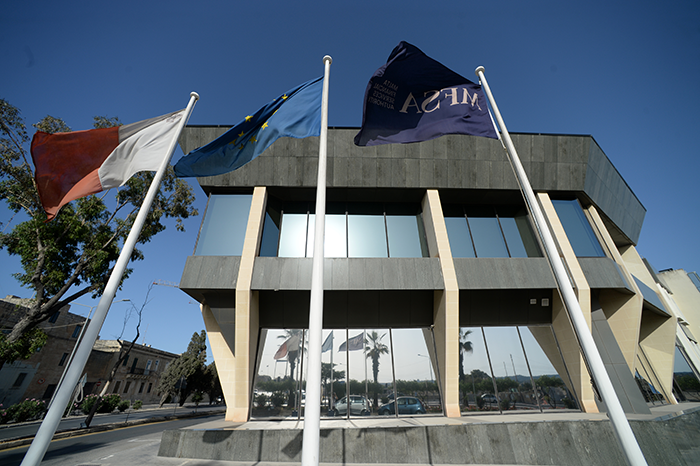
MFSA to ‘step up’ supervision of AI in financial services
Regulatory strategy is no longer just a compliance function
Teva Malta defends pay offer as GWU orders industrial action at Bulebel plant
The union said the decision to commence industrial action 'was not taken lightly,' but followed months of unsuccessful negotiations

MHRA backs proposal for on-the-spot fines targeting short-term visitors
'Malta is welcoming, but respect for its laws and residents is non-negotiable'