


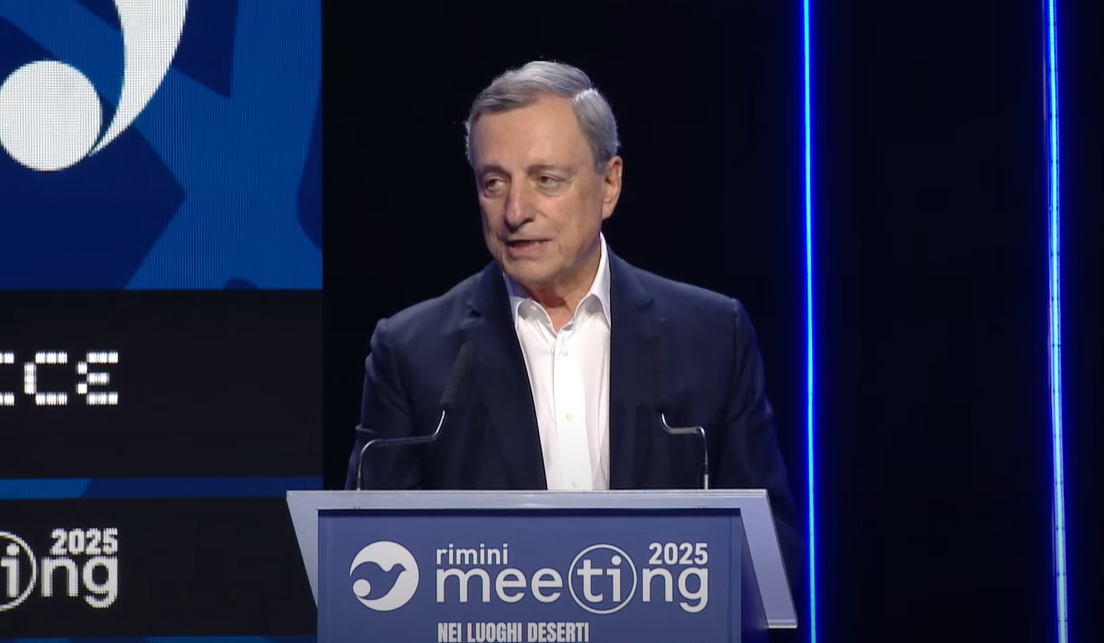
Mario Draghi doesn’t speak often; but when he does, we should all listen.
At this year’s Rimini Meeting, Mr Draghi, former European Central Bank President and former Italian Prime Minister, delivered what may well be one of the most important political-economic speeches of our time. His message was clear and uncomfortable: 2025 will be remembered as the year the illusion of Europe’s geopolitical relevance evaporated.
He’s right.
Despite being home to 450 million people and one of the largest economies in the world, the European Union today plays a marginal role in shaping global events. It was sidelined in peace talks on Ukraine, reactive during escalations in the Middle East, and alarmingly dependent on third countries for energy, defence, and critical raw materials.
We are witnessing the slow fading of Europe’s global influence, not because our values are wrong, but because we no longer have the collective capacity to defend them.
Not a crisis of values, but of action
Mr Draghi made a critical distinction: European citizens are not disillusioned with the principles of the EU – freedom, democracy, peace – but with our inability to act on them.
The world has changed. Great power politics are back. Trade is now a weapon. Industrial policy is strategic. And yet, Europe still behaves as if consensus-building and regulatory power are enough.
They are not.
While the US moves fast on industrial investment and security, and China consolidates global influence through infrastructure, energy and data, Europe is stuck in committee rooms and national silos. We have the ambition of a superpower and the agility of a museum.
Draghi’s call to action
Mario Draghi’s speech was not just diagnosis, it was a call for deep structural transformation. The EU, he argued, must take bold steps or risk irrelevance. That starts with abandoning the illusion that individual member states can tackle today’s challenges alone.
What’s needed is a re-foundation of Europe’s governance and financial architecture.
1. A common fiscal engine
To fund defence, digital infrastructure, energy transition and innovation at scale, Europe needs joint borrowing and a shared investment framework. The post-COVID recovery fund was a step forward but now it must become permanent.
2. A real capital markets union
Our fragmented financial markets are holding back investment in European innovation and climate leadership. Capital needs to flow seamlessly across borders. Entrepreneurs should not be limited by geography when scaling globally.
3. Strategic autonomy in key sectors
Europe must secure its access to energy, critical minerals, AI, defence systems and biotechnology. This means investing in resilient supply chains, reshoring strategically important industries, and reducing dependence on geopolitical rivals.
4. Faster decision-making
The current unanimity requirement on major issues, from foreign policy to taxation, is a recipe for paralysis. Europe must move toward qualified majority voting in strategic areas or risk being permanently stuck.
5. A leadership narrative
Europe needs leaders who speak the language of power, not just principle. We must reframe the European project not as a passive peace project, but as an active force for shaping the world order. Without that ambition, we will continue to drift.
A narrow window
The good news? The window for reinvention is still open. But it is narrow and shrinking.
Mr Draghi has lit the signal fire. The next European Commission must be defined not by technocratic continuity, but by bold reform. If Europe is to matter on the world stage in 2030 and beyond, the work must begin now.
This is not about choosing between ideals and power. It’s about understanding that without power, ideals go undefended.
Europe has everything it needs; talent, capital, credibility, innovation. But unless we learn to act like a geopolitical actor, we will remain a fragmented continent watching history unfold from the sidelines.
The EU doesn’t need to be dismantled. It needs to be reborn.
BOV’s balance sheet surpasses €16.5 billion
BOV reported stronger-than-expected profitability for 2025

Will the ‘magnificent seven’ become the ‘peace makers’ between the USA and Iran?
Financial markets have always had a seat at the table in wartime
Maltese MEPs hail EU anti-corruption law as milestone for business transparency
EU countries will now be required to align their national legal frameworks