



Malta’s agricultural sector registered steady growth in 2024, with output and profitability indicators showing improvement despite cost pressures and weaker crop yields, according to new data published by the National Statistics Office (NSO).
The total output value of local agricultural produce reached €140.7 million, marking a 1.6 per cent increase over 2023. At the same time, intermediate consumption by agricultural holdings rose only marginally – up 0.2 per cent to €87.1 million – helping to lift the sector’s gross value added by 4.1 per cent to €53.6 million.
Other financial indicators also point to resilience. Farmers’ use of fixed capital inputs increased by 1.4 per cent to €7.2 million, while wages paid by agricultural holdings saw a notable jump of 29.7 per cent, totalling €8.6 million.
Support from Government and EU programmes remained a crucial buffer for the sector, with direct assistance rising by 10.1 per cent to €25.8 million in 2024.
This financial backing contributed to a 3.9 per cent increase in the sector’s net operating surplus, which reached €63.6 million. After factoring in negative net property income of €1.0 million, net entrepreneurial income was estimated at €62.6 million, up 4.0 per cent year-on-year.
Livestock leads, crops decline
The growth in output was largely fuelled by stronger performance in livestock products (+6.1 per cent), sales from secondary activities (+4.5 per cent), and animal product sales (+2.8 per cent).
However, this was partly offset by a 2.6 per cent decline in crop production, underlining the sector’s ongoing structural challenges in crop cultivation.
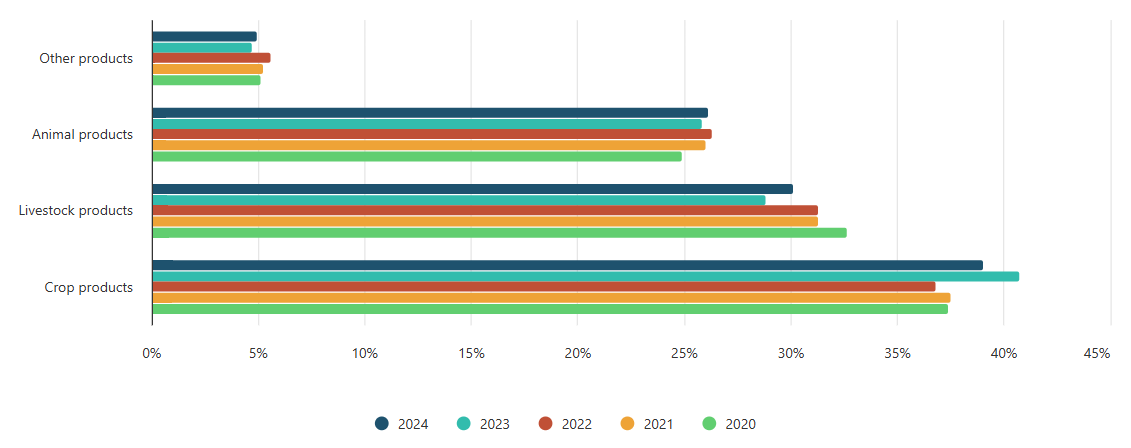
On the cost side, agricultural holdings reported higher outlays on other expenses (+3.2 per cent) and energy and fuel (+0.8 per cent). These increases were cushioned by lower spending on crop cultivation (-5.1 per cent) and livestock feeding (-0.5 per cent).
Policy implications
The figures highlight how Malta’s agricultural sector continues to rely heavily on external support and remains vulnerable to fluctuations in crop yields and input costs. The stronger performance in livestock and EU-backed funding programmes helped secure income growth in 2024, but persistent challenges in crop production may require further structural investment and innovation.


German court clears use of breached MGA documents in reporting, Lilith Wittmann says
The MGA has previously rejected the suggestion that its legal measures were intended to silence or intimidate her

Enemalta advances plans for new Malta-Gozo interconnector
This follows a €45 million general election pledge for a Malta-Gozo high-voltage link
MDIA to assess potential for new research and innovation network in Gozo
Research is intended to provide an assessment of how a future research and innovation ecosystem in Gozo could be structured