


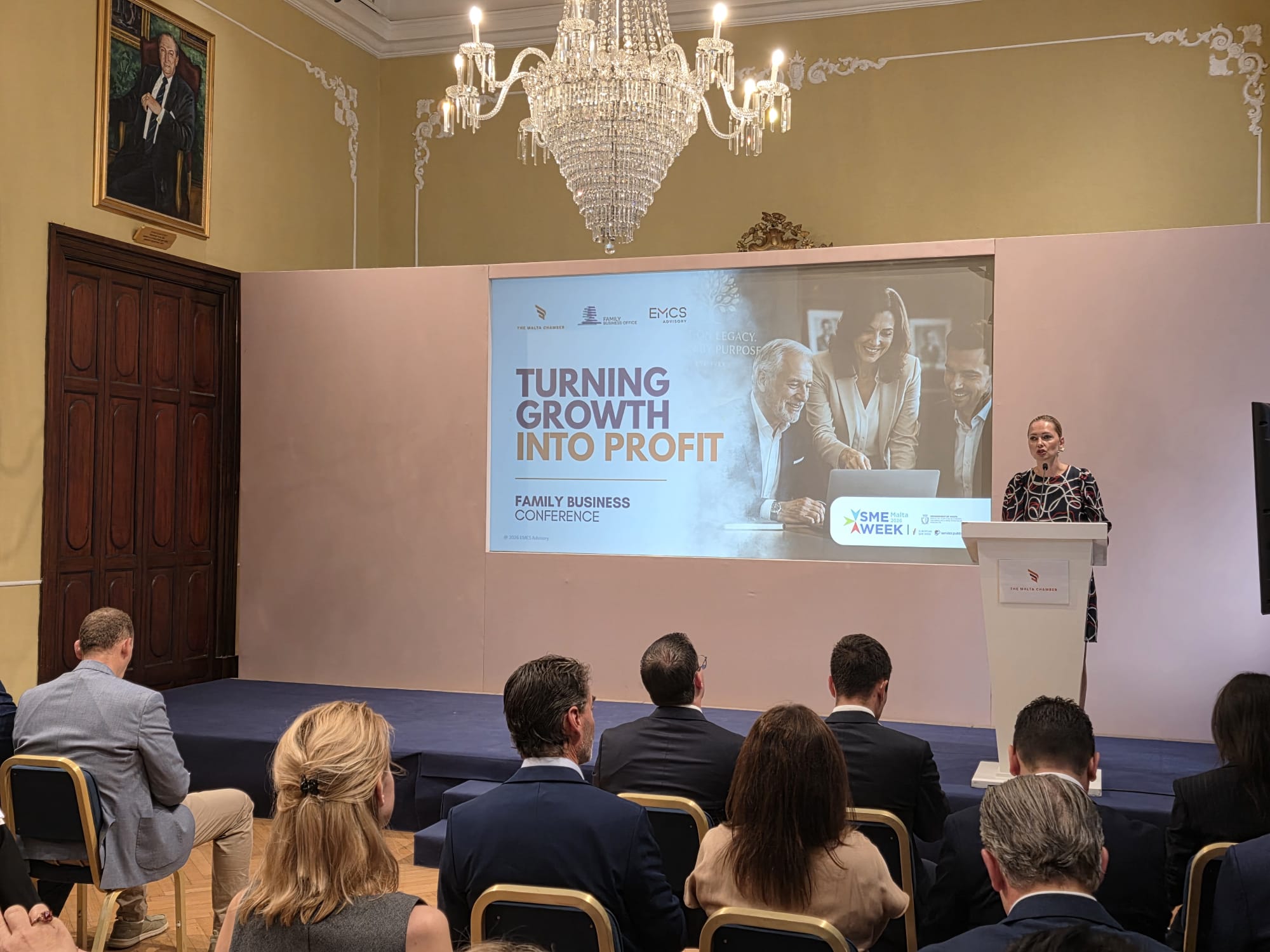
Malta's mid-sized family businesses are growing their turnover but not their profits, according to a new study that identifies a "scaling canyon" for firms with 10 to 50 employees.
The report, produced by The Malta Chamber in collaboration with the Family Business Office and EMCS Advisory, found that the highest rates of turnover growth without matching profit growth were among firms with 10 to 30 employees (51.4 per cent) and those with 31 to 50 (43.5 per cent).
The report argues that this points to a stage at which overheads rise before efficiencies kick in.
The picture improves markedly at the top end. Among the largest family enterprises with more than 250 employees, 60 per cent reported growth in both turnover and profitability, indicating that firms which clear the hurdles of mid-scale growth gain structural resilience and economies of scale.
Overall, the study – with 154 respondents from Malta’s family businesses – says the post-pandemic years of 2022 to 2025 gave family firms the market opportunities to expand their footprint and grow revenues, but that scaling up has strained legacy cost structures and diluted margins.
Almost all (92 per cent) of the study’s participants saw turnover grow over the period. However, that top-line growth did not necessarily filter down to the bottom line.
While 37 per cent of respondents grew both turnover and profit, 18 per cent saw profits stagnate and another 37 per cent actually saw profits decline – with a total of 55 per cent of the companies surveyed experiencing profitless growth.
Plans and boards
The clearest dividing line in the data is strategic planning. Of firms with an active written strategic plan, 42 per cent saw higher turnover and profits, while 49 per cent saw profits stagnate or fall. On the other hand, only 34 per cent of firms without a regularly reviewed strategy saw profits rise alongside revenue, while 61 per cent saw them stagnate or fall.
Boards tell a more nuanced story. Having a functioning board did not insulate firms from margin pressure: 40.4 per cent of companies with one reported profitless growth, against 28.9 per cent of those without. The authors suggest this may reflect the fact that larger, more mature firms, which are more likely to have boards, are also more exposed to headwinds such as inflation and rising operating costs.
Independent non-executive directors, however, appear to have a stabilising effect. Boards that included them reported stagnant profits at 25.5 per cent, compared with 11.1 per cent for family-only boards, and fewer outright profit declines (36.4 per cent against 44.4 per cent). They did not necessarily unlock stronger profit growth, with 32.7 per cent reporting higher profits against 37.0 per cent for family-only boards.
Investing to fix, rather than to grow
A notable finding is that many firms appear to be investing in response to weak results rather than ahead of them.
Among firms giving governance reform the highest priority rating, 48.4 per cent reported falling profits despite growing turnover, while healthier firms tended to treat it as a moderate priority.
Similarly, the firms researching AI most aggressively were in the profitless-growth group, with AI treated as “an exploratory remedy rather than a driver of bottom-line returns.”
Mature high-performers and the squeezed mid-market
The report concludes with an outline of the different characteristics typical of the top performers and those struggling to register material improvements in their financial performance.
The firms that have been capable of translating higher turnover into higher profits tend to be backed by active, regularly reviewed written strategic plans, are larger in size, and deploy investments like digital transformation and process automation offensively – not to fix structural failures, but to systematically expand capacity and accelerate their returns.
“Once a family business clears the operational hurdles of mid-scale growth, it achieves true structural resilience and economies of scale,” notes the report.
On the other hand, the companies most likely to be seeing profitless growth tend to be mid-sized firms in a “scaling canyon” that is difficult to escape.
“When family businesses scale without formalising their framework, they face severe margin contraction. Family businesses caught in the execution trap of “knowing they need a strategic plan but lacking the time to build one" are overwhelmingly represented in this lower-profit segment.”
While these businesses are likely prioritising corporate governance reform, digital investments, and internal restructuring, they are doing so in a reactive fashion in response to negative results.
“The data proves that growth without formal governance is a high-risk strategy,” note the authors. “A family business cannot successfully navigate the operational complexities using informal, legacy management styles. The defining separator between long-term value creators and those experiencing profitless growth is the transition from informal family-led execution to structured corporate professionalism.
“The family businesses that proactively build independent boards, map outwritten strategic plans, and couple automation with clean organisational design are the ones successfully turning higher turnover into lasting corporate wealth.”

Malta now has more €1,500,000+ homes for sale than ones under €250,000
A full quarter of the homes available for no more than €250,000 are in Gozo

Perit proposes underground transport network to tackle traffic, flooding and lack of open spaces
He calls the project 'A Second Malta'

AX Group calls for destination hubs as part of tourism strategy shift in Budget recommendations
Development of a national employment and skills strategy, investment in infrastructure, tourism strategy shift are its top priorities