


Despite the turbulent macro-economic and geopolitical events in recent months, international equity markets performed very strongly during the first half of 2026. The outbreak of war in Iran, the resulting sharp energy shock and rising inflation, an interest rate hike by the European Central Bank together with a leadership change at the US Federal Reserve, did not seem to matter much for equity investors.
In the US, the S&P 500 index rose by 9.6 per cent in the first half of the year with the second quarter (+14.9 per cent) ranking as the strongest in several years. The other popular indices used to measure the performance of the US stockmarket also participated in the bull market with the technology-heavy Nasdaq Composite rising by 12.8 per cent and the Dow Jones Industrial Average up by 8.9 per cent as it recorded its best first half in five years.
The Asian markets registered spectacular gains with South Korea’s Kospi index ranking as the best-performing major index in the world after doubling over the past six months as its two index heavyweights, Samsung Electronics and SK Hynix, each surpassed a market capitalisation of USD1 trillion on the back of surging demand for high-bandwidth memory. Taiwan’s Taiex index climbed 60 per cent, powered by Taiwan Semiconductor Manufacturing Company while Japan’s Nikkei 225 index rose by 39.2 per cent.
Meanwhile, the Euro Stoxx 600 index advanced by a more modest 8.4 per cent with some stronger gains in Southern Europe as Italy’s FTSE MIB gained 15 per cent, Spain’s IBEX 35 climbing by 12.5 per cent and the Greek market up by 16 per cent.
Chip stocks vs the Magnificent 7
Many people associate the US stockmarket to the so-called Magnificent 7 stocks comprising Nvidia, Apple, Alphabet, Microsoft, Amazon, Meta Platforms and Tesla. These collectively currently account for over 30 per cent of the S&P 500 index indicating a high-level of concentration risk for those investors who simply buy passive index funds or trackers.
While these 7 companies generated very strong returns over recent years and were the major contributors of the current bull market which commenced in late 2022, their performance in the first half of 2026 was very much subdued. Nvidia, which remains the most valuable company and largest component of the S&P 500 index, gained only 7.3 per cent over the past six months, while Microsoft’s share price dropped by 22.9 per cent and Meta shed 14.7 per cent.
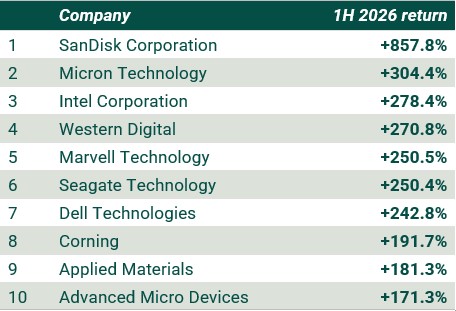
The ten best performers of the S&P 500 index during the first half of 2026 rose by an average of circa 265 per cent and eight of these are companies within the chip sector. The standout was SanDisk Corporation, whose shares surged by almost 860 per cent due to the global memory shortage and the insatiable demand for storage.
Essentially, after several years during which investors were amply rewarded for simply owning the index via a tracker fund, the developments over the past six months indicate that stock selection or exposure to specific sectors generate the most handsome returns for investors.
European technology names surge
Similar to the evident trend in the US, the best performing equities in Europe were also linked to the semiconductor sector or the wider technology industry. The standout performers were the Austrian circuit-board maker AT&S (up more than 555 per cent) and the French semiconductor specialist Soitec (up almost 406 per cent). Other notable performers were Aixtron, STMicroelectronics and Infineon with gains of 205 per cent, 187 per cent and 117 per cent respectively.
The Dutch lithography giant ASML remains Europe’s largest capitalized company after its share price surged by 86.8 per cent in the first half of 2026. ASML is the world’s sole manufacturer of the advanced extreme ultraviolet (EUV) machines required by TSMC, Intel and Samsung to print the microchips powering AI data centers.
It is evident that a number of European companies also have important roles within the global chip supply chain and have therefore been prime beneficiaries of the so-called AI trade albeit these are not mentioned regularly across the international media.
Earnings momentum and the bubble debate
The performance of global equity markets in the first half of 2026 offers another timely reminder that movements across indices and individual share prices are mainly driven by company fundamentals and earnings momentum rather than geopolitical uncertainty or ‘black swan’ events.
However, the extent of the gains across the chip sector have increasingly led to a number of commentators warning of an “earnings bubble”.
During the second half of the year, the central theme is whether the earnings momentum that powered the first six months can be maintained. The current bull market is essentially one that is being fuelled by the surge in company profits or earnings rather than one that is driven by expanding valuation multiples. A number of analysts are now forecasting profit growth of roughly 25 per cent for S&P 500 companies over the coming year. Since these profit estimates rose faster than the upturn in the index, the forward price-to-earnings multiple of the S&P 500 actually eased over the period and is also below the levels reached last year.
The strong increase in AI capital expenditure by the hyperscalers is set to exceed USD700 billion this year which is continuing to widen the beneficiaries of the AI trade to some companies within the power sector, infrastructure and industrials. The main concern is that the assumption around AI-related earnings and capital-spending may be approaching levels that are difficult to sustain.
Other commentators who are more bullish view the rotation out of many of the Magnificent 7 components into the AI enablers as a healthy development rather than a warning. There were several instances in recent years when the main concern was the dependence and the degree of concentration by the Magnificent 7 among the S&P 500 index. Some analysts have stated that this is the first time since 2022 that the S&P 500 index is close to its record highs despite the weak performance by most of the constituents of the Magnificent 7.
The preoccupation of the degree of earnings momentum that is already priced in to current sentiment was clearly visible this week when Samsung Electronics published its quarterly results. Although the company stated that the operating profit for the second quarter of its financial year is expected to jump by more than 1,800 per cent on a year-on-year basis (and more than its combined profit over the previous three years), the share price of Samsung and other memory stocks dropped sharply as the market questioned the sustainability of the chip rally and the risk of slower AI infrastructure spending by the major US technology companies.
The earnings season in the US begins next week as the major banks will publish their Q2 financial results. The main focus of the earnings season will be the publication of the results of the major technology companies especially the hyperscalers as attention will turn towards their huge capital expenditure, the returns on these investments and very importantly their free cash flow generation. Across the chip sector, the risk is that following the spectacular upturn in share prices following the strong growth in profitability, expectations of financial analysts are far too high and a correction in chip companies can affect sentiment across other sectors. One can expect a period of wide share price fluctuations across several companies as the earnings season unfolds.
The article contains public information only and is published solely for informational purposes. It should not be construed as a solicitation or an offer to buy or sell any securities or related financial instruments. No representation or warranty, either expressed or implied, is provided in relation to the accuracy, completeness or reliability of the information contained herein, nor is it intended to be a complete statement or summary of the securities, markets or developments referred to in this article. Rizzo, Farrugia & Co. (Stockbrokers) Ltd (“Rizzo Farrugia”) is under no obligation to update or keep current the information contained herein. Since the buying and selling of securities by any person is dependent on that person’s financial situation and an assessment of the suitability and appropriateness of the proposed transaction, no person should act upon any recommendation in this article without first obtaining investment advice. Rizzo Farrugia, its directors, the author of this article, other employees or clients may have or have had interests in the securities referred to herein and may at any time make purchases and/or sales in them as principal or agent. Furthermore, Rizzo Farrugia may have or have had a relationship with or may provide or has provided other services of a corporate nature to companies herein mentioned. Stock markets are volatile and subject to fluctuations which cannot be reasonably foreseen. Past performance is not necessarily indicative of future results. Foreign currency rates of exchange may adversely affect the value, price or income of any security mentioned in this article. Neither Rizzo Farrugia, nor any of its directors or employees accepts any liability for any loss or damage arising out of the use of all or any part of this article.



What is driving the dollar’s strength?
The US Dollar ended the third quarter of 2026 with its sixth consecutive quarterly gain

Alkagesta hosts banking partners summit as international financial support exceeds $1 billion
Malta's strong regulatory framework, EU membership, and expanding logistics infrastructure continue to attract international trading companies and their financial partners
Malta’s bond market in Q4
The next few months could prove to be an eventful period for the bond market