


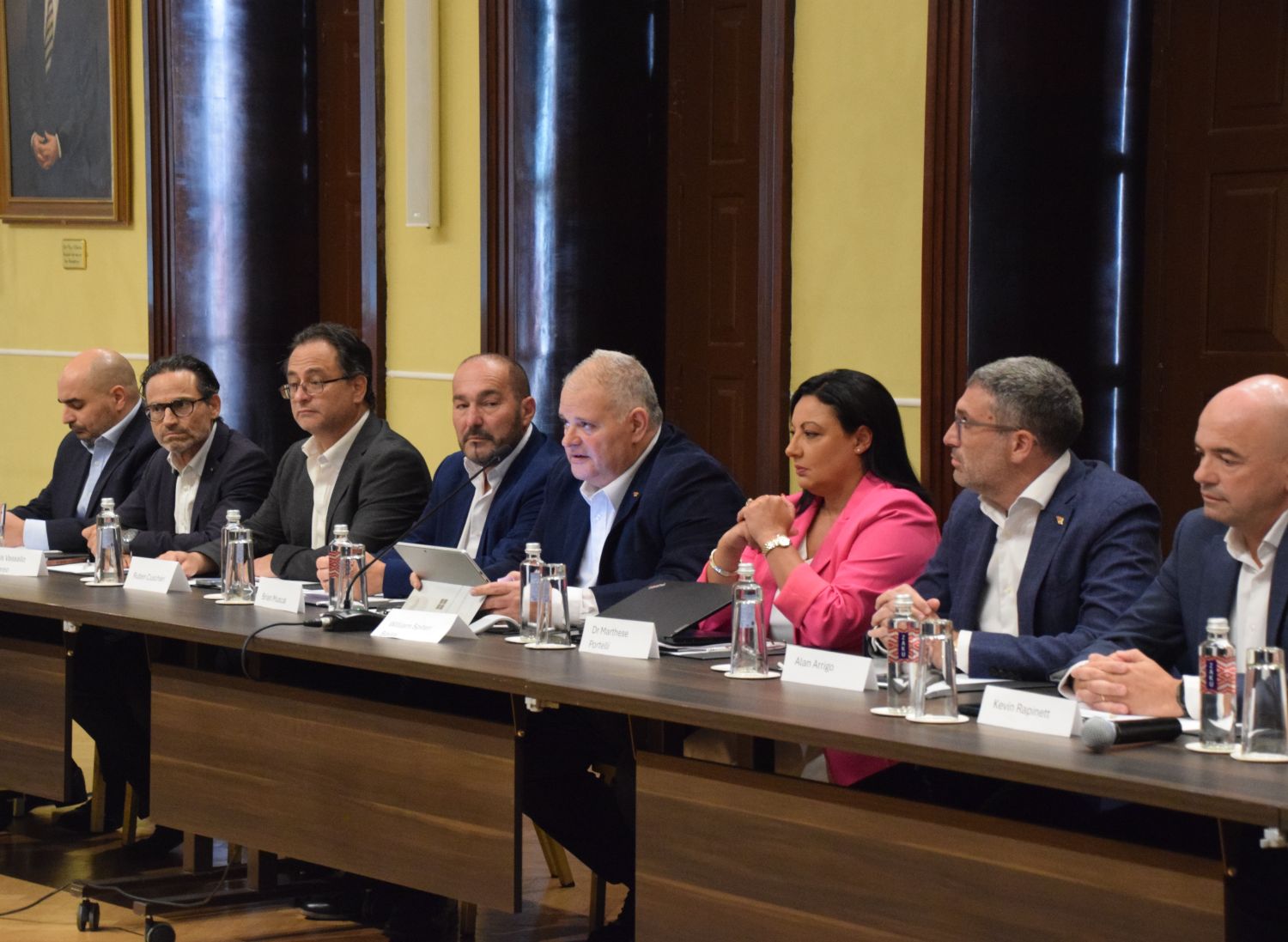
Competitivity is not built solely through competitive taxation, President of the Malta Chamber of Commerce William Spiteri Bailey said during a meeting with Opposition Leader Alex Borg.
“It is built through strong institutions, good governance, efficient processes, modern infrastructure, reliable energy, modern education, and with a country capable of long-term planning,” he said.
The Malta Chamber President told the Opposition Leader that good governance is not only a reputational question, but that it is also an economic one. “Countries with strong institutions attract more investment, create more trust and grow more sustainably.”
This is why, he said, good governance must remain a national priority.
Mr Spiteri Bailey held a meeting with Opposition Leader Alex Borg. He had held a meeting with Prime Minister Robert Abela on Monday.
He asked a question. “What kind of Malta does an Opposition aspiring to become the Government want to lead?”
This is not a political question, he said, adding that it is an economic one. “It is the question every investor, every entrepreneur, and every family is asking.”
He said that Malta’s economy has grown, but listed problems that have grown with it, related to energy and traffic, among other things. He said that they are symptoms of the economic model that served Malta well for a number of years but has now reached its end.
The time has come for Malta to take the next step, and move from a model based on volume, to one based on value, and from growth based on population numbers, to growth based on more productivity.
Success, he said, must not only be measured by GDP, but also by productivity, competitivity, quality of life, and people’s wellbeing.
This is a challenge for both the Government and the Opposition, he said.
He asked the Opposition how they will increase productivity, reduce dependency on population growth, which new investment Malta wants to attract, among other things.
He said that when looking at successful small countries, they didn’t become successful because they had more people, but because they were more productive, innovative, efficient, more predictable and were guided by a clear direction.
Regarding Vision 2050, he said that a vision alone is not enough, and emphasised that it must become a plan, and that a plan must lead to action.
He referred to proposals which the Malta Chamber of Commerce had made, and stressed that the role of institutions like his is not only to criticise, but to lead national discussions with concrete ideas. “We expect the same level of ambition from everyone who aspires to lead Malta.”
He stressed that there are themes which are larger than partisan politics, such as energy, education, justice, good governance and others. “The country needs clear direction, continuity, and agreement on national priorities.”
The Chamber President said that politics should be based on competition for the best ideas, not on who changes direction of the country every five years.
He said the Chamber is not interested in who wins an election, but that ultimately Malta wins, that the country continues growing, that people’s wellbeing continues improving, and that a better country is left behind for the next generation.
Tourist spending hits €1.21 billion in Malta in second quarter of 2026
The average length of stay per tourist dropped from six nights in 2025 to 5.5 nights this year

Revolut won’t disclose number of data breach victims in Malta, but there is at least one
Hackers obtained files by compromising an Italian government email system

Alkagesta hosts Malta U16 women’s basketball champions at Malta office
The Maltese team won with a score of 76-51