



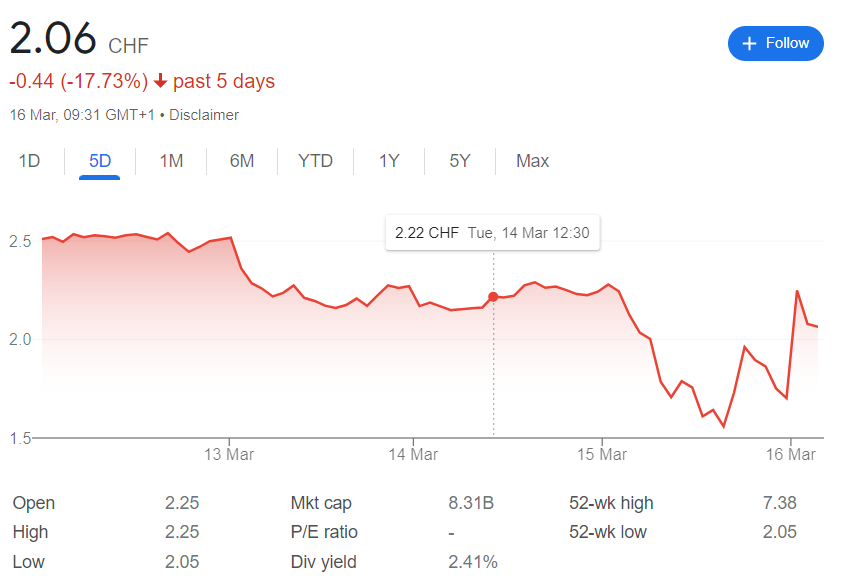
Switzerland’s second-largest bank, Credit Suisse has seen its share prices hit consecutive all-time lows after being denied financial assistance from its largest shareholder, the Saudi National Bank.
This situation led to the bank deciding to borrow up to $54 billion (€50.8 billion) from the Swiss National Bank (SNB) under a covered loan facility and short-term liquidity, amid fears that it could default on its debt.
While unrelated to the collapse of Silicone Valley Bank (SVB), challenges in Credit Suisse dented the confidence of an anxious global banking system, considering that, unlike SVB, Credit Suisse is bank with deep ties in global financial markets, and is considered a systematically important financial institution.
The bank’s issues are nothing new, having been at the centre of numerous scandals and reports of mismanagement. In 2022 the bank reported its biggest annual loss since 2008.
As it tumbled it pulled down other European banks with it, with Société Generale SA dropping 12 per cent, BNP Paribas dropping 10 per cent and both Deutsche Bank and Barclays Bank dropping a further eight per cent.
In a statement, Credit Suisse said it also announced a separate cash tender offer in relation to four euro-denominated senior debt securities for an aggregate consideration of up to €500 million.
The bank’s share price appears to have mildly recovered, however, whether the measures taken prevent further fallout in the global banking system is yet to be seen.
Featured Image via Credit Suisse Facebook Page


Ferrari unveils ‘Luce’: Its first fully electric supercar set for 2028
Pricing is anticipated to sit well above €500,000

Malta’s trade deficit narrows as import shifts and export rebalancing continue in 2026
Over the full year, Malta’s trade deficit narrowed by €444.1 million compared with 2024

Thinking of housing as part of an urban system: what Malta can learn from Singapore’s public housing
Five lessons we can take from the nation twice the size of Malta