


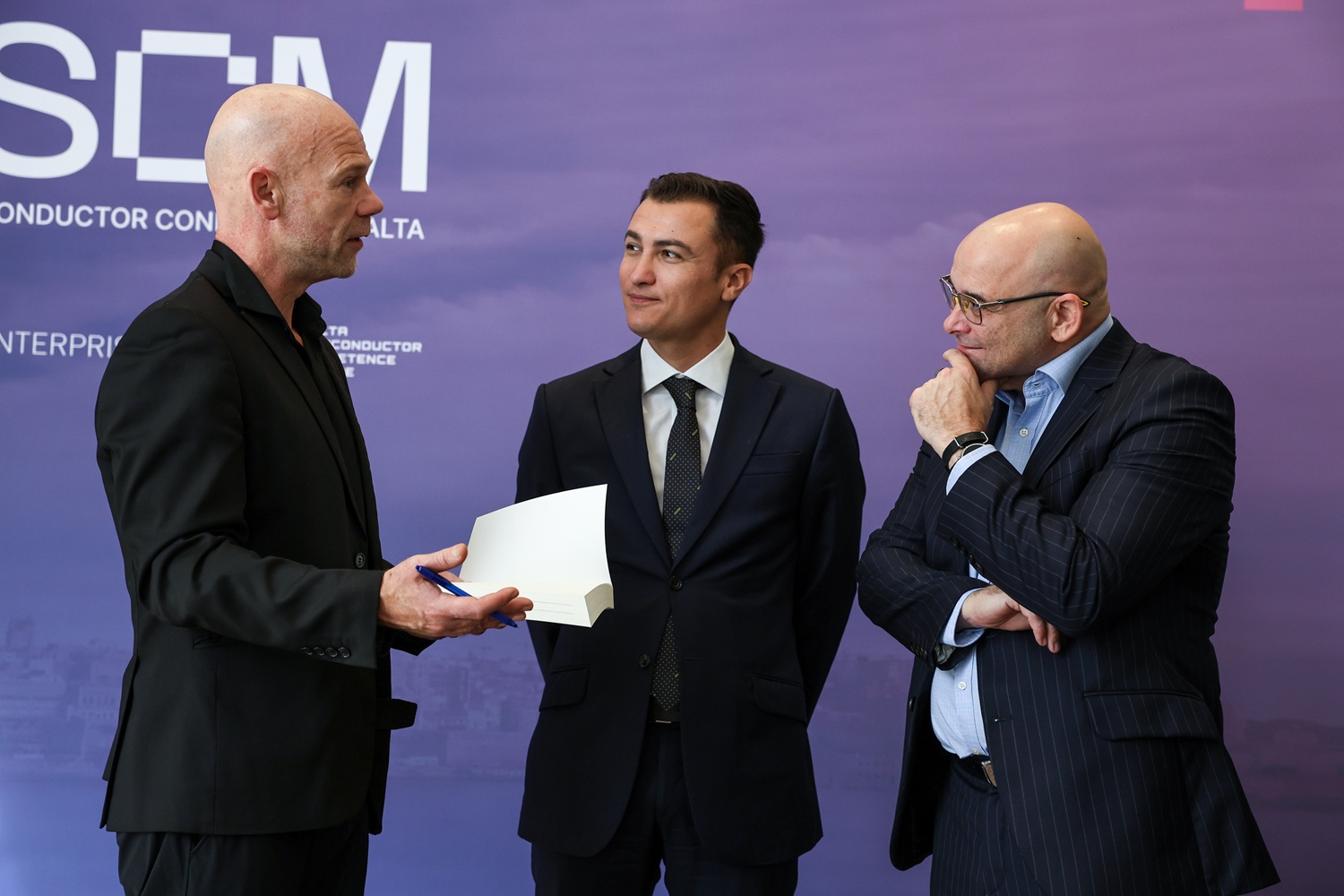
The first 12 semiconductor start-ups completed Silicon Catalyst’s incubation programme, Minister for the Economy, Technology and Strategic Projects Silvio Schembri announced
He spoke at the third edition of the Global Semiconductor Conference Malta (GSCM).
Some of these are now setting up operations in Malta, and a second group of 12 companies has already started the programme.
In his opening address, Minister Schembri explained that, through Malta Vision 2050, the Government is building on the experience Malta has gained in the semiconductor industry through companies such as STMicroelectronics. It is also creating opportunities in new areas such as chip design.
The Minister highlighted the success of local companies such as ICECAP. Founded as a spin-off from the University of Malta, ICECAP now specialises in deep cooling technologies. The company has developed its own intellectual property and secured international patents.
“Malta can do more than use technology. We have the skills to design it, develop it and bring it to market,” said Minister Schembri.
George Gregory, CEO of Malta Enterprise, said: “The Global Semiconductor Conference Malta (GSCM) has become an important platform for bringing together industry leaders, policymakers, investors and innovators to shape the future of the semiconductor industry. Through the work of Malta Enterprise in attracting investment, supporting businesses and fostering strategic partnerships, we are actively contributing to the development of Malta’s semiconductor ecosystem, in line with the ambitions of Vision 2050.”
“Hosting GSCM reflects our ambition to strengthen Malta’s position within Europe’s semiconductor ecosystem, build on our existing capabilities and unlock new opportunities across the value chain. Through continued investment in skills, innovation and collaboration, we aim to ensure that Malta makes a meaningful contribution to Europe’s semiconductor ambitions while supporting the development of a higher-value, more knowledge-driven economy,” he said.
Minister Schembri also stressed the importance of training to help more people pursue careers in the sector. The University of Malta has already offered short courses in semiconductors that lead to micro credentials. MCAST is developing further programmes in this field. Next year, Malta will host the European Chips Academy’s summer school, bringing together around 40 students from across Europe and from associated countries.
The two-day conference brings industry representatives, researchers and investors to Malta to discuss how Europe can strengthen its competitiveness in the semiconductor sector as artificial intelligence advances. Minister Schembri reaffirmed that Malta will continue to take part in discussions on the future of the European Chips Act to ensure it reflects both the needs of smaller economies and the contribution they can make.
Featured image: METP

Household disposable income reaches €16 billion
BOV noted that compensation of employees remained the principal source of household income

85% of non-EU survey respondents say TCN Budget measures are unfair and unnecessary
The least welcome measures among non-EU residents was the €400 annual infrastructure contribution

Scope Ratings affirms Malta’s A+ rating, flags energy subsidy pressures
'Private consumption remains a key driver of economic activity,' it said