



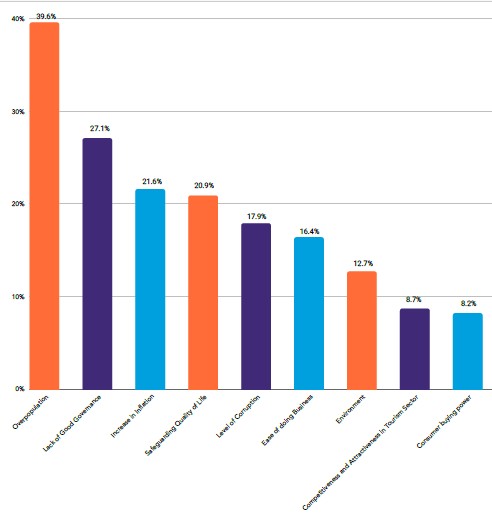
Businesses continue to rank overpopulation as the country's most important issue requiring government action (39.6 per cent), with concern increasing further compared with previous quarters, a survey has found.
The Malta Chamber of SMEs, in collaboration with MISCO Malta, has published the findings of the SME Barometer Q2 2026, based on responses from 402 businesses operating in Malta collected between 1st and 22nd July 2026.
Lack of good governance and increase in inflation were the second and third highest choices.
Safeguarding quality of life and improving the ease of doing business registered some of the largest increases in importance, the SME Chamber said, “indicating that businesses are increasingly seeking a better balance between economic growth, public services and the overall business environment.”
Asked to highlight the two most important issues their businesses face, an employee shortage was by far the most selected option, with 38.8 per cent choosing it. Unfair competition (19.2 per cent) and the processing of third-country-national VISA applications (16.7 per cent) were the second and third most selected options.
Both the shortage and unfair competition have been the top two issues highlighted by SMEs for a number of consecutive quarters, although the percentages have reduced from the last quarter.
However, “compared with previous quarters, concerns regarding the processing of Third Country National (TCN) visa applications and inflation have increased again, reflecting continued pressure on businesses trying to recruit workers while managing operating costs,” the Chamber of SMEs said.
Asked where they feel their business experiences the greatest level of unfair competition, 23 per cent said from businesses that do not adequately comply with laws or regulations, resulting in lower operating costs. 14 per cent (the second highest percentage of answers) selected public entities or Government initiatives competing directly with private businesses, and the same percentage selected unequal enforcement of existing laws and regulations between businesses.
Business concerned about country’s direction
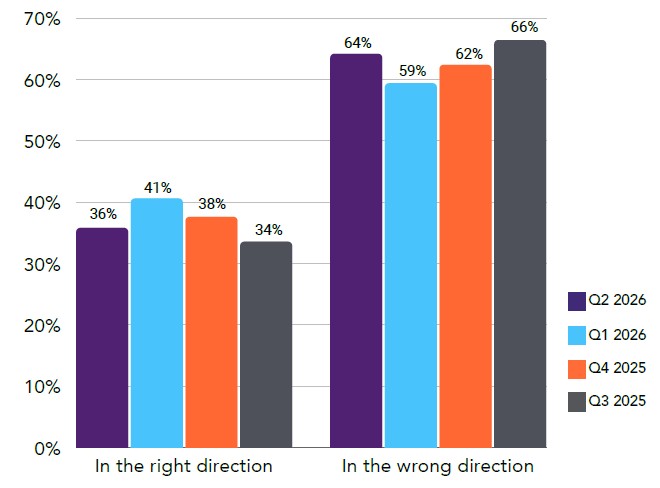
36 per cent of respondents believe Malta is moving in the right direction, and 64 per cent believe Malta is moving in the wrong direction, the survey found. The percentage of those who said the country is moving in the wrong direction is higher than in Q1 this year, when it was 59 per cent.
Among those who believe Malta is moving in the wrong direction, the principal 3 reasons relate to concerns over quality of life (26 per cent), infrastructure and national planning (19 per cent), and cost of living (19 per cent).
Respondents were also asked whether they think it would be a good time to invest in the next 12 months. 22 per cent said yes, a slight increase from the 19 per cent who said yes in Q1 this year. The majority, 56 per cent, said they are not sure, and 22 per cent said no.
The Chamber of SMEs set out a number of recommendations following the survey. It said that the bottleneck on TCN regulations needs to be improved, and stressed the need to ensure a level playing field and stronger enforcement against unfair competition.
Among other things, it highlighted the need to address overpopulation and infrastructural pressures, and the need to reduce the administrative burdens on SMEs by, for instance, simplifying licensing.


More than 50 startups collectively awarded €15 million in financial assistance
These businesses have created around 250 quality jobs, Government said

Insurers call for urgent clarity over EV disposal procedures while highlighting ‘practical difficulties’
Malta currently lacks suitable facilities for treating these batteries, association said

Working remotely abroad? Businesses warned of potential tax risks at Mobility Elite Summit
Working remotely abroad is not just a matter of finding a nice place