



The Budget for 2027 presented by the Minister of Finance on 26 October was naturally dominated by headlines on taxation, social measures and also the impact of energy subsidies. However, for participants in the local capital market, the more important figures are found in the fiscal estimates until 2029 published alongside the speech.
These confirm that the Government’s reliance on Malta Government Stocks (MGS) will remain very significant in 2027 and subsequent years, with important implications for both retail and institutional investors as well as for the wider fiscal position of the country.
MGS issuance to remain elevated
The Budget deficit for 2027 is projected at €724 million, slightly above the revised estimate of €679 million for the current year. In relative terms, however, the deficit is expected to remain broadly unchanged at 2.6% of GDP, since nominal GDP is forecast to grow by a further 6.6% to €28.1 billion. The Government is then targeting a gradual narrowing of the deficit to €644 million in 2028 and €556 million in 2029, equivalent to 1.8% of GDP by 2029.
The deficit will need to be funded via the issuance of MGS’s. Moreover, as in previous years, the Treasury also needs to refinance the sizeable amount of maturing debt every year. In 2027, a total of €915 million in MGS will be redeemed which includes €520 million issued at a rate of below 1% during the era of ultra-low interest rates. Total MGS issuance in 2027 is expected at €1.8 billion, maintaining the elevated issuance of recent years.
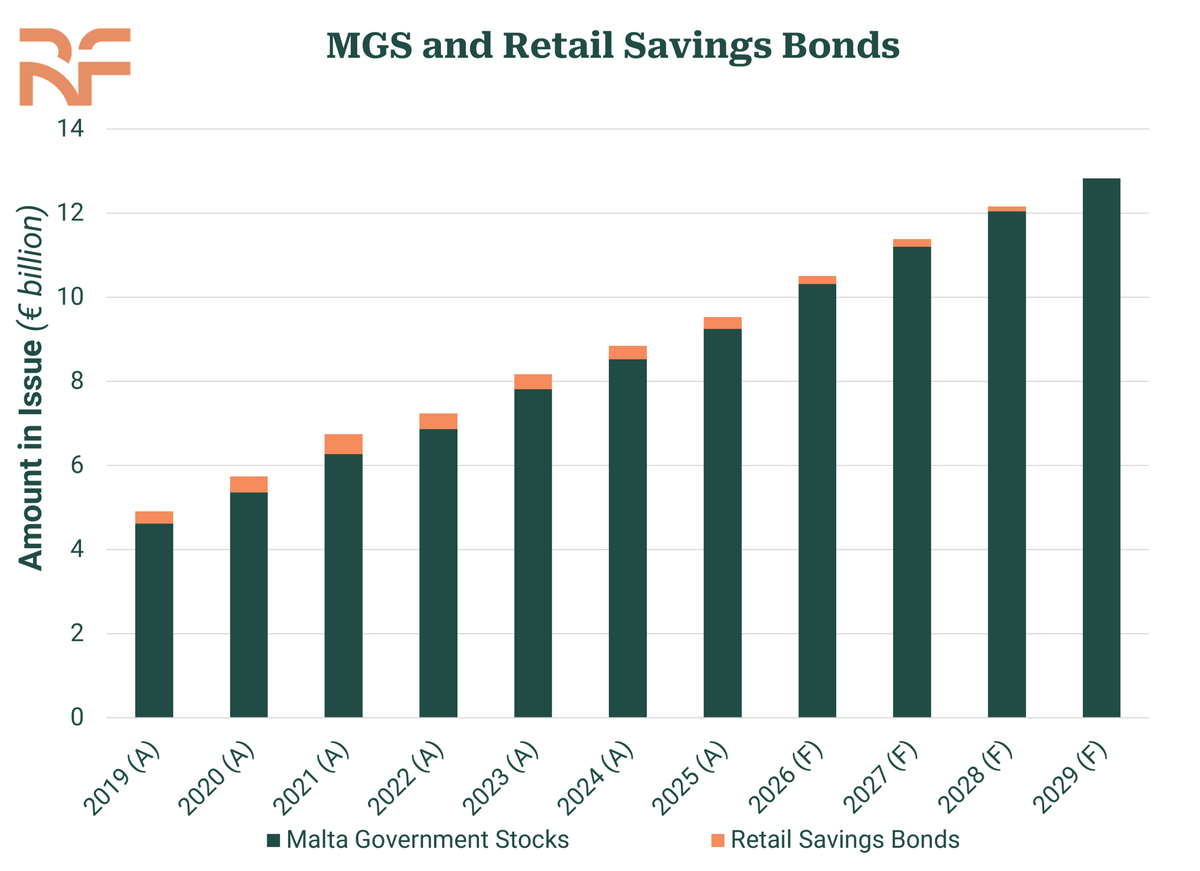
The extent of the rise in MGS and total national debt over recent years is rather extraordinary. At the end of 2019, just before the COVID-19 pandemic, total outstanding MGS in issue amounted to €4.6 billion. By the end of next year, the figure will be at €11.2 billion which is almost two-and-a-half times larger within a decade.
Ahead of the 2027 Budget, the Minister of Finance clearly articulated the reasons for the sharp increase in debt of over €6 billion with the largest drivers being energy subsidies estimated at €1.9 billion followed by subsidies related to the pandemic (€1.5 billion) as well as support relating to the national airline (both Air Malta and KM Malta Airlines) of over €630 million.
Who are the main buyers of MGS?
Given the continued need for the high amount of MGS issuance in the years ahead, the composition of demand is a critical consideration for the investing public. The MGS issues that took place so far this year totalling €1.5 billion provide some interesting insights.
Retail investors subscribed for a total of €550.7 million, equivalent to just over 36% of the total amount raised so far this year. This is a new record of retail allotment, surpassing the previous peak of €517.9 million achieved in 2016. The strong retail participation is not surprising. Despite the two rate increases by the European Central Bank this year, interest rates offered on bank deposits in Malta have remained very low, and MGS continue to represent a compelling alternative for savers seeking a secure and regular income stream.
The most notable development, however, is the dominant role now being played by foreign institutions. These were allocated €713 million, or 47.6% of the total, making them the largest single category of investors in the 2026 issues. On the other hand, local institutions who had been the largest buyers in recent years, accounted for only 12.5% or circa €188 million as these were mainly outbid by international credit institutions during the auction process.
This shift in the demand dynamics has some positive attributes in view of the very high levels of issuance also in the coming years.
The significant international investor demand reflects confidence in Malta’s creditworthiness at a time when the country is consistently registering the highest economic growth across the EU. Moreover, a broader and more diversified investor base deepens the market and reduces the risk that Government borrowing crowds out lending to corporate borrowers by local banks.
However, it also brings new dynamics that investors should be aware of. Foreign institutions tend to be more sensitive to relative value and to shifts in global sentiment. As such, these type of investors may tend to reduce their holdings swiftly in certain situations, which could amplify price movements across the secondary market despite the presence of the Central Bank of Malta as a liquidity provider in the MGS market.
The wider fiscal situation
The fiscal estimates published on 26 October indicate that the total stock of MGS in issue will exceed €12 billion in 2028 and reach €12.8 billion by the end of 2029. Total Government debt, which also includes Treasury Bills, foreign loans and other instruments, is projected to rise to €14.5 billion by 2029.
Given the strong rate of economic growth that is expected to continue in the coming years, the debt to GDP ratio is expected to remain broadly stable at between 46% to 47%, comfortably below the euro area average.
However, the sharp increase in debt since 2019 and the continued upward trajectory, has resulted in a considerable increase in the cost of servicing this debt. Interest payable on public debt amounted to €174 million in 2022, when the Treasury could still benefit from the very low rates on bonds issued during the prolonged historically low interest rate environment.
This is estimated to have climbed to €326 million in 2026 and is forecast to rise to €382 million in 2027, before surpassing €400 million annually from 2028. In other words, the Government will soon be spending more than €1.1 million daily on interest alone.
Interest payments next year will account for more than half of the projected deficit. Although Malta’s fiscal position currently remains favourable in view of the high rate of economic growth, the debt servicing burden should not be overlooked. At over €400 million annually, this is equivalent to the amount being budgeted for the energy subsidies.
The MGS market has clearly evolved over recent years and is now being supported by record retail participation and a growing base of international institutions. This requires continued efforts to enhance liquidity in the secondary market for the benefit of all investors.
Moreover, in order to sustain this positive sentiment by international institutional investors, the Government must articulate a credible path towards a meaningful reduction in the deficit as is being highlighted by the various credit rating agencies.

The article contains public information only and is published solely for informational purposes. It should not be construed as a solicitation or an offer to buy or sell any securities or related financial instruments. No representation or warranty, either expressed or implied, is provided in relation to the accuracy, completeness or reliability of the information contained herein, nor is it intended to be a complete statement or summary of the securities, markets or developments referred to in this article. Rizzo, Farrugia & Co. (Stockbrokers) Ltd (“Rizzo Farrugia”) is under no obligation to update or keep current the information contained herein. Since the buying and selling of securities by any person is dependent on that person’s financial situation and an assessment of the suitability and appropriateness of the proposed transaction, no person should act upon any recommendation in this article without first obtaining investment advice. Rizzo Farrugia, its directors, the author of this article, other employees or clients may have or have had interests in the securities referred to herein and may at any time make purchases and/or sales in them as principal or agent. Furthermore, Rizzo Farrugia may have or have had a relationship with or may provide or has provided other services of a corporate nature to companies herein mentioned. Stock markets are volatile and subject to fluctuations which cannot be reasonably foreseen. Past performance is not necessarily indicative of future results. Foreign currency rates of exchange may adversely affect the value, price or income of any security mentioned in this article. Neither Rizzo Farrugia, nor any of its directors or employees accepts any liability for any loss or damage arising out of the use of all or any part of this article.


When everyone asks AI and nobody writes on the Web…
'Artificial Intelligence does not create knowledge out of thin air, but learns from what humans have already written'

A look at developments in Cyprus
What Malta can learn from the fellow mediterranean country

The move to T+1 settlement
The settlement cycle in Europe had already changed before when in October 2014, European markets collectively moved from T+3 to ...