


Malta’s business activity continued to expand in February, with the Central Bank’s Business Conditions Index showing a slight increase in annual growth compared to the previous month. Activity remained above its historical average, signalling continued economic resilience.
However, sentiment indicators point to a more cautious outlook. The European Commission’s Economic Sentiment Indicator declined from the historic high recorded in January, although it remained at elevated levels. At the same time, the Employment Expectations Indicator fell below its long-term average, suggesting weaker hiring intentions in the months ahead.
Uncertainty also increased, with the Economic Uncertainty Indicator turning positive, reflecting heightened caution among businesses and households when making financial decisions.
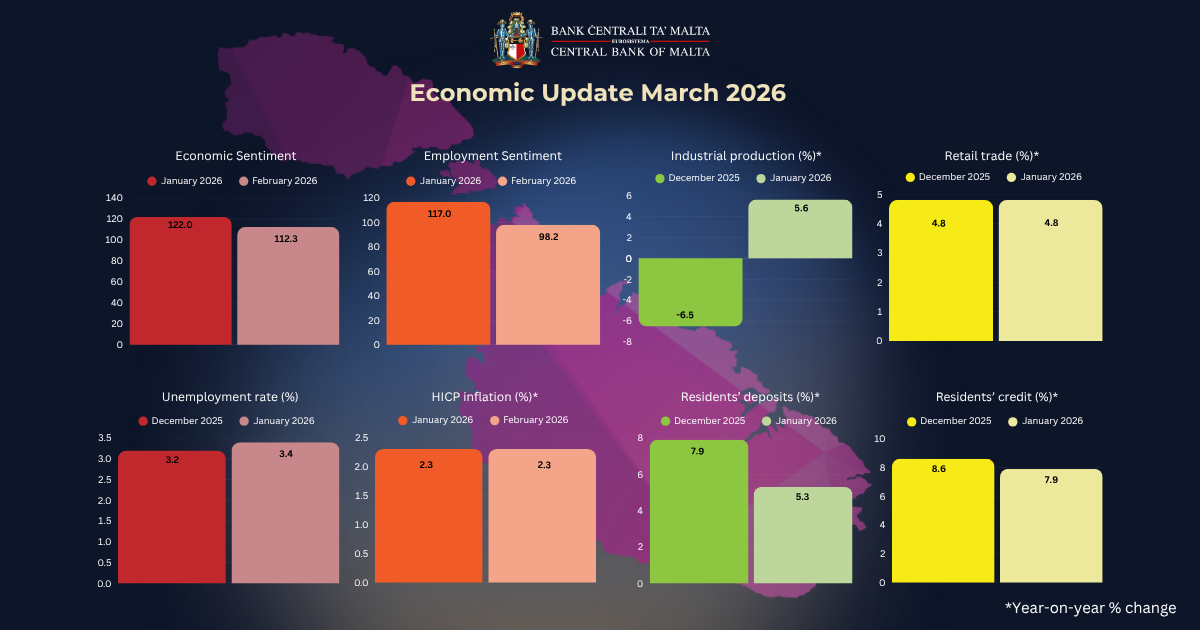
Sectoral data presents a mixed picture. Industrial production returned to growth in January on a year-on-year basis after contracting in the previous month, while retail trade growth remained unchanged. Services output, however, declined over the year to December, following a period of stagnation.
Labour market conditions remain tight, though signs of slight easing emerged. The unemployment rate stood at 3.4 per cent in January, marginally higher than December’s figure.
In the property market, residential building permits declined on a year earlier. However, activity in transactions picked up in February, with both promise-of-sale agreements and final deeds increasing compared to the same period last year.
Inflation remained stable. The Harmonised Index of Consumer Prices (HICP) stood at 2.3 per cent in February, unchanged from January. Core inflation, which excludes food and energy, stood at 2.2 per cent. While headline inflation in Malta remained above the euro area average, core inflation was lower. Meanwhile, Retail Price Index (RPI) inflation held steady at 2.5 per cent.
Public finances improved at the start of the year. In January, the Consolidated Fund registered a lower deficit compared to a year earlier, as increased government revenue outpaced higher expenditure.
Monetary data showed a moderation in the annual growth of both deposits and credit among Maltese residents in January, pointing to a gradual cooling in financial activity.
Education system ‘stifles creativity’, Malta Employers’ chief says as association calls for ‘transformation’
Association's Director General says system is geared towards conformity

MFSA flags missing information in pension statements
Some pension statements omitted key details on investments, fees, contributions and account changes
Budget should support sustainable economic growth, promote financial stability – BOV
Maintaining a stable and predictable business environment, encouraging investment in productivity remain important, it said