


Malta recorded some of the lowest household electricity prices in the European Union during the second half of 2025, according to the latest data published by Eurostat, with the country also ranking as the most affordable when prices are adjusted for purchasing power standards (PPS).
According to Eurostat, Malta registered household electricity prices of €0.1282 per kilowatt-hour (kWh) in the second half of 2025, making it the second cheapest country in the EU after Hungary (€0.1082 per kWh). Bulgaria followed at €0.1355 per kWh.
The EU average stood at €0.2896 per kWh, meaning Maltese households paid less than half the EU average electricity price.
The highest electricity prices in the bloc were recorded in Ireland (€0.4042 per kWh), Germany (€0.3869 per kWh), Belgium (€0.3499 per kWh), and Denmark (€0.3312 per kWh).
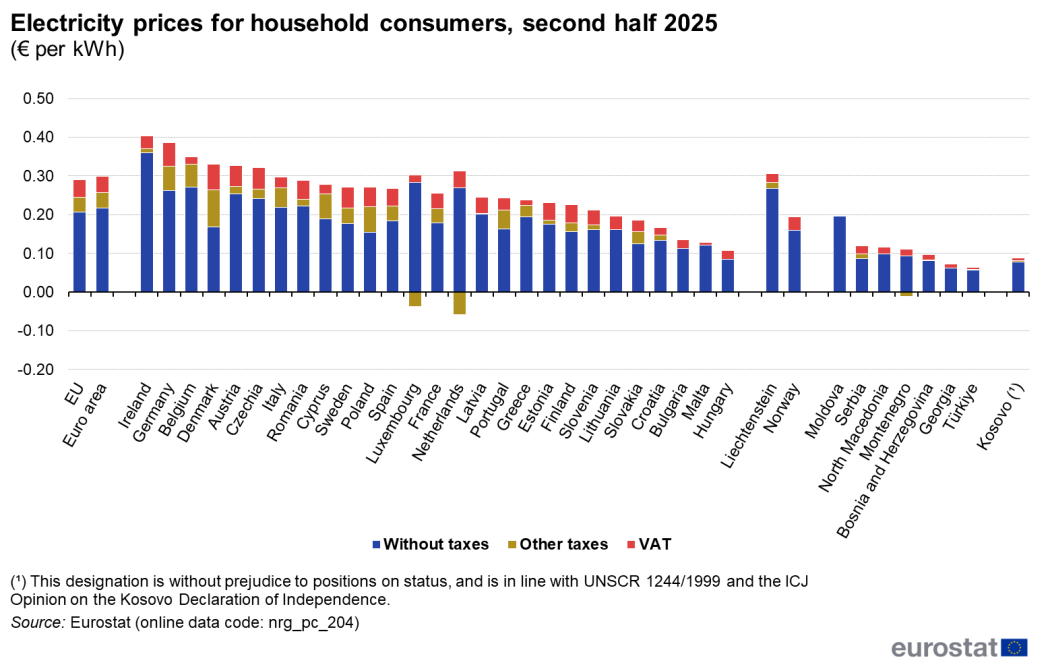
Source: Eurostat (nrg_pc_204)
When adjusted for purchasing power standards – a measure that takes into account household income levels and cost of living – Malta ranked as the most affordable country in the EU for electricity. Malta recorded a PPS score of 14.09 per 100 kWh, ahead of Hungary (15.10) and Finland (18.77).
By comparison, Romania registered the highest electricity burden at 49.52 PPS per 100 kWh, followed by Czechia at 38.65 and Poland at 37.15.
In comments accompanying the figures, Minister for the Environment, Energy and Public Cleanliness Miriam Dalli said: “Price stability remains a priority for us because it gives certainty to families and businesses in their everyday lives. At a time when many European countries are facing sharp increases and instability in energy prices, Malta has managed to keep electricity prices stable."
Eurostat’s data also highlighted the broader trend across Europe, where electricity prices surged sharply during the energy crisis in 2022 before gradually stabilising in subsequent years. Household electricity prices across the EU peaked at €0.2916 per kWh during the first half of 2024 before easing slightly.
The statistics also showed that taxes and levies accounted for 28.9 per cent of electricity prices across the EU during the second half of 2025. In Malta, VAT represented 4.8 per cent of the total electricity price, among the lowest rates in the bloc.
The renewed focus on energy subsidies comes amid growing concerns over geopolitical tensions in the Middle East and their impact on international energy markets, particularly oil and gas prices.
Addressing Parliament earlier this year, Prime Minister Robert Abela said the Government would continue absorbing higher international energy costs rather than passing them on to consumers and businesses.
‘Businesses are making money, but at what cost?’ Malta’s tourism under the lens
Important questions were raised during FAA's national conference on Tuesday (today)

Planning Malta’s future, one shared map at a time
Ahead of the PA's annual conference, Joseph Gauci discusses integrated planning, 3D mapping and global insights for Malta’s future.
PA CEO resigns as director of his consultancy firm
The PA CEO remains the sole shareholder of the consultancy firm, under his legal name 'John Buttigieg'