


Today, we all use Artificial Intelligence (AI) for everything. A quick answer to a question, a summary of a text, what our blood tests say, or even help with a piece of code? Just "Ask AI". It is fast, direct, free, and convenient, so everyone loves it!
There is, however, one detail, a trap. Artificial Intelligence does not create knowledge out of thin air, but learns from what humans have already written:
• answers in forums
• mathematical proofs
• blog posts
• online encyclopedias
• scientific articles and research results
• literary works
• financial analyses
• and any other available sources.
Millions of data points.
Every answer and every AI-generated analysis is based on someone else's effort. Think of it simply as meta-research or meta-analysis.
All this raises a question that we rarely ask and almost never answer: "Who pays for the knowledge that Artificial Intelligence depends on?"
For decades, millions of users wrote and answered questions on Stack Overflow, Reddit, GitHub, forums, and blogs, enriched Wikipedia, developed open-source applications, and shared specialized knowledge, almost always for free.
And why did they do this?
Perhaps out of interest, maybe curiosity, generosity, professional pride, or simply the desire to help someone and help the Internet grow.
Now, however, many of these users are competing with systems that have been trained on their own thoughts and their own words! Crazy, isn't it?!
The user who once toiled for hours and wrote the answer to an obscure technical problem may find that an AI model gives a similar answer immediately, without citing a source or paying the creator. So, what reason does the user have to continue contributing?
Copyright or credits are not our issue here. That is another discussion.
Wait and see where I'm going with this.
The problem turns into an economic one at the same time. AI companies create immense value (economic wealth) from a good that belongs to everyone: human knowledge. Yet the creators of this good often receive little or nothing in return. In other words, producing useful content ends up being an unpaid service that primarily benefits AI companies and AI model developers.
The existing risk we run
Have we thought about what will happen if we stop asking questions, stop writing, and stop producing new knowledge because AI "already knows everything"?
The creation of new human knowledge slows down, and we begin recycling what already exists.
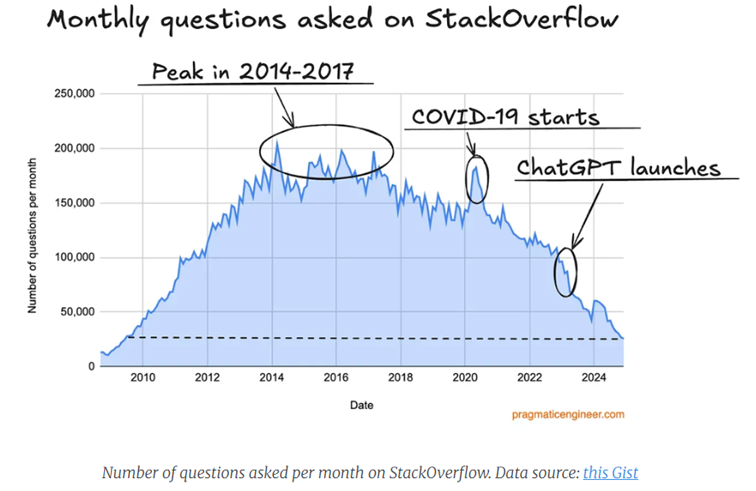
Look at Stack Overflow, which was once the reference point for programmers; it has already seen a sharp decline in activity since AI tools became widespread. The monthly volume of questions, which was over 200,000 in 2014, decreased to fewer than 50,000 by the end of 2025. The use of AI tools contributed to this decline.
With less human creation and contribution, AI risks learning increasingly from content written by other AI. Researchers call this phenomenon "Model Collapse": copies of copies, each slightly blurrier than the previous one, and so on.
Did you think this is impossible?
It could happen.
Models trained with a healthy combination of new human data and synthetic analyses can avoid the worst cases, but the faster and cheaper path often leads to the easy choice: creating copies of copies of copies of copies....
And then came the Hallucinations
AI is known to invent facts, references, and sources, particularly when reliable information is unavailable. It is especially likely to do so on obscure topics for which human knowledge and contribution are limited.
See a simple example: you search for a traditional recipe from a small village in Gozo, one that survives only in a grandmother’s notebook and in two or three amateur cooking blogs. In other words, sites that have already started to shut down due to low traffic.
The AI will give you the “best and easiest” step-by-step recipe, complete with ingredients, quantities, and a beautiful story about its origin.
Isn’t it great?
But here’s the catch. Be careful.
The proportions might be invented, and the story behind it might never have happened. Why? Because if no one wrote down the actual version and origin of the recipe, the AI model has nothing to learn from. It simply fills in the gaps and makes up whatever details it needs (measurements, spices, utensils, pans, cooking times, temperatures, etc.) just to answer your question. The model is built to give a convincing answer, not to admit it doesn’t know.
And since it looks like any other recipe, you will have no reason to doubt it. Right? AI found it, after all.
So go on, start with the ingredients...
This is the real danger: we stop noticing mistakes because the answers sound so confident, certain, and expected.
The problem of the two trillion dollars and investments in AI
Having seen the potential risk of "Model Collapse", there is also the economic and investment risk.
Global investment in AI was estimated at about 1.5 trillion dollars for 2025 and is expected to exceed 2 trillion dollars by 2026, almost 2 per cent of global GDP. These expenditures are funded by corporate capital, bank borrowing, various forms of financial leverage, and the assumption that AI will continue to improve and eventually generate substantial profits, as most AI model development companies are currently burning cash.
Bain & Company estimated that ‘the development of AI will require annual revenues of about 2 trillion dollars simply to break even. If, however, the quality of AI stops improving, these expected returns may not materialize, and trust in both the technology and the companies involved could be severely damaged.
Many skeptics liken AI to another investment bubble due to the investment frenzy and growing interdependence among technology companies.
There are, however, those who remain confident about its success, as the companies spending the most money on AI have also been among the most profitable companies in the world for years.
Nevertheless, the risk is real.
Artificial Intelligence is an excellent tool that is changing the world as we know it. A new era is already here.
It still needs people who can think, solve problems, write, create, and share knowledge with its help, as well as a system that respects and protects human intellectual wealth.
Disclaimer: This article is the product of the author's independent research and analysis, citing actual market data and proprietary calculations. The views and opinions expressed herein are solely those of the author. This material is for informational purposes only and should not be construed as investment advice, a recommendation, or a reflection of the official outlook or position of FIMBank.
Reproduction of this material, in whole or in part, is permitted only with clear attribution to the author and a link to the original article.
Malta-based Alkagesta takes ownership of first vessels with completion of energy petrol deal
Two senior appointments accompany the completion.

Tourism readjustment year 2027: A welcome reset to evolve
When fewer Europeans are travelling, competition across the Mediterranean gets fierce. If we go quiet, we lose out
AI chaos after US midterm results
'Interestingly, the initial reaction to the outcome of the election across equity markets was positive...'