



The outcome of the US midterm elections held on Tuesday 3rd November triggered one of the most turbulent weeks for international equity markets in recent years. Throughout 2026, US equities had reached successive record highs despite the war in the Middle East and rising bond yields, driven to a large extent by the enthusiasm surrounding the investment linked to artificial intelligence (AI).
The Democratic Party regained control of both the House of Representatives and the Senate last week with new governors in a number of states in which the large technology companies had planned significant investment in data centres. Texas is expected to host around one third of the new data centre capacity planned in the US over the next two years. The Governor-elect publicly stated support for a prolonged moratorium on the approval of new data centres until concessions are obtained from the technology companies.
Interestingly, the initial reaction to the outcome of the election across equity markets was positive. On Wednesday 4th November, the Dow Jones Industrial Average rallied by over 3 per cent as investors welcomed a clear result, while oil dropped below USD100 per barrel on hopes of an earlier end to the conflict with Iran. Meanwhile the S&P 500 index and the Nasdaq Composite climbed by 1.6 per cent and 1.4 per cent respectively. However, there was a sudden changed in sentiment on Thursday as it was then feared that the election outcome could lead to a much stricter regulatory environment for the AI industry that has essentially helped propel the American economy in the past couple of years.
A historic decline for chip stocks
On Thursday 5th November, the Nasdaq Composite fell by 5.5 per cent to 24,315 points – its largest single-day percentage decline since 4 April 2025 at the time of the tariff-driven turmoil. This was only the eighth time since 2015 that the Nasdaq Composite dropped by more than 5 per cent in one day.
The S&P 500 index shed 4.4 per cent on the same day and the Dow Jones declined by 3.4 per cent.
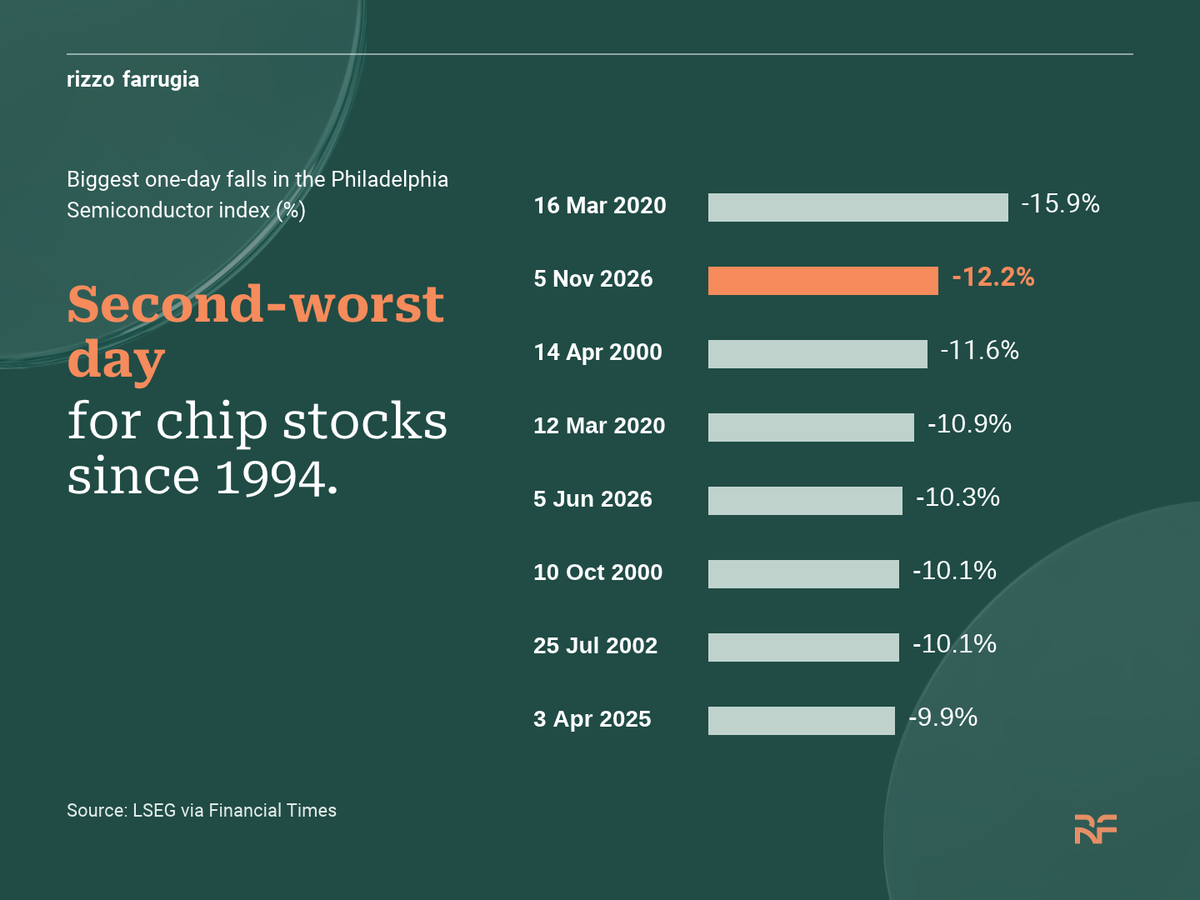
The semiconductor sector was the worst performer with the widely-followed Philadelphia Semiconductor Index (SOX) plunging by 12.2 per cent, its second-worst daily decline since 1994. This index had posted a steeper decline of 15.9 per cent during the pandemic sell-off on 16 March 2020. Nvidia which was the largest capitalised company in the US until earlier this week saw its share price drop by over 9.3 per cent last Thursday resulting in a decline in its market value of almost USD450 billion of market value. Memory and storage companies were the hardest hit as SanDisk plummeted by 22.3 per cent and Micron by 17.5 per cent.
It is important to highlight that the sell-off was not uniform. The companies most exposed to the construction of new data centres suffered the steepest declines, namely the “neoclouds” which rent out computing capacity such as CoreWeave, the chipmakers (AMD, Micron and Nvidia) and their equipment suppliers (Applied Materials) as well as the power generation companies. On the other hand, the share prices of Alphabet, Amazon, Meta and Microsoft were largely unchanged throughout last week. In fact, a slowdown in construction of data centres could benefit companies which already own extensive data centre capacity and would need to spend less on new projects.
Since the start of the fourth quarter of this year, 35 of the 50 worst performers in the S&P 500 were technology companies, led by Intel (-56.5 per cent), SanDisk (-51.2 per cent) and Marvell (-49.5 per cent). Despite these extraordinary declines, the S&P 500 index only declined by 3.7 per cent and is 6 per cent below its record high reached in early October.
Lower valuations despite higher earnings
The political developments of last week in effect accelerated a correction in the semiconductor sector that was already underway. It is important to note that the SOX index has fallen by nearly 40 per cent since its peak in June, while the Nasdaq Composite is in correction territory as it dropped by 10.9 per cent from its record close on 6 October.
Notably, this downturn took place despite a continued improvement in earnings expectations. Since the end of June, the forward earnings estimates for the memory, AI infrastructure and semiconductor companies increased by between 30 per cent and 32 per cent. Despite this extraordinary increase in earnings expectations following the strong rise in profitability levels over recent quarters, the forward price-to-earnings multiples of these segments has contracted materially. In fact, the forward price-to-earnings multiples of the memory companies has contracted by 50 per cent, that of AI infrastructure companies by 36 per cent and of semiconductor companies by 35 per cent.
Global contagion and a partial recovery
The turmoil in the US spread rapidly across Asia on Friday with Japan’s Nikkei 225 index tumbling by over 6 per cent and trading temporarily suspended in South Korea after the Kospi index dropped by as much as 8 per cent to a nine-month low. The equity markets in the US and also in Asia then partially recovered on Friday and during the start of this week after the publication of strong employment data in the US.
Lessons from previous sell-offs
An analysis of the seven previous occasions since 2015 when the Nasdaq Composite fell by more than 5 per cent in a single day provides some useful insight to the investing public. Although the index was typically lower one week later, it was higher three months later on six of the seven occasions, with an average gain of 23.2 per cent.
Opinions on the near-term outlook are mixed. Some fund managers warn that various companies linked to the AI trade remain too reliant on debt circular financing arrangements across the sector while at the same time reporting negative free cash flows. Others argue that demand for computing power remains strong and that, although the build-out may be slower and less predictable, it will nonetheless continue given the strong focus on this revolutionary technology.
Equity markets are often described as climbing a “wall of worry”, since share prices can continue to advance despite negative headlines as long as developments prove to be less damaging than feared. Undoubtedly, the events of the past week serve as a reminder of the high degree of concentration in certain areas of the global equity markets and the risks this poses to investors. AI will undoubtedly remain a transformational technology for many years to come and an important determinant of stock market returns.

The article contains public information only and is published solely for informational purposes. It should not be construed as a solicitation or an offer to buy or sell any securities or related financial instruments. No representation or warranty, either expressed or implied, is provided in relation to the accuracy, completeness or reliability of the information contained herein, nor is it intended to be a complete statement or summary of the securities, markets or developments referred to in this article. Rizzo, Farrugia & Co. (Stockbrokers) Ltd (“Rizzo Farrugia”) is under no obligation to update or keep current the information contained herein. Since the buying and selling of securities by any person is dependent on that person’s financial situation and an assessment of the suitability and appropriateness of the proposed transaction, no person should act upon any recommendation in this article without first obtaining investment advice. Rizzo Farrugia, its directors, the author of this article, other employees or clients may have or have had interests in the securities referred to herein and may at any time make purchases and/or sales in them as principal or agent. Furthermore, Rizzo Farrugia may have or have had a relationship with or may provide or has provided other services of a corporate nature to companies herein mentioned. Stock markets are volatile and subject to fluctuations which cannot be reasonably foreseen. Past performance is not necessarily indicative of future results. Foreign currency rates of exchange may adversely affect the value, price or income of any security mentioned in this article. Neither Rizzo Farrugia, nor any of its directors or employees accepts any liability for any loss or damage arising out of the use of all or any part of this article.


The evolving MGS market
Edward Rizzo says next year’s €400 million interest bill will match energy subsidies
When everyone asks AI and nobody writes on the Web…
'Artificial Intelligence does not create knowledge out of thin air, but learns from what humans have already written'

A look at developments in Cyprus
What Malta can learn from the fellow mediterranean country